Bats master the dark with sound. WPI engineers hope their drones do the same in dangerous situations.

Bats can fly through total darkness, dodge obstacles at high speed, and weave through caves without crashing. They do it through echolocation, where they send out bursts of sound and use the returning echoes to build a picture of the world around them.
Now a team at Worcester Polytechnic Institute (WPI), led by robotics professor Dr. Nitin Sanket, is building drones designed to do the same.
"(Bats) basically scream into the abyss and then they look and hear for these echoes," Sanket said.
Instead of relying only on a camera, the WPI drones use ultrasound sensors to detect objects in front of it. The goal is to help drones operate in places where cameras often struggle, like darkness, smoke, snow, fog, or cluttered spaces.
That could be critical in emergencies.
In demonstrations at WPI, one of their drones was able to move through obstacle courses, detect barriers, and stop before collisions. Even after the lights were turned off and the room was filled with smoke and snow, the drone was still able to navigate.
The technology depends on a sensor that uses very little power.
"This sensor uses only 1.2 milliwatts of power," said student researcher Colin Balfour.
That matters because every bit of power saved can mean longer flight times and lighter drones.
In some conditions, Balfour said, "even the most skilled pilots won't be able to achieve the same thing."
Researchers said the drones are also being built with affordability in mind.
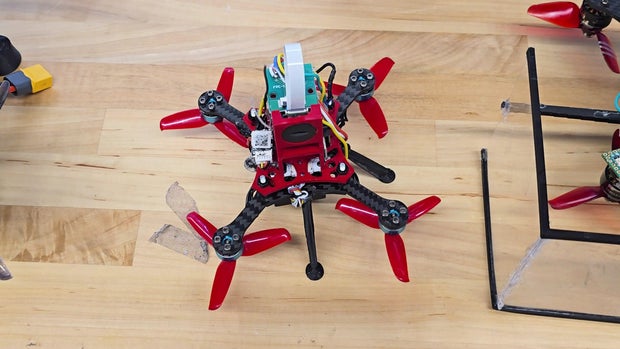
"This whole drone, I think, is about $200 or $300 in consumer parts," Balfour said.
That lower cost could make it easier to scale the technology in the future.
The long-term vision is ambitious - first responders carry a backpack full of drones and deploy them before rescuers enter dangerous areas.
"You press a button, and it's a turnkey solution where the robots go and search an area," Sanket said.
If the drones locate someone, they could also help guide rescuers.
"This is the exact path you take to go rescue them," Sanket said.
For Dr. Sanket, the deeper lesson is that engineers do not always need to invent solutions from scratch.
"Nature has already figured it out," he said. "It's already given us a solution. If there is a blueprint we just need to reverse engineer it and figure out how to do it."


