Baltimore City Fire Battalion Chief Lawrence Goldberg to be honored as a fallen hero
For the family of Baltimore City Fire Department Battalion Chief Lawrence Goldberg, the memories are flooding back now that his death from cancer is finally being recognized in the line of duty, both locally and nationally.
Goldberg is being honored on Friday, May 1, at Dulaney Valley Memorial Gardens during the Fallen Heroes Day Ceremony. Of the nine heroes being honored, six lost their lives to occupational cancer, including Chief Goldberg.
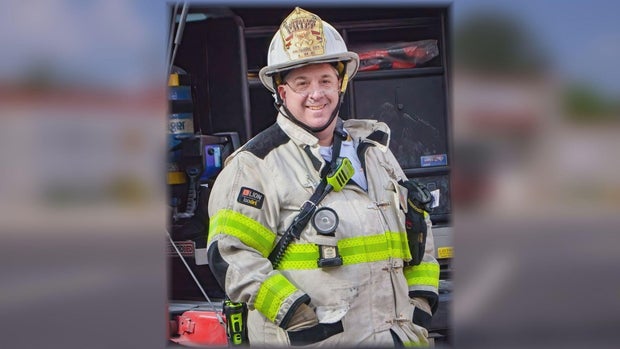
"He was such a great guy," said his wife, Deborah Goldberg. "He would do absolutely anything for anyone."
Chief Lawrence Goldberg, better known as "Larry," died on July 11, 2019, after a roughly three-year battle with colorectal cancer at age 50.
Now, seven years since his death, his wife, Deborah Goldberg and son, Zachary Goldberg, share their memories in the place where his love for firefighting began nearly 40 years ago — at Pikesville Volunteer Fire Company.
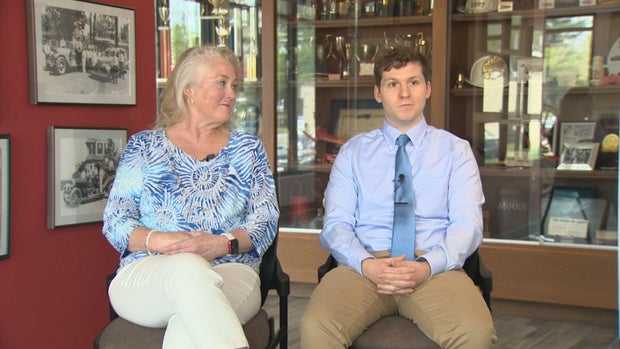
"When he wasn't home or working for the city fire department, he was here, hanging out," said Deborah. "22 years of marriage, every Friday night," she chuckled. "I knew he was gonna be here."
He started at Pikesville Volunteer Fire Company as a volunteer in 1988 when he was just 18 years old, before he decided he wanted to be a paramedic. He remained a lifelong member and went on to become the Chief Officer.
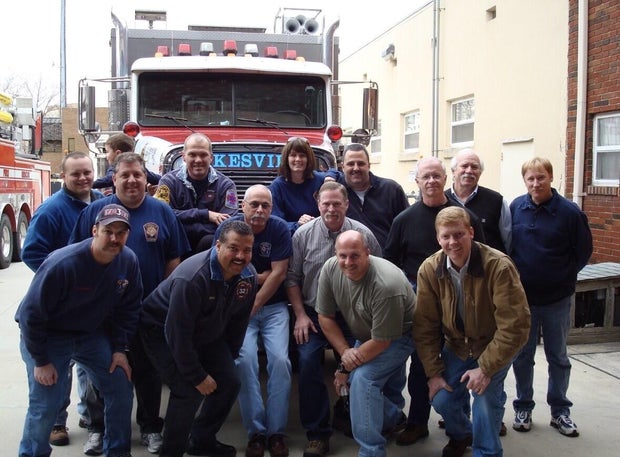
Later, he was hired at the Baltimore City Fire Department and spent almost 10 years as a paramedic before transitioning over to the suppression side. He worked his way up the ranks to become a lieutenant, captain, and spent the last eight years of his career as a battalion chief.
"I work in the city now and I constantly have people come up who and tell me how he taught their fire 1 class when they were a volunteer or their EMT class," said Chief Goldberg's son, Zachary Goldberg. "And obviously now if I'm meeting them at the city fire department, they're career firefighters or EMS providers now, and I think that's the biggest testament to who he was."
His son, Zachary, is now an EMT/Firefighter for the Baltimore City Fire Department.
"I grew up at the fire station," he said. "I had a birthday party at this station [Pikesville Volunteer Fire Company] on the same tower that's over there on the other side of the station right now."
Occupational Cancer
Chief Goldberg was diagnosed with colorectal cancer around 2015. It was treated, but a few years later, another tumor had metastasized.
"He was 50 years old," said Deborah. "He did not want to die."
In March of 2019 – on his 50th birthday – he spent 14 hours on the operating table in a final attempt to save his life.
"Surgeons had all come out at different times and said there's nothing really we can do," said Deborah. "We can patch him up and you know he wants to get back to work, that's what our goal is, we're going to get him back to work."
He worked as chief of the Fourth Battalion at Engine 42 on Harford Road up until the end.
"It's definitely a testament to his strength and willpower to be able to still go to work through how tired he was and how much pain he was in," said Zachary.
On the job, firefighters can be exposed to a number of known carcinogens. Now 7 years later, with help from the National Fallen Firefighters' Foundation, his death is finally being recognized as line of duty from occupational cancer, both nationally and locally.
Later this weekend, Goldberg will be honored again, after the ceremony at Dulaney Valley Memorial Gardens. His name will be added to the National Fallen Firefighters' Memorial in Emmitsburg, Maryland.
Cancer among firefighters
"Get screened regularly, I mean, I think the greatest risk for firefighters at this point is occupational cancer," said Deborah.
Cancer is the leading cause of death among firefighters, according to the CDC.
The American Cancer Society states that all types of fires create a mixture of toxic combustion products, including liquids, gases, and particulate matter. Protective equipment for firefighters can also contain chemicals that release suspected carcinogens.
"The cancers are only really going to get worse, and that has a lot to do with the materials that they're constructing furniture out of nowadays," said Zachary. "If you think, you know, 30 years ago furniture that was being made was being made with real materials and everything nowadays is all synthetic, petroleum-based, and all the byproducts from that burning are all carcinogens, and it's going, like the rates [cancer rates] are going to get higher."
Chief Lawrence Goldberg's Legacy
His son Zachary is now an 8-year member of the Pikesville Volunteer Fire Company, along with an EMT and Firefighter for the Baltimore City Fire Department.
"Larry would definitely be so proud of him [Zachary], he always was, both the kids," she said. "Proud of the fact that he's turned into the young man he has, proud of the fact that he followed in Larry's footsteps."
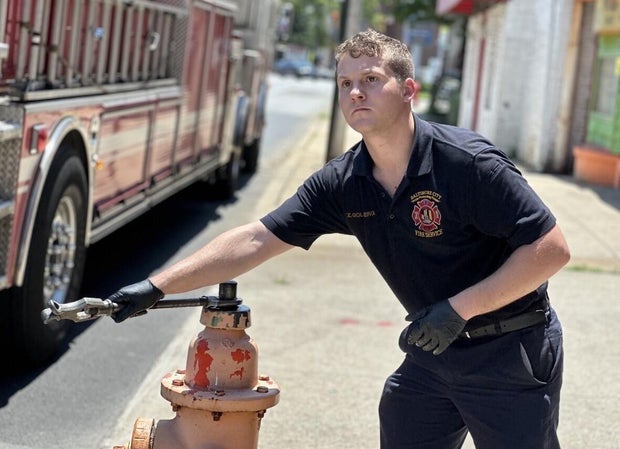
When he was younger, Zachary wasn't sure what he wanted to do, but in high school, he decided to explore firefighting.
"I was really nervous to ask my father, but I asked my father one day if I could come up here [to Pikesville Volunteer Fire Company] and join here just to see what it was about, and you know, after I joined here I realized why he fell in love with the fire service and I understood why he was gone so many nights," Zachary said.
Chief Goldberg taught at The Maryland Fire and Rescue Institute for more than 25 years and taught Zachary's EMT class just months before he died.
"One of the things I'm most grateful for in my life is I had the opportunity to experience his teaching," he said.
Stories that speak volumes
For Deborah and Zachary, some stories speak volumes to the incredible person Larry was.
Zachary knew a firefighter in the city whose EMT was set to expire. If that happens, he says, "that's a fireable offense, like right off the rip." His father helped put on a refresher class to make sure the man got his EMT renewed in time so he would not lose his job.
"He came up to me and was like, 'your father was a great man; I owe him my career, essentially,'" Zachary said.
Another story is something that happened in the days before Goldberg transitioned to hospice. His room was always full, and Deborah says the fire department has 15 companies come through. Every half hour, a team of 2 to 4 people would come in and pay their respects, and this went on for about a week.
"I mean, it was just the constant, so not only was the apparatus coming through but visitors, students, everything," she said.
He could say the name of every single person who walked through the door.
"He knew who they were, where he knew them from, how long, like, could tell a story about them, except for two people, and it really threw him, and you could see it on his face," she said. "And the one person that came in, he goes, 'Dude, I'm sorry, I don't remember you. Where do I know you from?' He was like, 'Oh, chief, don't worry about it, today's my first day on the job, I've never been here before,' and it was a similar situation with the second person. I think they'd been on the job maybe three weeks."


