Emory and Georgia State turn to improv comedy to help caregivers connect with people living with dementia
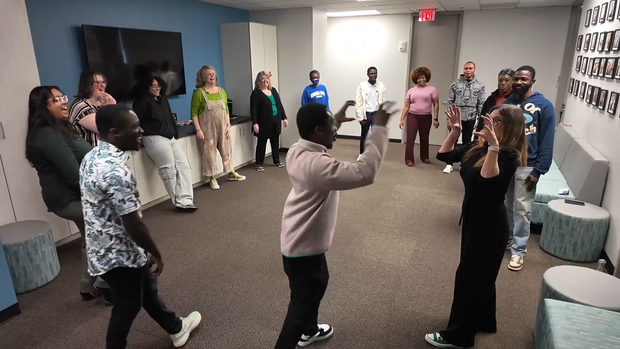
Inside the Georgia State University Gerontology Institute, a group of graduate nursing students cluck like chickens, pretend to build LEGO sets and react to imaginary scenarios.
At first glance, the exercise looks silly, but instructors say there's serious science behind it.
The class is led by improv comedian and educator Amanda Lee Williams, who uses improvisational theater techniques to help future caregivers communicate more effectively with people living with dementia. The effort is part of a collaboration with researchers at Emory University.
Students learn that dementia care often requires flexibility when logic, correction or contradiction can sometimes increase confusion or frustration.
"If you're working with people with dementia, especially older adults, you need to be ready for anything," one graduate student said during the training.
A core principle of improvisation is something called "Yes, and..."
In comedy, performers accept whatever scenario another actor introduces and build on it rather than rejecting it. Williams says the same approach can help caregivers respond more compassionately when someone with dementia expresses a mistaken belief, confusing idea, or hallucination.
"If someone says, 'Mom, I want to go to the grocery store right now,' I might say, 'Yes, we can go to the grocery store,'" Williams explained. "I'm accepting their reality. Then the 'and' builds on it — 'Yes, we can go to the grocery store and we can stop by your father's office and bring him a burrito.'"
Instead of correcting the person or insisting on factual accuracy, caregivers join the emotional reality the person is experiencing. That shift can reduce fear and agitation.
For Williams, the work is deeply personal.
Her father lived with Parkinson's disease, and she says using improvisational techniques changed the way her family communicated during the final years of his life.
"It really changed things for us in a positive way," she said. "It made the last years of his life a lot calmer, more loving. He felt heard."
Williams says hallucinations or unusual statements often reflect deeper emotions like fear, confusion or longing and responding empathetically can make a significant difference.
The program is being co-led by Dr. Ted Johnson at Emory and Dr. Candace Kemp at Georgia State.
"You're not trying to trick the person," Kemp said. "You're trying to work together with the person to have the desired outcome."
Researchers at Georgia State and Emory hope to expand the program and eventually integrate the training into gerontology and caregiving education programs around the world.
For the graduate students taking part, the lesson is simple: when memory fades, connection doesn't have to.