This giant salmonella-carrying invasive lizard is spreading in Georgia — officials say it must be stopped.
Georgia is home to a wide range of wildlife, from white-tailed deer and wild turkeys to black bears and American alligators. But lurking in the grasslands and forest clearings of at least two southeastern counties is a scaly intruder that state wildlife officials say poses a serious threat to native animals and crops alike.
It's the Argentine black and white tegu.
According to the Georgia Department of Natural Resources, this large lizard, native to South America, has established a wild population in Toombs and Tattnall counties in southeast Georgia, and the agency is working urgently to assess and eradicate it.
What exactly is a tegu?
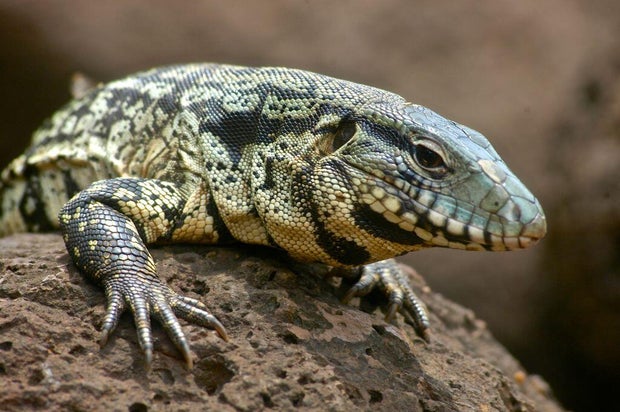
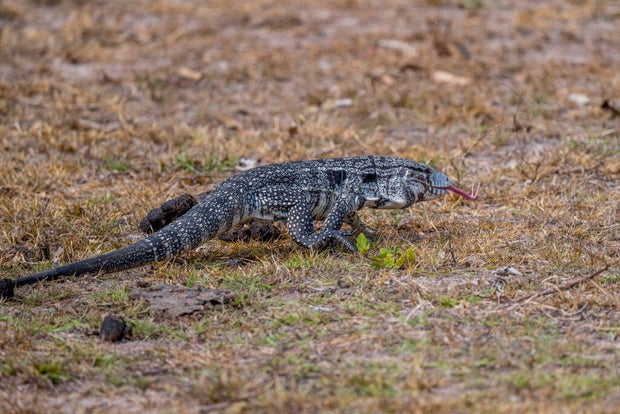
The Argentine black and white tegu, known scientifically as Salvator merianae, is the largest of all tegu species. DNR describes it as black to dark gray with white speckled bands across its back and tail. Adults can grow up to 4 feet long and weigh 10 pounds or more, and they can live up to 20 years.
Hatchlings, which can be about 6 to 8 inches long, have a distinctive bright green coloration on their heads that fades at around one month old.
The lizards are active during the day and are fast-moving, ground-dwelling creatures. But don't let that fool you, DNR says they are also strong swimmers capable of staying submerged for extended periods of time.
Why do Georgia officials consider tegus dangerous?
Wildlife officials say tegus pose a significant threat to several native Georgia species, particularly those that nest on the ground.
DNR says tegus will eat the eggs of ground-nesting birds, including quail and turkeys, and other reptiles, such as American alligators and gopher tortoises, both protected species.
Their diet doesn't stop there. According to DNR, tegus will also consume chicken eggs, fruit, vegetables, plants, pet food, carrion and small live animals, ranging from grasshoppers to young gopher tortoises.
There are also concerns that tegus could spread exotic parasites to native wildlife and cause bacterial contamination of crops. Research shows tegus, like most reptiles, carry salmonella.
Adding to the concern is how quickly they can reproduce. Females reach reproductive age after their second season of winter dormancy and can lay around 35 eggs per year, with hatching in Georgia expected in June and July.
How did tegus get to Georgia?
DNR points to the exotic pet trade as a primary pathway. The agency warns residents to do their research before purchasing exotic pets and to never release them into the wild.
Since December 2023, Argentine black and white tegus have been classified as wild animals in Georgia and cannot be kept as pets unless they were registered with DNR and tagged before that date. Importing and breeding tegus in the state is also illegal.
What should Georgia residents do they spot a tegu?
If you see a tegu in the wild, dead or alive, DNR wants to know about it. Residents are asked to note the location, take a photo if possible and report the sighting here.
As for what residents can do beyond reporting: on private property, tegus can be legally trapped or killed year-round with the landowner's permission and in accordance with local ordinances.
On state Wildlife Management Areas, tegus may be taken with firearms that are legal for the current hunting season on that specific WMA. Trapping tegus on WMAs is not permitted.
DNR also advises residents in Toombs and Tattnall counties to keep pet food inside, fill holes that could serve as shelter and clear yards of brush piles and other debris that tegus might use for cover.
What's being done at the state level?
Since 2022, DNR has led trapping efforts in the affected counties in partnership with the U.S. Geological Survey and Georgia Southern University.
Trapped tegus are humanely euthanized, and their diet and reproductive status are documented at Georgia Southern. DNR says it is also responding to reported sightings elsewhere in the state, emphasizing that early detection and rapid response are key to preventing tegus from spreading further.


