Shutdown threat looms as Senate Democrats pledge to block funding after Minneapolis shooting
Washington — The threat of a partial government shutdown looms large this week after Senate Democrats came out against a funding package in the wake of the deadly shooting of a Minneapolis man by federal agents, with just days until the deadline to fund the government.
For weeks, lawmakers in both parties and across both chambers have been working to pass individual funding measures before government funding lapses on Friday, Jan. 30.
Six of the 12 appropriations bills have already cleared both chambers and been signed into law. And the Senate was expected this week to take up the remaining six funding measures, which passed the House earlier this month and were grouped together to secure swifter passage through the upper chamber.
The remaining six bills include funding for the departments of Defense; Labor, Health and Human Services and Education; Transportation and Housing and Urban Development; State; and Treasury and other related agencies. And crucially, funding for the Department of Homeland Security, which includes ICE and Border Patrol, is part of the six-bill package.
Now, the grouping of those funding measures is creating complications in the Senate, after the fatal shooting of 37-year-old Alex Pretti by Border Patrol agents led a slew of Senate Democrats to oppose any funding package that includes DHS. Minority Leader Chuck Schumer announced Saturday that Democrats would not provide the necessary votes to advance the package to fund the remaining government agencies and programs if DHS funding is included. With 53 Republicans, Democratic support is necessary to reach a 60-vote threshold to advance the legislation.
Even independent Sen. Angus King of Maine, who was among a trio of senators who crossed the aisle to negotiate a deal with Republicans to reopen the government during the longest shutdown in history last year, said he won't vote for a package that includes the DHS measure.
"I hate shutdowns," King said on "Face the Nation" Sunday. "But I can't vote for a bill that includes ICE funding under these circumstances."
Still, King, who caucuses with Democrats, argued that "there's an easy way out" of the funding fight, saying Senate Majority Leader John Thune should separate the DHS bill from the other five funding measures.
"If those bills pass, 96% of the federal government is funded," King said. "Take up DHS by itself, let's have an honest negotiation, put some guardrails on what's going on, some accountability, and that would solve this problem."
King joined a number of Senate Democrats advocating for the approach. And later Sunday, Schumer signaled Democrats more broadly would be willing to move forward with the other five funding bills.
"Senate Republicans must work with Democrats to advance the other five funding bills while we work to rewrite the DHS bill," Schumer said in a statement, calling it the "best course of action."
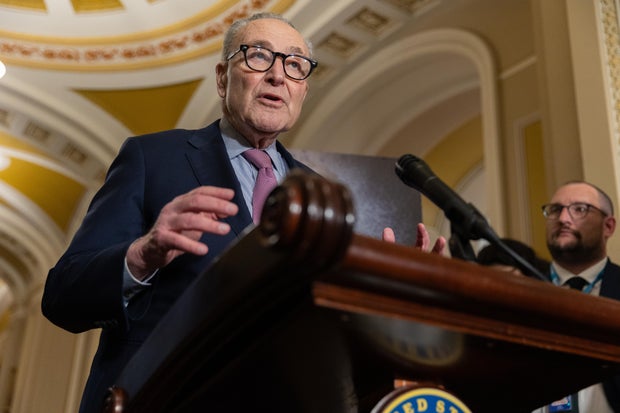
In another statement Monday, Schumer put pressure on Senate GOP leaders to move forward with the funding bills without the DHS funds.
"The responsibility to prevent a partial government shutdown is on Leader Thune and Senate Republicans," Schumer said. "If Leader Thune puts those five bills on the floor this week, we can pass them right away. If not, Republicans will again be responsible for another government shutdown."
But whether the will exists among Senate Republicans to strip out the DHS funding bill from the broader package, which would require unanimous consent, remains to be seen. Heading into the week, GOP Senate leaders were expected to move forward as planned. Any changes to the legislation would require approval by the House, which is away on recess this week.
The DHS bill was considered separately from the other funding bills in the House last week after many Democrats said they would not support it because it did not include extensive reforms to ICE, following the first deadly shooting by federal agents in Minneapolis. The measure ultimately picked up support from seven House Democrats.
House and Senate appropriators released the text of the DHS funding measure, along with three other measures, last week.
At the time, Sen. Patty Murray of Washington and Rep. Rosa DeLauro of Connecticut, the top Democratic appropriators, characterized the DHS measure as a positive step, while acknowledging that it fell short of the reforms that Democrats had sought. And they argued that neither a continuing resolution to keep the government funded nor a government shutdown would rein in ICE due to funding allocated in the One Big Beautiful Bill Act last year, making an alternative strategy in the funding fight futile.
Ultimately, DeLauro voted against the bill that she had negotiated, while Murray has pledged to do the same.
"Federal agents cannot murder people in broad daylight and face zero consequences," Murray said in a post on X pledging to oppose the measure. "The DHS bill needs to be split off from the larger funding package before the Senate — Republicans must work with us to do that."
Some Senate Republicans have spoken out following Saturday's shooting, including Sen. Bill Cassidy of Louisiana, who called the events in Minneapolis "incredibly disturbing," while arguing that the "credibility of ICE and DHS are at stake" and calling for a joint federal and state investigation. Sen. Thom Tillis of North Carolina likewise called for "thorough and impartial investigation," as did Sen. Lisa Murkowski of Alaska, who said a "comprehensive, independent investigation of the shooting must be conducted in order to rebuild trust and Congressional committees need to hold hearings and do their oversight work." Sens. Pete Ricketts of Nebraska, Dave McCormick of Pennsylvania and Jon Husted of Ohio later joined the calls for an investigation into the incident.
Whether more Republicans follow suit, or go further, remains an open question.
Adding to the difficulties for the Senate this week is a winter storm in Washington. Though the Senate had been set to return Monday for votes, senators are now set to return Tuesday afternoon due to the weather, shortening the already tight timeline to avert a partial shutdown by the week's end.
Should senators be unable to approve additional funding, agencies and programs would begin to shut down after Jan. 30. But the shutdown would differ from the one that stretched through October and into November since some appropriations bills have already passed both chambers and been signed into law.
Funding for military construction and the Department of Veterans Affairs; the Department of Agriculture and FDA; and operations for the legislative branch passed as part of the deal to reopen the government in November and was signed into law. Funding for the departments of Commerce and Justice; Interior and the EPA as well as energy and water development has also passed both chambers and was signed into law last week, meaning they would continue to operate like usual even as other parts of the government shut down.