Federal trial for alleged Alvarado ICE facility attack heads to jury deliberations
After eight months of what the government says was an attack on a North Texas ICE detention center, the federal case is now nearly in the hands of the jury. Deliberations are set to being Thursday in the Prairieland case.
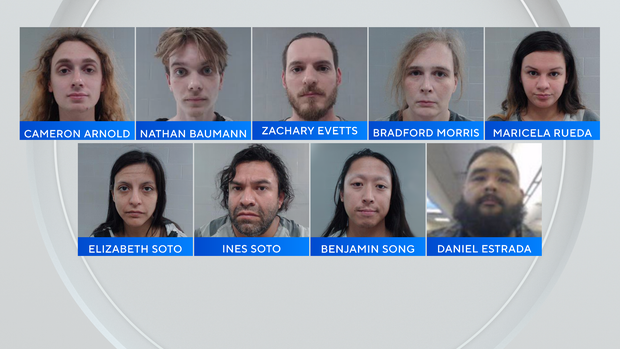
Closing arguments took place on Wednesday for the trial of nine people accused of a coordinated attack at the Prairieland ICE Detention Center in Alvarado. Combined, they face a total of 65 charges ranging from providing material support to terrorists to attempted murder.
It took Judge Mark Pittman more than an hour to read the jury instructions and all of the charges against the nine defendants. Prosecutor Shawn Smith began the government's closing arguments by asking, "Why?"
Prosecution says case is about "using legal things to do something illegal"
Why wear black bloc? Why pay cash for fireworks? Why put your phone in a Faraday bag?
"Because you know you're doing something illegal," Smith answered.
According to Smith, Benjamin Song "wanted to create a conflict" that night.
Smith said online chats made it clear that Song wanted a confrontation, and that many of the defendants were "intimately familiar" with what was going on in Song's head. That's part of the reasonable foreseeability argument from the government.
Smith says while Song pulled the trigger, Autumn Hill, Zachary Evetts, Meagan Morris and Maricela Rueda knew or should have known what he was going to do. All five are charged with attempted murder and discharging a firearm in furtherance of a crime.
Smith stood inside the courtroom with the exhibits piled around him: rifles, fireworks, literature, flags and more seized from the homes and cars of the defendants. He told the jury there is nothing illegal about firearms, fireworks, or hating the government.
"This case," he said, "is about using legal things to do something illegal."
Defense teams highlight First and Second amendments
Then it was time for the defense. Each of the nine teams had 15 minutes to speak to jurors, and while attorneys spent time focusing on their clients, many spoke in broad terms about the First and Second amendments and how they applied to the case in general.
Savanna Batten's attorney said she is being "prosecuted for her political beliefs," while Elizabeth Soto's attorney said her only crime is that "she's got a book club that the government hates."
Many of the defense teams took aim at the government's cooperating witnesses. Attorney Brian Brouffard called one of them, Nathan Baumann, a "government-sponsored liar" who repeatedly changed his story in hopes of a reduced prison sentence.
Christopher Weinbel said his client, Daniel Sanchez, is charged with "carrying a box and conspiracy to carry a box." Weinbel said it was filled with old letters, cards, and writings that belonged to Sanchez — not evidence — and had nothing to do with the case against his wife, Maricela Rueda, or the protest at Prairieland.
"He moved his own stuff," Weinbel said.
The plan wasn't an attack, said several defense attorneys. The plan was a fireworks display to show support for those being held inside the facility.
"They're here asking you to put protesters in prison as terrorists," attorney Blake Burns said.
All of the guns seized as evidence were lawfully owned, several attorneys said, and most of them were locked in cars or homes.
"If it was a planned ambush," said one, "Why was Song the only one holding a gun?"
The very last person to speak was prosecutor Frank Gatto, who reminded jurors of the Pinkerton rule. According to the landmark Supreme Court decision, a member of a conspiracy is liable for all crimes committed by co-conspirators in furtherance of the conspiracy, even if the defendant did not directly participate in, or have knowledge of, the specific acts.
Gatto said the case law makes everyone there that night responsible for the shooting and vandalism.
Jurors must make unanimous decisions on 65 charges against the defendants. They will begin deliberations at 9 a.m. on Thursday.