How genetic genealogy helped solve the abduction of two North Texas girls decades later

This story is part 2 of the CBS News Texas series The Long Hunt. Click here for part 1.
How a family's DNA solved a decades-old kidnapping case
Decades after a pair of young North Texas girls were kidnapped from their neighborhoods in two separate abductions, law enforcement in Plano and Dallas still hadn't identified the man responsible.
So, they turned to the Texas Rangers and a new approach to DNA investigations.
A decades-old mystery
Texas Rangers Lt Jason Shea handles some of the state's hardest cases, serial rapes and murders where all leads have run dry.
"We are the Texas Rangers' unidentified crime investigation program. We focus on cold cases," he said.
In 2023, Shea began looking into the decades-old mystery of two North Texas girls abducted eight years apart.
Ashley Keith was 8 years old when a man snatched her from her neighborhood in Plano in 1991.
"He put me in his car and drove away," she said in an interview with CBS News Texas. "What happened while he had me in the vehicle was awful."
The second victim, in 1999, was a 9-year-old girl who was taken while walking home in southeast Dallas.
Both girls were sexually assaulted and released hours later.
With the help of witnesses, police in both cases were able to produce sketches of the attacker.
"We see the similarities in the mustache, the nose shape, the hairstyle, and we see these consistencies going back over the years," said Plano Police Det. Aaron Benzick.
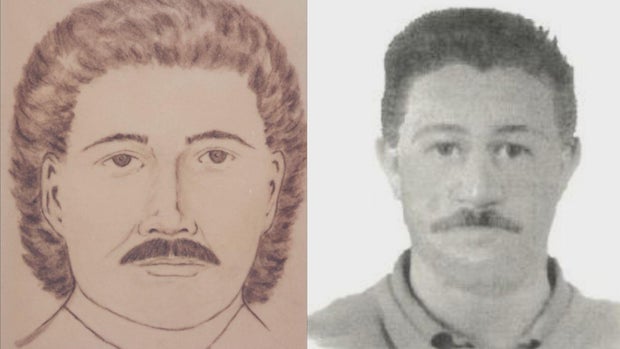
It wasn't until 2004 that investigators in the neighboring cities connected the cases after discovering that male DNA recovered from both crime scenes matched.
Still, there was no suspect.
"We know the profile of the offender, and we know it's connected to multiple offenses, but we don't know who they are," Benzick said.
Finding the needle in the haystack
Shea brought a secret weapon to the investigation. Genetic genealogy.
"It's all about these people who have their DNA in these genealogy databases that can help us out," he explained.
The strategy was pioneered in 2017 when a genealogist in California used it to help police identify the Golden State Killer, who had eluded law enforcement for decades.
"We found the needle in the haystack," the Sacramento County District Attorney announced at the time.
Law enforcement has since used the approach in high-profile cases where police have the DNA of a potential suspect, but its owner does not appear in the FBI's national DNA database and there is no known suspect from whom investigators can collect a sample.
The genealogy site, GEDMatch, is among those embracing cooperation with law enforcement, allowing customers to opt in to its Genetic Witness Program to allow police to see connections between them and DNA samples they're trying to identify in order.
"GEDmatch has already contributed to the successful resolution of more than 1,000 investigations thanks to the generosity of those who have voluntarily uploaded their genealogical data and have consented to their data being included in law enforcement comparisons," reads a statement on its website.
According to its portal for law enforcement use, more than two million DNA profiles are available on its site alone.
Embracing cooperation
The genealogy site, GEDmatch, is one that's embraced cooperation with law enforcement with its Genetic Witness Program.
According to its website, customers can "choose to opt in and enable law enforcement to solve violent crimes and exonerate the falsely accused."
More than 2 million profiles, it says, are currently available through the program, and more than 1,000 cases have been solved, as a result.
The federal government has also stepped in with financial resources.
"There are a lot of grants out there that are now expanding what they're allowed to be used for to include genetic genealogy because it's so powerful," said Ellen Greytak, director of Bioinformatics for Parabon Nanolabs, which assists law enforcement with genetic genealogy investigations.
She says, genealogy sites, though, limit what type of cases their databases can be used for.
"So, they say, they're only for unidentified remains and for violent crimes," she said. "Also, these advanced DNA techniques are sort of considered like last-ditch efforts. In some states, they're working on rules that every other avenue has to be exhausted before you can try this."
Federal grant funds increased use of genetic genealogy
In 2023, the U.S. Department of Justice's Sexual Assault Kit Initiative (SAKI) awarded the Texas Department of Public Safety $1.5 million to help cover "the cost of performing Familial DNA Searches" while investigating cold cases involving sexual assault.
The funding has allowed the Texas Rangers to partner with local law enforcement agencies and expand the use of genetic genealogy.
The Texas Legislature increased support for the effort as well, doubling the size of the Unsolved Crimes Investigation Program and expanding staffing dedicated to the SAKI initiative.
The results have been promising, Shea said, with over 200 sexual assaults and 30 or 40 homicides solved.
Narrowing in on a suspect
Shea was able to have the unidentified DNA from the 1991 and 1999 kidnappings sent to Bode Technology, a lab in Virginia that looks for even distant relatives among the millions who've shared samples of their DNA with genealogy websites like GEDMatch and Family Tree DNA.
The odds of finding a match, Shea says, are fairly good.
GEDMatch is among the testing services embracing cooperation with law enforcement, allowing customers to opt in to its Genetic Witness Program, which allows police to find connections with DNA samples they are trying to identify.
"GEDmatch has already contributed to the successful resolution of more than 1000 investigations thanks to the generosity of those who have voluntarily uploaded their genealogical data and have consented to their data being included in law enforcement comparisons," a statement on the GEDmatch website says.
According to its website for law enforcement use, GEDmatch has more than 2 million available DNA profiles.
The odds of finding a useful lead this way are surprisingly good, Shea said.
"Let's say each one of us has 10,000 fifth cousins. That's a lot of people. And do you even know who your second cousin is? Most likely not. So we do get a lot of people who have some degree of separation in one of these databases," he said.
Bode returned a list of names and potential relationships to the man who attacked the two girls, based on the amount of shared DNA.
"Then, the good old-fashioned police work starts. Who are these people?" Shea said.
Detectives began building a family tree and narrowing their focus to a suspect.
That process can sometimes require help from the public.
"A Ranger may come to your house, or a law enforcement agency, and say, 'We're working this case. We need your help. We'd like to get a sample of your DNA,'" Shea said.
Investigators use long cotton swabs to collect cells from the inside of a person's cheek.
It can be a delicate request.
"It's hard to say, 'Hey, you're related to a potential serial killer, and we need your help to identify who that is,'" Shea said. "We get a variety of reactions of, 'Is it my brother? Is it my cousin?'"
In this case, the search led investigators to a pair of sisters.
"We believed it was going to be one of their sons," Shea said.
One of the women, investigators learned, had six sons.
The DNA profile they were trying to identify did not match her husband, ultimately leading detectives to their suspect.
"We were able to identify that Nicholas Carney didn't have the same father as the other five brothers," Shea said.
The case against Nicholas Carney
With a suspect finally identified, Benzick, the Plano PD detective, began digging into the background of Nicholas Ray Carney, a 64-year-old man who had moved between Texas and Oklahoma over several decades.
"We first started seeing things that showed he was in the Dallas area at the time of both the 1991 and 1999 offenses," Benzick said. "My crime analyst, she started pulling driver's license photos for Nicholas Carney from that time. Then we looked at the composite sketches we got from witnesses."
The resemblance was undeniable, he said.
Now in her 40s, Ashley Keith remembers when Benzick first told her there had been a break in the case.
He brought her photographs of Carney from over the years.
"He shows me pictures and he's like, 'This is the guy based on the family tree that we've made that I think is the guy that hurt you,'" she recalled.
Decades after her abduction, Keith no longer had a clear memory of her kidnapper.
One photograph, however, stood out.
"There was one family picture that was taken from below, and immediately I was like, 'That's him,' because he'd kept me on the floorboard of the car. I think most of my vantage point was from below," she said. "It was interesting that that picture—I had an immediate physical response to it. It was the most surreal moment of my life," she said.
Making an arrest
Working with Oklahoma law enforcement, investigators were able to obtain Carney's DNA. It was a match to their suspect.
"We were able to piece together an arrest for him, and we arrested Nicholas Carney, charging him with aggravated sexual assault of a child," Benzick said.
He immediately called Keith.
"Pretty exciting to be able to share with her, 'I just placed handcuffs on Nicholas Carney and he's off the streets,'" he said.
"It's still one of those moments that, like, what do you say?" Keith said. "There's not enough thanks. There's not enough 'thank you.'"
As the Collin County District Attorney's Office prepared to take Carney to trial for the sexual assault of Ashley Keith, investigators uncovered yet another victim.
Click here for the next part of this story.


