Save Dallas City Hall Coalition files lawsuit to prevent "demolition by neglect" of building
The fight over the future of Dallas City Hall is headed to court after a group filed a lawsuit to force city leaders to repair the 48-year-old building.
In a press release shared with CBS News Texas on Tuesday, the Save Dallas City Hall Coalition announced it filed suit against the city government, Mayor Eric Johnson, the city council, City Manager Kimberly Bizor Tolbert and other city officials. CBS News Texas has asked the city for comment.
The coalition says the suit asks a judge to halt what it calls the "demolition by neglect" of City Hall.
"The City expects private citizens to maintain their properties, but refuses to take responsibility for maintaining our historic City Hall and Plaza," said coalition president Bruce Richardson. "Dallas City Hall has at least one failed generator, active parking garage leaks, and is due for roof maintenance. Instead of tackling these problems with millions in available funds, the City halted repairs, wasting money and time to explore a move. Incredibly, the City now proposes an additional $40 million in bond debt to move our 911 center to a less secure site."
"Our Coalition refuses to sit idle while city officials ignore the public and delay mandated action until the historic predesignation moratorium expires," Richardson said.
The lawsuit comes two months after the city council voted to explore options on relocating city hall to an office tower downtown. Proponents of the change say that City Hall has outgrown its current building, which is in need of extensive repairs and modernization; One estimate puts the repair bill over $1 billion. Relocating would also help a central business district that is experiencing high vacancy rates in office towers. The prime piece of land that City Hall sits on could then be sold and redeveloped to better suit the city's needs.
Opponents of relocating City Hall have argued that the building was designed by renowned modernist architect I. M. Pei, who also designed the Meyerson Symphony Center in Dallas. They also argue that the cost estimates to repair the building are exaggerated and the effort will take less time and money than an estimate of $1.1 billion over two decades, including five years the site would need to be vacant.
What led to the lawsuit being filed?
According to the lawsuit, City Manager Tolbert and Chief of Real Estate John Johnson are accused of "abusing city property" by failing to maintain core life-safety infrastructure of the building, that city officials have breached their fiduciary duty, and that the city failed to complete a historic landmark designation more than 17 months after the Landmark Commission's unanimous vote in March 2025 to initiate the designation. The coalition's suit claims that Watson has not completed the required historical significance report, which could allow a two-year moratorium on potentially tearing down the building to expire in March 2027.
The coalition also alleges the city government failed to initiate mandatory inspections after it filed a formal request on July 22. The coalition also claimed Marcus Watson, the city's Historic Preservation Officer, acknowledged the July 22 request in August but "simply referred future communications to the City Attorney's Office, and by all appearances has failed to schedule the legally-mandated owner meeting, inspections, or report timetables."
What does the coalition want from the court?
The coalition is asking the district court to issue orders that would compel city leaders to make the necessary repairs to stabilize Dallas City Hall and to properly maintain its emergency generators, which were identified as part of the core life-safety infrastructure of the building.
The coalition is also seeking a court order to extend the legal prohibition on tearing down the building by the exact number of months it said Watson has delayed in compiling the historic designation report. The coalition said it wants this to ensure the clock can't run out on the building's legal protections.
Why does the coalition want to save Dallas City Hall?
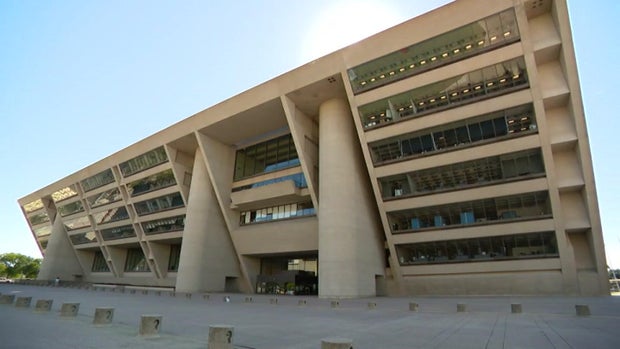
Dallas City Hall, completed in 1978, was designed by renowned architect I.M. Pei, who, the coalition notes in its lawsuit, designed other famous buildings. His works include the Louvre Pyramid in Paris, France; the Bank of China Tower in Hong Kong; the National Gallery of Art's East Building in Washington; and the John F. Kennedy Library in Boston.
Specifically, the coalition says Dallas City Hall is an example of Modernist and Brutalist architecture. The building is noted for its inverted trapezoidal shape, something the coalition says is unprecedented among other city halls in the United States. The building was also created in the years following the 1963 assassination of John F. Kennedy in Dallas, which the group says represents how the city moved forward to reshape its national image in the wake of the tragedy.
The coalition also notes the building has had impacts beyond its role as part of Dallas' civic function. The building was used in the original "RoboCop" movies, in the 1980 television movie "The Lathe of Heaven", and it further inspired the shape and appearance of the J. Erik Jonsson Central Library building, located just across the street from Dallas City Hall.
Do city leaders want to preserve Dallas City Hall?
While residents, business leaders, and former officials recently shared hours of testimony both in favor and against preserving the building, the city council voted in June 2026 against a plan to repair it. The vote was 9-6 against the repair plan.
"It is overwhelmingly clear that relocation will be not only a far more prudent use of taxpayer dollars but will also be a better long-term solution for our government, City employees, and all Dallasites," Mayor Eric Johnson said in a statement at the time.
Former city leaders, including former council member Jaynie Schultz, questioned the timing of the vote. Business leaders argued that redeveloping the site was the best path forward for Dallas. Former mayors Ron Kirk and Tom Leppert urged the council to focus on downtown expansion rather than restoring the building.
A district judge issued a temporary restraining order blocking any vote tied to relocating City Hall operations, ruling that the city failed to provide proper public notice.


