Columbus Day vs. Indigenous Peoples' Day. What Texas, Dallas and Fort Worth recognize.
This Monday, Oct. 12, marks both Columbus Day and Indigenous Peoples' Day, two observances that have sparked debate in recent years over how to recognize the legacy of Italian explorer Christopher Columbus.
To that end, Columbus Day remains a federally recognized holiday as of 2026, but some states and municipalities have opted to observe it as Indigenous Peoples' Day, Columbus Day, or both.
That being said, where do Dallas and Fort Worth stand regarding either day? How long has Columbus Day been recognized? And what's the history behind the holiday? Let's take a closer look.
Who was Christopher Columbus?
Christopher Columbus was an Italian explorer and navigator. In 1492, Columbus and his expeditionary crew, comprising three ships, landed in the Bahamas as part of a voyage approved by the Spanish monarchy. The main goal was to find a direct sea route from Europe to Asia, though King Ferdinand and Queen Isabella also sought to spread Catholicism worldwide. Columbus also sought riches and treasures to gift the monarchs.
However, Columbus landed on Caribbean islands on Oct. 12 that year, encountered the indigenous people there, began establishing the settlement on Hispaniola, and returned to Spain in early 1493. He kept a detailed diary that he later gifted to Queen Isabella; the History Channel notes that, in it, Columbus argued for enslaving them.
Columbus made a return trip in September 1493, finding that the settlement he had established had been destroyed. He left his two brothers to rebuild it and manage it. The History Channel said he continued westward and, instead of sending riches to the monarchs, sent about 500 enslaved people to Queen Isabella. This, however, horrified her, because she believed the people he encountered were Spanish subjects who couldn't be enslaved. She returned the people.
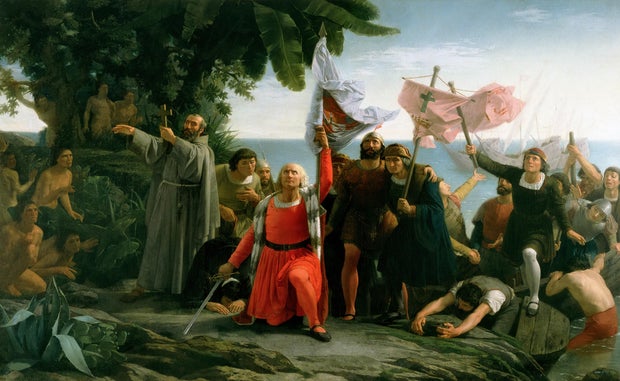
During a third voyage in 1498, Columbus visited Trinidad and the South American mainland before returning to the original Hispaniola settlement. The colony, however, had revolted against his brothers, prompting Spanish authorities to send a new governor to take over. Further, the native Taino population had been decimated, and an investigator reported how Columbus used torture and mutilation as punishments. Columbus was arrested and taken back to Spain.
Columbus was eventually cleared of the most serious charges, but was stripped of his noble titles. He convinced the monarchy to pay for a final trip across the Atlantic Ocean in 1502, but he largely came up empty-handed due to storms and conflict with native peoples.
Columbus died on May 20, 1506, aged 54.
Did Christopher Columbus "discover" the Americas?
No. Indigenous peoples had inhabited the Americas for thousands of years before Columbus arrived in 1492.
The continents were later named after another Italian explorer, Amerigo Vespucci, who helped establish that the lands Europeans had encountered were part of a previously unrecognized continent. Historians largely agree that Columbus' voyages expanded European exploration and helped accelerate global trade and cultural exchanges.
Columbus was later elevated to iconic status in Western history. A statue of Columbus, approved by President Martin Van Buren, was unveiled outside the U.S. Capitol in 1844.
When was Columbus Day first recognized?
The Encyclopedia Britannica notes that the holiday was first celebrated in New York by the Society of St. Tammany on Oct. 12, 1792, the 300th anniversary of Columbus's first landing.
Colorado was the first state in the United States to enshrine it in 1907. In 1892, President Benjamin Harrison declared Columbus Day a one-time national celebration as part of a wider effort to ease diplomatic relations with Italy, following a mob lynching of 11 Italian immigrants in New Orleans.
It wasn't until 1934 that Congress passed a statute calling for the president to recognize Columbus Day, with President Franklin Delano Roosevelt responding in kind by proclaiming it, though it was not yet a modern federal holiday. That didn't happen until President Lyndon Johnson signed legislation into law in 1968, with the federal holiday taking effect in 1971, per the Congressional Research Service.
Since that year, Columbus Day has been an officially recognized federal holiday in the U.S., observed on the second Monday in October. Banks, the bond market, the U.S. Postal Service, and other federal agencies observe it, as do many businesses, state government offices, and school districts.
Does Texas recognize Columbus Day as a state holiday?
No. In fact, Texas stopped recognizing Columbus Day as a state holiday in 1991, according to state legislative records.
What about Dallas and Fort Worth?
The Dallas City Council passed a resolution in 2019 that opts to observe the day as Indigenous Peoples' Day.
Meanwhile, Fort Worth does not recognize either day.
Why is recognizing either day controversial?
According to the Indigenous Peoples Day Committee, much of the push to recognize Indigenous Peoples' Day began as a counter-celebration in the late 1970s, with most advocates citing the harms indigenous people faced as a result of the Columbus expeditions. Such harms noted include forced assimilation, diseases, and massacres, among others.
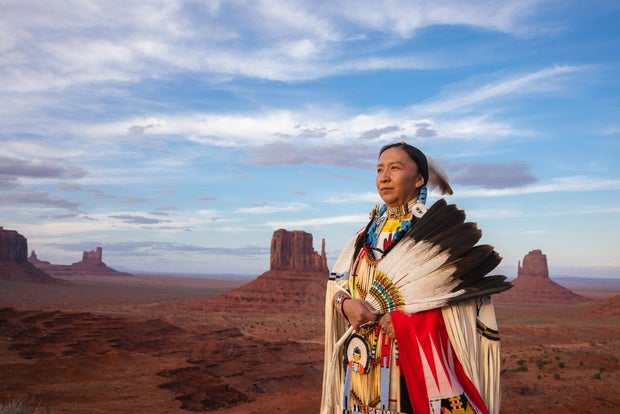
Over the years, the movement caught on; the Encyclopedia Britannica notes that South Dakota became the first state to replace Columbus Day with Native Americans' Day in 1990, and that the city of Berkeley, California, adopted Indigenous Peoples' Day in 1992. In 2021, President Joe Biden was the first U.S. president to formally recognize Indigenous Peoples' Day. However, it remains unrecognized as a federal holiday.
Much of the pushback against Indigenous Peoples' Day has come from politically conservative voices, including the second Trump administration. Last year, President Trump issued a proclamation to "reclaim" Columbus Day, saying the explorer was a "titan of the Age of Exploration" and was recently made "a prime target of a vicious and merciless campaign to erase our history, slander our heroes, and attack our heritage". He issued a similar proclamation this year as well.