Bay Area Reservoirs Get Much-Needed Rain To Boost Low Winter Rainfall Totals
Rain has returned to the Bay Area, and not a moment to soon. Rainfall totals are lagging this winter, and it's becoming a pattern.
Watch CBS News
Rain has returned to the Bay Area, and not a moment to soon. Rainfall totals are lagging this winter, and it's becoming a pattern.
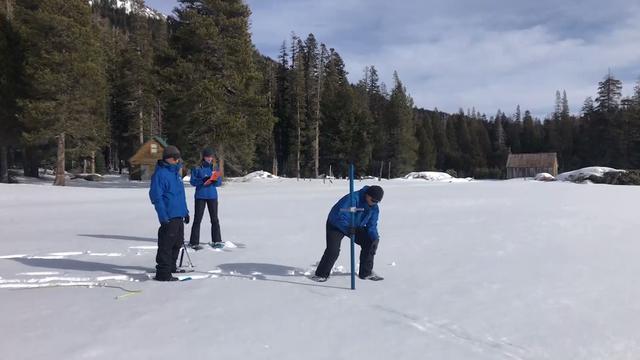
A California water official says that the water in the state's mountain snowpack is currently about half of average for early winter, but noted that a dry start doesn't always predict the season's outcome.

After a long, dry autumn, a significant amount of rain has finally fallen in Northern California and, in the North Bay, it officially means fire season is at an end.

The first of two storm fronts lined up off the Northern California coast arrived in San Francisco Bay Area Friday, bringing the first rain in months to a region in the grip of a severe drought.

Gusty offshore winds topped 60 mph on Mt. St. Helena early Monday, fueling anxieties among Wine County residents who have grown weary of California's lingering historic wildfire season as the region remained under yet another Red Flag Warning.

With much of Napa and Lake counties falling into extreme drought conditions, forecasters warned Saturday that little if any precipitation was expected until mid-December at the earliest.

More than a month and a half into this year's rainy season and significant precipitation was finally falling on Tuesday in Northern California. The state could use it in more ways than one.
With a new round of Red Flag Warnings and power outages less than 24 hours away, San Francisco Bay Area residents were once again Wednesday wrestling with the impact of months without a measurable rainfall that have transformed green hillsides into tinder-dry fuels for fire.

Wildfires across California have burned "well over" 4 million acres so far this year with about two months remaining in the fire season.

Arthur Gies has lived in Northern and Southern California his entire life. Now, after weeks of smoky air plus sporadic heat waves he's looking to leave the Golden State. He's not alone.

There's a chance water levels in the two largest man-made reservoirs in the United States could dip to critically low levels by 2025.

Amid prolonged drought and climate change in a region that's only getting thirstier, when that reckoning will arrive — and how much time remains to prepare for it — is still a guess.

As if pandemic, social unrest, and economic uncertainty weren't enough, the tiny town of Inverness is facing a water shortage.

Using tree ring evidence going back 1,200 years, scientists researching previous megadroughts, some lasting up to 40 years, say recent dry spells in the West appear to be following a similar longterm pattern.

Fire season is just around the corner and with temperatures Thursday soaring into the 90's in parts of the Bay Area, the fire danger kicked up a notch.

The final snow survey of the season in the Sierra Nevada recorded just 1.5 inches snow depth at Phillips Station -- just 3 percent of the May average.
The San Francisco Sheriff's Office on Sunday confirmed a second case of an inmate testing positive for the COVID-19, adding the inmate did not show any COVID-19 symptoms and had been kept isolated from the general population.
Almost half of the two-decade-long drought which has parched much of the western United States can be blamed on man-made global warming, according to a study in Thursday's journal Science.

Several feet of snow was predicted for the Sierra Nevada during a spring storm with the possibility of scattered showers continuing for much of the week, according to the weather service.

After more than a month of keeping the storm door slammed shut, Mother Nature flung it open Saturday bringing much needed rain to the Bay Area and several feet of snow to the Sierra.

Midnight closed out the first rain-free February in San Francisco since the Civil War, according to the National Weather Service.

The Sonoma County Water Agency has begun inflating its rubber dam on the Russian River near Forestville in response to a month of dry weather, officials said Friday.

As San Francisco neared its first February without rain since 1864, federal weather monitors reported Friday that moderate drought conditions have returned to northern Contra Costa and Alameda counties and southern Solano County.

February has been a magnificently beautiful month for Bay Area weather, but the fact that the region didn't get a single drop of rain the past four weeks has raised some concerns about drought.

A high pressure system remained stalled off the Northern California coast Tuesday, locking the region into a dry spell that reached 27 consecutive days without rain and edged the region toward a record set during the Civil War.