U.S.-Iran Latest: Trump says ceasefire with Iran over and "we're going to hit them hard again tonight"
What to know about the Iran war today:
- President Trump said the U.S. would likely launch more strikes against Iran Wednesday night, telling reporters at a NATO summit in Turkey "we hit them very hard last night," and "we're going to hit them hard again tonight." He later said he's not sure he wants to make a deal with the Iranians, but also said he doesn't think the war will "start again."
- Earlier Wednesday Mr. Trump said, "as far as I'm concerned, it's over," when asked about the ceasefire with Iran. After an exchange of strikes by both countries, Mr. Trump called Iran's leaders "sick" and declared it "a waste of time dealing with them."
- Oil prices soared Wednesday and stocks slumped after Mr. Trump said the ceasefire with Iran was over, with international benchmark Brent crude jumping almost 8% to trade over $80 a barrel. The main U.S. contract, West Texas Intermediate, was also up over 7% at $75 a barrel.
Iranian foreign minister: "We do not answer vulgarity with vulgarity"
Iranian Foreign Minister Abbas Araghchi, a key member of senior leadership negotiating a peace deal, said they would respond with "action" in response to President Trump's daylong string of insults against Iran.
"Iranians are known for their civility, culture, and strong moral values," Araghchi wrote on X. "We do not answer vulgarity with vulgarity, but with action: fearlessly and with great valor."
Mr. Trump, who held several press conferences at the NATO conference in Turkey, referred to Iranian leadership as "scum," "loco," "cuckoo," "cancer" and "evil, sick people" on Wednesday.
Esmaeil Baqaei, a spokesperson for the foreign ministry, claimed the memorandum of understanding returns control of the Strait of Hormuz to Iran, an argument the U.S. disputes.
"The United States, despite the explicit provision of the fifth clause of this memorandum—which emphasizes the Islamic Republic of Iran's responsibility in determining arrangements for the safe passage of ships through the Strait of Hormuz—has challenged this clause and, in practice, violated the agreement's structure through its unilateral actions and also aggressive attacks against Iran," Baqaei said in a statement.
8 Iranian soldiers killed in U.S. attacks, state broadcaster says
Eight members of the Iranian armed forces were killed in American attacks in the south of Iran, according to the state broadcaster IRIB.
The semi-official Fars news agency said the troops were members of Iran's air force and navy killed in the southern coastal regions of Bandar Abbas and Bushehr.
IRIB reported the names and sketches of all eight of the men it said had been killed by the U.S. strikes.
Iran threatens oil facilities in Gulf nations that support U.S.
With the peace deal between the U.S. and Iran in tatters, Iran is now threatening to strike oil production facilities in Gulf nations that have supported the United States.
"The Gulf states that have stood alongside Trump in the Iran-America regime conflict should watch over their oil and gas wells," Ebrahim Rezaei, a spokesperson for Iran's national security council. "In defense of the security of the great Iranian nation, we have no red lines."
Iran repeatedly targeted nations like Kuwait, Qatar, Saudi Arabia and the United Arab Emirates with drone and missile attacks as the war began in the region. Those countries have repeatedly voiced support for the United States and criticized Iran's targeting of commercial vessels in the Strait of Hormuz.
"Trump's statements today, from insulting the Iranian nation to threatening further attacks, are not a sign of strength, but rather an admission of the failure of a policy built on brute force, sanctions, and threats for years, which could not bring the Iranian nation to its knees," Iranian Deputy Foreign Minister Kazem Gharibabadi said on X. "With the criminal and murderous Trump, one must speak in his own language; apparently, he understands the language of force better!"
Trump pressed on switch to older Air Force One as he departs Turkey
President Trump was pressed by reporters as to why he is not leaving Turkey aboard the new Air Force One gifted to the U.S. by the Qatari government.
The president said on Truth Social ahead of the press conference that the new aircraft would be flying to Royal Air Force Mildenhall in the United Kingdom so service members can tour it, and he will be taking an older plane from Turkey to England "for old time's sake."
Mr. Trump flew to Turkey aboard the new jet for the NATO summit.
"It's flying to Europe to one of the big bases, two or three of the big bases, where we can show it to the people and we'll be going home by normal methods," Mr. Trump told reporters of the new Air Force One.
The $400 million Boeing 747-8 jet was unveiled last month.
Asked whether the decision not to take the new plane was because of security concerns involving Iran, Mr. Trump said the job of president is a "very dangerous profession."
"I'm No. 1 on the kill list for Iran," he said.
Trump says he doesn't think Iran war will "start again"
President Trump said Wednesday at a press conference in Ankara, Turkey, that he doesn't think the Iran war is going to "start again."
"I think it's going to go very quickly," he said. "They hit a couple of ships and so we hit them much harder. When they hit, we hit 10 times harder. You know, we hit much harder than they do."
He said the U.S. "might" hit Iran tonight, and that "anything that happens is going to be over very quickly."
He added that "we're not looking for long-term."
Trump: "I'm not sure I want to make a deal" with the Iranians
Asked about his sharp rhetoric on Iran's leaders, who the president previously called "strong people, smart people," President Trump said his view has shifted as negotiations with Tehran have continued.
"They're not doing a service to the people," he said.
Mr. Trump said the U.S. doesn't want to have "lunatics" in control of nuclear weapons.
"I'm not sure I want to make a deal with them," he told reporters. "We can play games, but I'm not sure I want to make a deal. Let's just finish the job."
When pushed on rising oil prices, the president said it will only be up slightly and the U.S. has an "oil glut."
Trump continues attacks on Iranian leaders, calling them "loco"
During a press conference at the conclusion of the NATO summit in Turkey, President Trump reiterated his goal to prevent Iran from obtaining a nuclear weapon and said he believes the war is a "tremendous success."
"They have no military left. Their Air Force is gone. Their ships are gone," Mr. Trump said.
He said Iranian leaders claim they want to make a deal with the U.S. to end the war but don't know how to.
"I think they're a little loco. They're a little crazy," the president said.
Mr. Trump also called the Iranian leadership "scum" and suggested he was at risk of being assassinated by Tehran.
"I may be gone, too, because I'm their No. 1 target," he said.
Iran won't give up Strait of Hormuz, its "new nuclear weapon," analyst says
Iran won't give up the Strait of Hormuz, its "new nuclear weapon," an analyst told CBS News on Wednesday.
Speaking soon after President Trump said the ceasefire between the U.S. and Iran was, in his view, "over," Aaron David Miller, a Senior Fellow at the Carnegie Endowment and a former State Department adviser on Arab-Israeli negotiations, said: "Iran is not going to give up what is now their new nuclear weapon," the Strait of Hormuz, "which is leverage and control over a choke point through which 20% of the world's daily global oil supply transits."
The two countries' dramatic flare-up this week began with an attack on three commercial vessels in the Strait of Hormuz by Iran, which had demanded that all ships pass through the waterway in coordination with its maritime authorities. The U.S. wants the strait to be freely open to all vessels, like it was before the war launched jointly by the U.S. and Israel on Feb. 28.
The memorandum of understanding between the two countries in mid-June called for a period of 60 days to negotiate a final peace deal, including a resolution to the Hormuz situation.
"I think that was tethered to a galaxy far, far away, rather than the realities back on the planet," said Miller of the proposed timeline.
"Flawed military campaign produces flawed memorandum of understanding, produces flawed process of implementation," he added.
Meanwhile, Mr. Trump, who called Iranian leadership "scum," "cuckoo" and a "cancer" Wednesday, "cannot leave this conflict completely humiliated when none of his objectives [have been] achieved" said Miller. "I think it's going to be very difficult for him simply to walk away."
Iran will close Strait of Hormuz in retaliation for any new U.S. strikes, state TV network says
Iran will "immediately" close the Strait of Hormuz to all traffic if the country is attacked again, the state-owned Press TV network said Wednesday, quoting an unnamed regime source. The report said Iran would retaliate for any U.S. strikes by attacking twice as many targets.
Iran struck three commercial vessels in the strait this week, leading the U.S. to hit more than 80 Iranian targets, according to the U.S. Central Command. Iran then launched attacks targeting U.S. Gulf allies Bahrain and Kuwait.
Speaking Wednesday at a NATO summit in Turkey, President Trump said the memorandum of understanding signed in mid-June, extending the ceasefire between the two countries, was, in his mind, "over," though he said he would allow negotiations to continue.
"Developments over the past 48 hours have solidified Tehran's resolve, with a new military and strategic doctrine now in place," Press TV said. "The memorandum of understanding signed on this matter clearly states that Iran will reopen the strait in accordance with its own arrangements. Therefore, Iran will not permit the establishment of any new route outside the framework of its own arrangements."
"Trump will gain nothing from these recent threats," the network said, after the U.S. president said forces would hit Iran "hard again" on Wednesday evening. "But he will certainly lose both the Strait of Hormuz and the negotiations over a final agreement. The choice is now his."
Could disagreements over the Strait of Hormuz lead Iran to abandon negotiations?
Government sources inside Iran told CBS News on Wednesday that the latest U.S. strikes were a "serious violation" of the memorandum of understanding signed between the two countries — an agreement that President Trump said on Wednesday was, in his view, "over."
The dispute appears to stem from fundamentally different interpretations of the MoU: Tehran believes all commercial shipping through the Strait of Hormuz must continue to coordinate with Iran, while Washington maintains vessels can move through the waterway without Iranian approval.
For Iran, the issue is not simply about maritime traffic but preserving its ability to exert leverage over the vital shipping lane in any future conflict — something officials in Tehran fear is being undermined by U.S. efforts to establish a shipping route outside Iranian oversight, close to Oman's coast.
There is now genuine concern across the region that the sharp escalation of this week could ultimately spell the end of the MoU.
If Tehran believes Washington is using the agreement to strip Iran of its control over the Strait of Hormuz, more figures within Iran's ruling theocracy could potentially see going back to war as justified.
Iraqi holy cities host processions amid ongoing funeral ceremonies for former Iranian supreme leader
Huge crowds thronged the streets of Najaf, Iraq, packing the courtyards of its majestic shrine, as they mourned the slain Iranian supreme leader Ali Khamenei during his funeral procession in Iraq on Wednesday.
Iran began six days of public funeral ceremonies for Khamenei on Saturday, including a dedicated day in neighboring Iraq — a Shiite Muslim powerhouse with close ties to Tehran and home to the faith's most sacred shrines.
Iran hopes the marathon ceremonies will show strength and unity as the Middle East war — which started with U.S.-Israeli strikes that killed Khamenei and several relatives on Feb. 28. — reignited this week with back-and-forth strikes.
President Trump declared on Wednesday that the ceasefire agreed to in mid-June was "over."
Mohammed al-Bayati, 30, told the AFP news agency he would have never missed the funeral "of the person who challenged the power of America and Israel."
After a massive procession in Iran's holy city of Qom, Khamenei's body was brought Tuesday night to Iraq, where authorities declared Wednesday a public holiday.
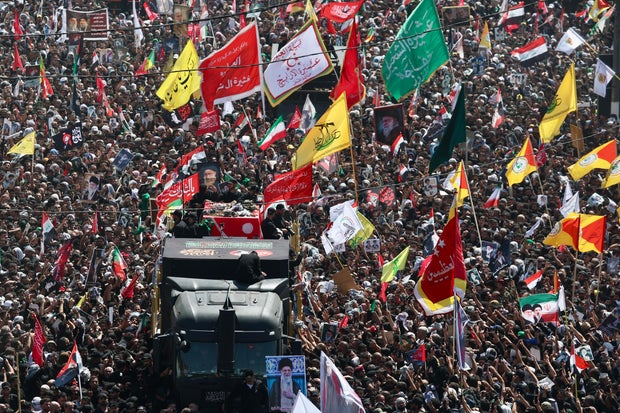
Vast crowds filled the streets of Najaf, with some people pushing close hoping to touch Khamenei's coffin as it rode slowly in the back of a truck en route to the shrine of Imam Ali — the Prophet Mohammed's son-in-law and the first Shiite Imam.
There, the call for prayer echoed in the vast courtyards as hundreds of clerics in white and black turbans waited for hours to pray over Khamenei's remains. Inside the shrine, thousands jostled to get closer to the coffin as it was carried away in the mausoleum's halls — its last stop in Najaf before being flown to the other holy city of Karbala.
Khamenei's funeral will conclude with his burial on Thursday in his hometown of Mashhad in northeast Iran.
CBS/AFP
Trump says U.S. may reinstate naval blockade as he threatens more strikes on Iran
President Trump said Wednesday that the U.S. might reinstate the naval blockade of Iran's ports and associated vessels after saying the ceasefire between Tehran and Washington was "over" in his view and warning that more strikes were likely.
"We may put down the blockade, we may put it back, the blockade, and it'll only be a blockade for Iran," Mr. Trump said during the NATO summit in Ankara, Turkey. "Anybody else can have whatever they want. Now, of course, they'll drop some mines if they can, you know, if they can do it."
The U.S. lifted its blockade as a part of the memorandum of understanding that Mr. Trump and his Iranian counterpart signed in mid-June.
The White House and U.S. military said more than 140 ships were interdicted during the blockade, and Central Command denied reports of multiple Iran-linked tankers managing to evade the restrictions.
Trump renews threat to attack Iran's oil, electric and water infrastructure
President Trump threatened Wednesday to strike Iran's civilian infrastructure and to seize Kharg Island, with its oil infrastructure, as his ceasefire with Tehran appeared to be in tatters.
Mr. Trump made the threats after announcing that the U.S. was preparing for a second night of strikes against Iran after Iranian attacks on American military sites in the Gulf.
If the U.S. has to, the president said, it will take out Iran's electric plants and desalinization plants. He said Tuesday's strikes included attacks on Kharg Island but not its oil facilities.
"Maybe we'll take over Kharg Island. We may take over Kharg Island. There's not a thing they could do about it," Mr. Trump said.
Bahrain says it intercepted aerial Iranian attacks targeting civilians
Bahrain said Wednesday that it had intercepted several Iranian aerial attacks targeting civilians, as the U.S.-Iran war flared up again dramatically.
In a statement, the Bahraini armed forces said that "Iran continues its systematic hostile approach through its wrongful attacks using missiles and drones targeting civilians in the Kingdom of Bahrain."
It added that the military had "confronted, intercepted, and destroyed a number of treacherous Iranian aerial attacks," and urged people to "avoid approaching or touching any foreign or suspicious objects resulting from the remnants of the Iranian attack."
The statement did not say whether anyone had been hurt or killed in the Iranian strikes.
Trump says U.S. will probably hit Iran "hard again tonight"
Speaking to reporters at a NATO summit in Turkey, alongside Ukrainian President Volodymyr Zelenskyy, President Trump said the U.S. would probably hit Iran with a deluge of strikes again Wednesday evening.
"They are behaving very badly, as they have for 47 years," he said, adding that the U.S. hit Iran "hard last night" after Iran launched "a couple of drones and one rocket" at ships in the Strait of Hormuz.
"And so we hit them very hard last night," he said. "Very, very hard. Probably hit them hard again tonight. I'll give them a little warning, we're going to hit them hard again tonight."
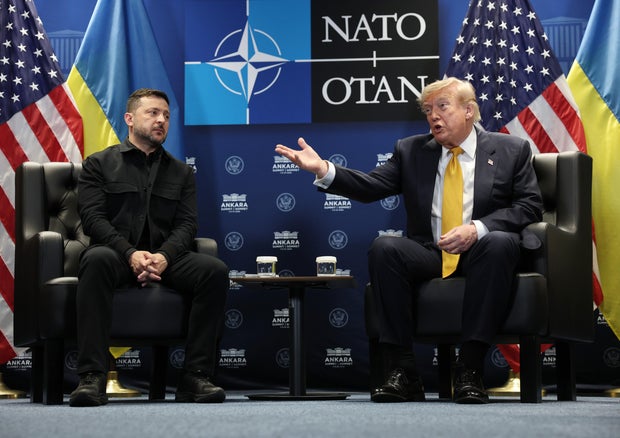
Mr. Trump accused Iran's leaders of agreeing to something in private, then saying something different in public.
"They're cuckoo," he said. "There's something wrong with these people."
Stocks slump, oil surges after Trump says Iran ceasefire is over
Stocks tumbled in early trading on Wednesday after President Trump said the ceasefire with Iran is "over" and that it is "a waste of time dealing with them."
Oil prices jumped 6% on concerns that a re-escalation of hostilities would jeopardize the flow of oil through the Strait of Hormuz.
Mr. Trump's remarks come after attacks by Iran's Islamic Revolutionary Guard Corps on three tankers in the Strait of Hormuz, which were followed by U.S. strikes.
Iranian lawmaker says U.S. must "recognize the new Iranian order in the Strait of Hormuz"
The U.S. must recognize the "new Iranian order in the Strait of Hormuz," an Iranian lawmaker said Wednesday.
In a short post on X, Ebrahim Azizi, the head of the national security commission of Iran's parliament, wrote: "Recognize the new Iranian order in the Strait of Hormuz; this is the only way forward."
His comments come amid an escalation in hostilities between the two countries after Iran attacked three commercial vessels in the vital waterway Monday and Tuesday.
Kuwaiti army says it intercepted 15 Iranian missiles and drones
Kuwait said Wednesday that it had intercepted two ballistic missiles and 13 drones fired by Iran.
In a statement on X, the Kuwaiti army said it "detected, at dawn today, two hostile ballistic missiles and 13 hostile drones that breached Kuwaiti airspace."
Iran launched a barrage of weapons at U.S. Gulf allies Bahrain and Kuwait after the U.S. hit over 80 Iranian targets Tuesday, according to CENTCOM, in retaliation for Iran striking three commercial vessels in the Strait of Hormuz.
Kuwaiti authorities said there were no casualties from the Iranian attack.
Trump says he is "number one" on Iran's hitlist and his luck might run out
President Trump said Wednesday that he has been "number one" on Iran's hitlist for years, and while he's been lucky so far, his luck might run out.
"They're dirty players, they go after everyone, probably including me. I've been number one on their list for years," Mr. Trump said at a NATO summit in Turkey, after the U.S. retaliated to Iranian strikes on vessels in the Strait of Hormuz, triggering further Iranian attacks on U.S. Gulf allies.
"We took out their first set of leaders. We took out their second set of leaders. They want to take out the U.S. leader, me. I'm on every list," he told reporters. "I'm on every single one of their lists, and so far I guess I've been a little bit lucky, but that maybe doesn't last very long, because that's the way it goes."
"These are evil, sick people," he said. "They're cancer. You know what you do, you got to cut out cancer early, man that's the way I feel."
U.N. maritime agency boss condemns "reckless attacks" on vessels in the Strait of Hormuz
The head of the United Nations' shipping agency has condemned "reckless attacks" on commercial vessels and "innocent seafarers" in the Strait of Hormuz, after Iran launched strikes against several ships in the strategic waterway.
"I regret that once again I am compelled to speak out following attacks on commercial ships and innocent seafarers, due to geopolitical circumstances beyond their control," Arsenio Dominguez, head of the International Maritime Organization (IMO), said in a statement Wednesday.
"I condemn the attacks over the past two days against several ships transiting the Strait of Hormuz," he added, referring to Iranian attacks on three vessels within 24 hours Monday and Tuesday.
"These reckless attacks have again placed innocent seafarers in grave danger," said Dominguez. "No seafarer should have to risk their life simply for doing their job."
According to the IMO, several hundred ships carrying around 6,000 seafarers remain stranded in the Persian Gulf, which can only be exited via the Strait of Hormuz.
Trump says Iran has killed "thousands and thousands of our soldiers"
President Trump said Wednesday that Iran had killed "thousands and thousands of our soldiers" as he blasted the country and said that, in his view, the ceasefire and negotiations were "over."
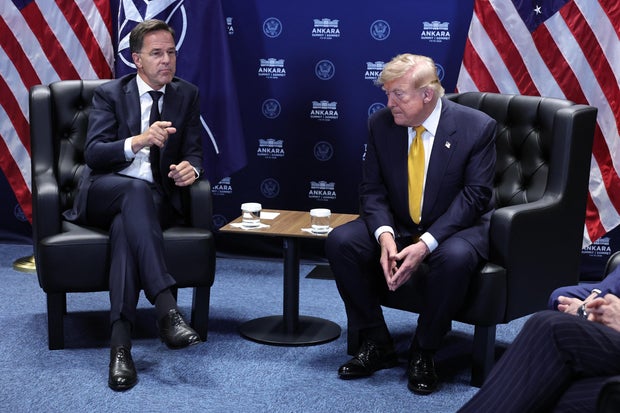
"They can't have a nuclear weapon, and they go around killing people," he said during a sit-down with NATO chief Mark Rutte at a summit in Ankara, Turkey.
"They've killed thousands and thousands of our soldiers," he added, calling Qassem Soleimani — the Iranian general assassinated by the U.S. in 2020 — the "father of the roadside bomb."
He also referred to the deadly October 2000 attack on the USS Cole off the coast of Yemen as "theirs."
"Remember that disaster?" Mr. Trump said of the attack that killed 17 American sailors. "So, I don't like them at all."
Iranian chief of staff dares U.S. to "enter a hell" by launching a ground invasion
Iranian forces will make the country's coastline a "hell" for U.S. forces if they are ordered to attack, Iranian Army Chief of Staff Rear Admiral Habibollah Sayyari said Wednesday.
Speaking on state television, Sayyari said Iranian army, police and paramilitary Revolutionary Guard Corps forces "are so strong and firmly present on the scene that the enemy will no longer even think about deploying forces on Iran's shores."
"The enemy knows that if it makes such a mistake, it will enter a hell from which it will no longer have a way out," he said, according to Iran's official IRNA news agency. "I promise that no matter how much the enemy makes slogans, it will still not dare to deploy forces on our shores."
He added that recent statements by President Trump were "intended to prove that there is no obstacle preventing a military presence on Iran's shores."
"Our response, however, is clear," he said: "If you have the courage, come."
"We may today be behind the enemy in terms of technology and advanced equipment," Sayyari said, "but we are proud that what we have belongs to ourselves, and we are working to overcome all our shortcomings."
NATO chief says U.S. strikes on Iran were "absolutely necessary," tells Trump, "I'm with you"
Overnight U.S. strikes on Iran were "absolutely necessary," NATO Secretary General Mark Rutte told reporters at a summit in the Turkish capital Ankara, where President Trump declared peace talks with Iran "over" on Wednesday.
"I think it was absolutely necessary because when you have a ceasefire and Iran is basically violating the ceasefire ... I think it is totally crucial that the U.S. forcefully react," he told reporters.
"It was a very strong response, and I'm with you on this," Rutte said, sitting next to Mr. Trump.
Trump calls Iranian leadership "scum" and "cuckoo"
President Trump called Iranian leaders "scum" on Wednesday as he declared negotiations with the country over.
"They're scum, they're sick people, they're led by sick people, and they're vicious, violent people," Mr. Trump said at a NATO summit in the Turkish capital, Ankara. "And if they had a nuclear weapon, they'd use it."
"Everyone's agreed, no nuclear weapon," the president said. "We make a deal. They go outside, joke to the press, they say we never even talked about it. There's something wrong with them, they're cuckoo."
Top European Union diplomat says U.S. and Iranian strikes "further complicate already fraught" peace talks
The European Union's top diplomat Kaja Kallas said Wednesday that the back-and-forth strikes between Iran and the U.S. of the past two days "further complicate already fraught talks to end the war."
"Iran's attacks on Bahrain and Kuwait are unacceptable," she wrote in a post on X, criticizing Iran's Tuesday attacks on ships in the Strait of Hormuz and targeting Persian Gulf states.
EU foreign ministers are set to meet with their counterparts from Gulf states on Monday to discuss how to "preserve freedom of navigation in the strait as well as the Red Sea," Kallas said.
Oil prices jump 5% after Trump says Iran ceasefire over
World oil prices soared more than five percent Wednesday after President Trump said the ceasefire with Iran was over, following a fresh exchange of strikes in the Middle East.
International benchmark Brent North Sea crude jumped 5.3 percent to $78.09 a barrel, while the main U.S. contract, West Texas Intermediate, advanced 5.4 percent to $74.23 a barrel.
The U.S. said it had hit over 80 Iranian targets overnight following attacks on ships in the Strait of Hormuz, triggering a wave of reprisals against American bases in the Gulf.
CBS/AFP
Trump says ceasefire is "over" and dealing with Iran is a "waste of time"
President Trump said Wednesday that the interim agreement with Iran was "over" but he will allow talks to continue.
"For me, I think it's over," Trump responded when asked about the status of the ceasefire. Referring to the country's leadership as "sick," he added: "It's just a waste of time dealing with them."
"I'll let our wonderful negotiators keep talking if they want, but I don't see it. I don't like these people, you know that," he said.
He made the comment on the sidelines of the two-day NATO summit in Ankara, Turkey, and hours after striking Iran in what the U.S. described as retaliation for attacks on tankers in the Strait of Hormuz.
CBS/AP
Iran media report explosions in key port city of Bushehr
Iranian media reported Wednesday a series of blasts in the port city of Bushehr.
"Explosions have been heard in Bushehr and the surrounding area," the Mehr news agency said, without providing details.
A provincial official told Iran's FARS news agency two military bases in Bushehr province were targeted but there were no reports of casualties, according to the Reuters news agency.
Located in Iran's southwest, Bushehr hosts the country's only civilian nuclear power plant and lies near Kharg island, the main oil terminal through which 90 percent of the nation's crude exports transit.
CBS/AFP
More missiles aimed at Bahrain as Iran and Kuwait address latest strikes
Bahrain sounded its missile alert sirens a third time Wednesday morning after Iran launched retaliatory attacks over airstrikes by the United States.
Both Bahrain and Kuwait were targeted by Iran on Wednesday.
Iran's Revolutionary Guard issued a statement acknowledging targeting U.S. military installations in both countries.
"The child-killing and terrorist U.S. army ... openly violated the ceasefire and violated the Islamabad understanding by launching an airstrike on a number of coastal bases and civilian stations on the coasts of Hormozgan and Mahshahr provinces," it said, without addressing Iranian attacks on ships in the Strait of Hormuz.
Iran's Parliament Speaker Mohammad Bagher Qalibaf wrote on social media that, "The era of bullying and extortion is over. It leads nowhere. We don't fold."
Kuwait bristled at the Iranian attacks on its soil, which it said undermined efforts to de-escalate tensions in the region, according to French news agency AFP.
CBS/AP
Trump ordering strikes on Iran from NATO summit caught alliance leaders off guard
President Trump surprised NATO leaders he is meeting with in Turkey when he ordered the launch of a series of strikes on Iran late Tuesday and the revocation of a license that allowed Tehran to sell its oil on the world market.
The moves were a major twist for a summit that had been aimed at showcasing how alliance members were stepping up spending on defense and focusing on support for Ukraine's war with Russia.
The strikes were retaliation after three merchant ships were struck in the Strait of Hormuz, and underscored the fragility of an interim deal to end months of fighting between the two countries. Mr. Trump launched the attacks shortly after leaving a dinner hosted by Turkish President Recep Tayyip Erdogan where the leaders of the alliance's 32 member countries had gathered ahead of Wednesday's talks.
Mr. Trump didn't directly address the strikes Tuesday night. It's rare for U.S. presidents to launch military action while outside the U.S., though former President Barack Obama authorized strikes in Libya while on a trip to Brazil in 2011.


