Trump calls off scheduled attack on Iran amid "serious negotiations" toward peace deal
Follow updates on the war in the Middle East for Tuesday, May 19, here. See earlier developments below.
What to know about the Iran war:
- President Trump announced Monday that he was calling off what he said was a scheduled attack on Iran that was supposed to happen Tuesday. The president said he made the decision because "serious negotiations" were taking place toward a peace deal that Mr. Trump said will be acceptable to the U.S. and countries in the Middle East.
- Before Mr. Trump's announcement, Iran said it conveyed another amended set of terms for a potential peace deal. Tehran said it is focused entirely on an agreement to end the war and has not yet "discussed any details regarding nuclear matters."
- Mr. Trump had warned Sunday that "the Clock is Ticking" for Iran to accept a peace agreement, and "there won't be anything left of them" if the Islamic Republic's leaders don't "get moving, FAST."
Iran showing no signs of budging
President Trump has considered himself an effective dealmaker above all else, but he appears to have hit a wall with Iran as his tough talk, threats and even military action haven't moved Tehran from its long-established positions.
With shifting goals that make it difficult to judge the status of the U.S. effort, Mr. Trump and his top aides have insisted the United States has already won the war and that Iran is ready to reach an agreement in the wake of escalating U.S. threats during a tenuous ceasefire.
But Mr. Trump backed down once again, saying Monday he had put plans for an imminent resumption of attacks on hold at the request of Gulf Arab states because "serious negotiations are now taking place, and that, in their opinion, as Great Leaders and Allies, a Deal will be made, which will be very acceptable to the United States of America, as well as all Countries in the Middle East, and beyond."
Although he said he had called off strikes planned for Tuesday, Mr. Trump kept up the bravado, saying he told military leaders "to be prepared to go forward with a full, large scale assault of Iran, on a moment's notice, in the event that an acceptable Deal is not reached." He has repeatedly set deadlines for Tehran and then backed off.
Despite growing internal unrest, a crippled economy and the deaths of many of its leaders, there is no evidence Iran is set to meet Mr. Trump's demands - many of which it has long rejected. In fact, it has dug in. That's left his stated top objectives unrealized: Iran has yet to agree to abandon its nuclear program or its ballistic missile development, or cease support for its proxies in the region, including those in Gaza, Iraq, Lebanon and Yemen.
WH deputy press secretary: "Iran must renounce their nuclear ambitions for good"
Following President Trump's announcement that he is delaying strikes on Iran that had initially been planned for Tuesday, White House deputy press secretary Anna Kelly said Monday in an interview with Fox News that "nothing has changed" in regard to Iran and that Mr. Trump remains focused on the country's nuclear program.
"The Iranian ability to enrich has been totally decimated by Operation Midnight Hammer," she said, referring to the June 2025 strikes on several Iranian nuclear facilities. "This enriched uranium that they possess, they can't keep it. President Trump has been very clear about that. That is one of the red lines in these negotiations."
"The President has made our red lines in these negotiations very clear," she said. "Iran must renounce their nuclear ambitions for good."
Stocks, oil prices yo-yo amid Iran uncertainty
Oil prices and stock markets worldwide swung through a shaky Monday with uncertainty about what will happen with the Iran war.
The S&P 500 swiveled between gains and losses before finishing with a dip of 0.1%, its second loss since setting an all-time high last week. The Dow Jones Industrial Average added 159 points, or 0.3%, and the Nasdaq composite fell 0.5% after both indexes likewise yo-yoed.
Stock prices moved in the opposite direction of oil prices, which have been twitchy because of uncertainty about how long the Iran war will keep the Strait of Hormuz closed and prevent oil tankers from delivering crude. The price for a barrel of Brent crude oil, the international standard, went from a high of $112 overnight to below $107 in the morning before turning back higher.
Trump warns assault on Iran could happen "on a moment's notice" if deal isn't reached
President Trump warned that a full, large-scale assault of Iran could happen "on a moment's notice" if a deal isn't reached.
Mr. Trump said in a social media post he's not going ahead with a planned attack of Iran on Tuesday, saying serious negotiations are taking place.
Iran said it's focused entirely on an agreement to end the war, but has not discussed any details on nuclear matters, the Trump administration's top issue.
Trump says U.S. "will NOT" follow through with "scheduled" military attack on Iran
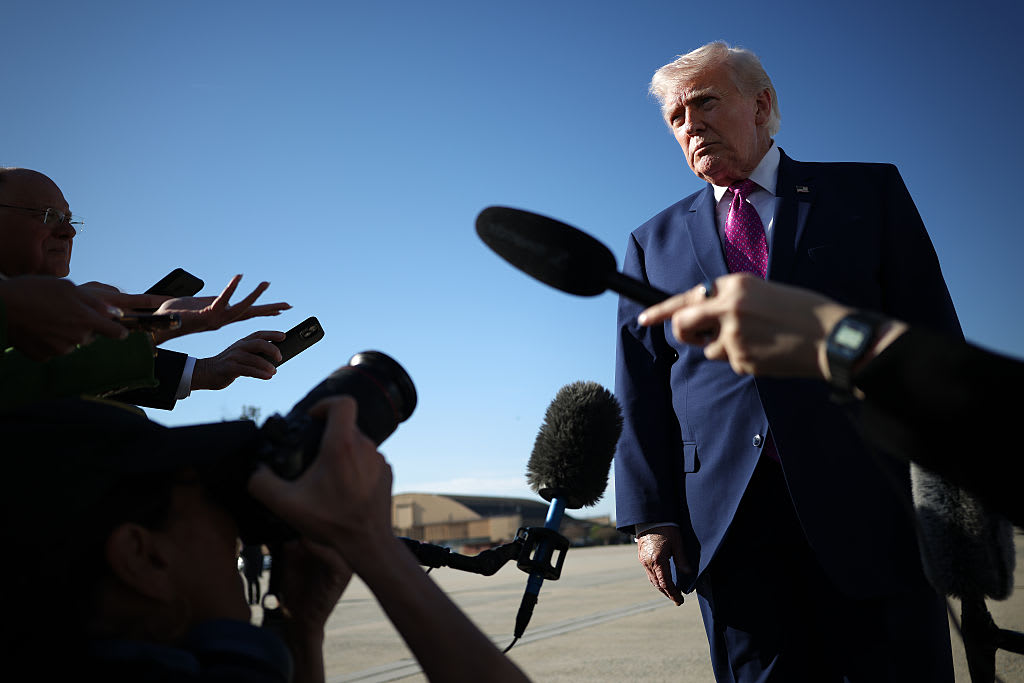
President Trump on Monday afternoon said the U.S. "will NOT" follow through with "scheduled" attacks on Iran on Tuesday, after he said partner nations in the Middle East asked him to hold off. The president made the announcement on Truth Social.
"In their opinion, as Great Leaders and Allies, a Deal will be made, which will be very acceptable to the United States of America, as well as all Countries in the Middle East, and beyond," he wrote. "This Deal will include, importantly, NO NUCLEAR WEAPONS FOR IRAN!"
He said he told Pentagon leaders that while "we will NOT be doing the scheduled attack of Iran tomorrow," he instructed them "to be prepared to go forward with a full, large scale assault of Iran, on a moment's notice, in the event that an acceptable Deal is not reached."
Iran threatens permits for internet cables passing through Strait of Hormuz
Iran's Revolutionary Guard said Monday that internet fiber optic cables passing through the Strait of Hormuz could be brought under a system of permits as Tehran tightens control over the waterway.
"Following the imposition of control over the Strait of Hormuz, Iran, citing its absolute sovereignty over the bed and subsoil of its territorial sea ... could declare that all fiber-optic cables passing through the waterway are subject to permits," the Guard said in a social media post.
Trump tells New York Post: Iran knows "what's going to be happening soon"
President Trump told the New York Post on Monday that Iran knows "what's going to be happening soon," and that he is "not open" to any concessions for Tehran after its latest response in the peace talks.
The president made the comments to the Post in a brief phone call with the outlet.
"I can tell you they want to make a deal more than ever, because they know we're—what's going to be happening soon," Mr. Trump said.
CENTCOM says forces redirected 85 vessels amid blockade
U.S. Central Command said midday Monday that the military has redirected 85 commercial vessels amid the ongoing U.S. blockade on Iranian ports – up from 84 a few hours earlier.
U.S. forces have disabled four other vessels, CENTCOM said earlier on social media.
"CENTCOM continues to strictly enforce the U.S. blockade against Iranian ports," it posted.
U.S. extends sanctions waiver on Russian at-sea oil by 30 days, Bessent says
The U.S. Treasury on Monday extended its sanctions waiver for Russian oil cargoes that were already at sea by 30 days.
The latest "temporary 30-day general license" will "provide the most vulnerable nations with the ability to temporarily access Russian oil currently stranded at sea," Treasury Secretary Scott Bessent said in a post on X.
"This extension will provide additional flexibility, and we will work with these nations to provide specific licenses as needed," he said. "This general license will help stabilize the physical crude market and ensure oil reaches the most energy-vulnerable countries."
"It will also help reroute existing supply to countries most in need by reducing China's ability to stockpile discounted oil," Bessent added.
Strait of Hormuz tanker traffic slightly higher after wartime low
Traffic through the Strait of Hormuz was slightly higher last week, returning to levels in line with the average recorded since the start of the conflict, after hitting a wartime low.
A total of 55 commodities vessels crossed the strategic waterway between May 11 and 17, according to data from maritime tracking firm Kpler as of Monday morning. The previous week, just 19 vessels crossed - the lowest weekly figure since the first U.S.-Israeli strikes on Iran on Feb. 28.
Iranian state television said Friday the Revolutionary Guards were allowing more ships to transit the strait, after reporting a day earlier that "more than 30 ships" had been permitted to pass.
Despite the increase, last week's crossings remain broadly in line with wartime averages.
Since March 1, Kpler has recorded 663 commodity vessels transiting the strait, 55 per week on average.
In peacetime, the Strait of Hormuz handles roughly a fifth of global oil and LNG shipments, as well as other major commodities, including fertilizer.
Israeli strikes killed more than 3,000 people in Lebanon, health ministry says
Lebanon's health ministry said Monday that 3,020 people have been killed in Israeli strikes since early March and another 9,273 people have been wounded.
Lebanese President Joseph Aoun said Monday he was ready to "do the impossible" to stop the war with Israel. Last week, a truce was extended for 45 days following a third round of talks between Lebanon and Israel in Washington, D.C. — discussions to which Hezbollah is opposed.
"The framework that Lebanon has set for the negotiations consists of an Israeli withdrawal, a ceasefire, the deployment of the army along the border, the return of the displaced, and economic aid," Aoun said in a statement Monday.
"My duty, based on my position and my responsibility, is to do the impossible, and to choose what is least costly, in order to stop the war against Lebanon and its people," he added.
Since the start of the ceasefire on April 17, Israel has continued to launch strikes, carry out demolitions and issue evacuation orders in south Lebanon, saying it is targeting the Iran-backed armed group.
Hezbollah has continued operations against Israeli forces in south Lebanon and northern Israel, including what it said was a drone attack Monday on "the vehicle of the commander of the 300th Brigade of the Israeli enemy army."
U.S. forces redirected 84 vessels amid blockade, military says
U.S. forces have redirected 84 commercial vessels amid the ongoing U.S. blockade on Iranian ports, U.S. Central Command said Monday.
They have disabled four others, CENTCOM said in a post on X.
The blockade has been in place since mid-April.
Oil prices, stocks swing up and down
Oil prices swung Monday after a scare overnight where prices popped and then moderated — and the yo-yo moves kept stock markets worldwide unsettled.
The S&P 500 edged up by 0.1% in morning trading after flipping between modest gains and losses. The Dow Jones Industrial Average was up 187 points, or 0.4%, as of 10:30 a.m. Eastern time, while the Nasdaq composite was down 0.1% but remained near its all-time high set last week like the S&P 500.
The center of the action recently has been the world's bond markets, where climbing yields have cranked up the pressure on economies and stock markets worldwide.
The price for a barrel of Brent crude oil, the international standard, got as high as $112 overnight. Prices eased later in the morning, with hopes still remaining that the two sides can reach a deal that would get oil flowing again. The price for a barrel of Brent crude fell back to $108.75, down 0.5% from Friday, although that's still well above its roughly $70 price from before the war.
That drop in oil prices helped boost stock markets that hadn't finished trading yet, and France's CAC 40 index went from a loss of 1.2% to a gain of 0.6%. By that point, Japan's Nikkei 225 had already finished 1% lower, with Hong Kong's Hang Seng down 1.1%.
Trump lashes out at news outlets and Democrats, claims even Iranian surrender would be portrayed as a U.S. loss
President Trump complained Monday in a post on his Truth social platform that even if Iran's leaders were to sign "'Documents of Surrender,' and admit their defeat" some news outlets and Democrats would still seek to portray it as "a Masterful and Brilliant Victory over The United States of America."
Mr. Trump did not give any indication of his administration's opinion of the latest terms handed over by the Iranian regime as the two sides continue haggling over a framework for a potential peace deal, 80 days into the war launched by the U.S. and Israel.
"If Iran surrenders, admits their Navy is gone and resting at the bottom of the sea, and their Air Force is no longer with us, and if their entire Military walks out of Tehran, weapons dropped and hands held high, each shouting 'I surrender, I surrender' while wildly waving the representative White Flag, and if their entire remaining Leadership signs all necessary 'Documents of Surrender,' and admit their defeat to the great power and force of the magnificent U.S.A., The Failing New York Times, The China Street Journal (WSJ!), Corrupt and now Irrelevant CNN, and all other members of the Fake News Media, will headline that Iran had a Masterful and Brilliant Victory over The United States of America, it wasn't even close," said Mr. Trump in his post, accusing Democrats and news outlets of having "totally lost their way. They have gone absolutely CRAZY!!!"
Mr. Trump has threatened to resume attacks on Iran multiple times, most recently on Sunday when he warned the regime the "clock is ticking" for a peace deal. He has set several deadlines for Iran to accept a peace deal before, however, but backed down, extending a ceasefire and saying he wants to leave room for diplomacy.
Iran state media claim U.S. has offered to suspend oil sanctions during negotiations on full peace deal
Iranian state media claimed Monday that U.S. officials had agreed to suspend sanctions against the country's crude oil exports while talks on ending the war continue, seemingly easing concerns over a possible return to hostilities among investors.
The unconfirmed report by the semi-official Tasnim news agency cited an unnamed source, but analysts said traders seized on the news after President Trump warned Tehran Sunday that time was running out to make a deal to end the war.
Fawad Razaqzada, an analyst at Forex.com, called the notion a "good first step, if confirmed."
The Trump administration has not confirmed the offer.
Stock markets fell earlier in Asia and European indexes had also opened mostly lower before the Tasnim report, but oil prices eased later in the day, and Wall Street also opened higher in the wake of the claim.
Tasnim quoted a source close to the Iranian negotiating team as saying that, unlike previous drafts, the latest proposal from the U.S. included an offer to waive sanctions that currently bar any purchase of Iranian energy products, at least during negotiations toward a final peace deal.
Tasnim later quoted a source close to the negotiating team — it was not clear if it was the same source — as saying that, despite some "adjustments" in the U.S. draft, "fundamental differences remain, stemming from American excessive demands and lack of realism."
The source called U.S. demands for Iran to hand over its enriched uranium and severely restrict its nuclear program "purely political excuses and contrary to the rights of the Iranian people."
"The Americans must understand that Iran will never accept ending the war in exchange for nuclear commitments," Tasnim quoted the source as saying, while reiterating Iran's longtime stance that the regime has no intention of building a nuclear weapon.
CBS/AFP
Oil prices ease slightly after overnight spike, but stay volatile with no Iran peace deal in view
Oil prices eased slightly Monday after a scare overnight that saw prices pop and then moderate, helping steady stock markets worldwide as trading headed from Asia through Europe to Wall Street.
Brent crude, the international standard, lost 7 cents to trade at about $108 per barrel Monday morning, after surging back over $110 overnight. It was trading at roughly $70 a barrel in late February before the start of the Iran war. Benchmark U.S. crude was down 33 cents to about $102 per barrel.
The S&P 500 rose 0.1% in early trading after European stocks reversed losses and most Asian markets finished lower. The Dow Jones Industrial Average edged up 33 points, and the Nasdaq composite added 0.2%.
Wall Street had looked likely to see losses before markets opened, and oil prices were volatile after President Trump warned Tehran that the "clock is ticking," as negotiations over a permanent end to the war appeared to stall.
CBS/AP
Iran's president admits nation has "suffered harm," but says it remains "fully capable of defending" rights
Iran's President Masoud Pezeshkian acknowledged Monday that the country had suffered amid the ongoing war with the U.S. and Israel, but he insisted the Islamic Republic was still "fully capable of defending our nation's rights with strength."
During a meeting with executive agencies under the guises of the Government Information Council, attended by a number of his cabinet members, Pezeshkian said Iranian leaders "should avoid any tone or voices that create division, but we must also face reality; It is not the case that we have not suffered harm."
"Anyone in a position of leadership must speak honestly and transparently to their society and their people," he said in remarks aired by state TV. "Misleading information, false messaging, or portraying a reality in which 'they are collapsing while we are prospering' is unacceptable. The truth is that both we and others face challenges."
Pezeshkian insisted that while Iran would continue to engage in diplomacy, it "will not bow to pressure. … We will not sacrifice our country's dignity and honor for comfort or convenience. We have valid reasons and clear justification, and we are fully capable of defending our nation's rights with strength, backed by our people."
Irish leader's sister said to be among Gaza flotilla members detained at sea by Israeli forces
The sister of Ireland's president was among dozens of people detained by Israeli forces at sea Monday in the latest interception of a "flotilla" aimed at breaching Israel's blockade of the Gaza Strip, according to the Irish Independent newspaper.
The paper said Dr. Margaret Connolly, sister of President Catherine Connolly, was detained with other activists on one of the boats seized by Israeli forces.
The Global Sumud Flotilla activist group, which has organized successive flotillas to try and breach Israel's blockade of the war-torn Palestinian territory, condemned the latest Israeli interception as an "illegal, high-seas aggression."
It said 54 civilian boats carrying humanitarian aid had taken part in the flotilla, leaving Marmaris, Turkey, four days earlier "to establish a humanitarian corridor and break Israel's illegal siege of Gaza."
Many of the flotillas — all of which have been stopped far from Gaza's coastline by Israeli forces — have included high-profile members, including environmental activist Greta Thunberg, who was detained with others last summer on a boat, brought to Israel and then deported.
Israel rejects the humanitarian purpose of the flotillas, dismissing them as "provocation for the sake of provocation."
"The current flotilla on its way to Gaza, without any coordination, contains 0 humanitarian aid for the residents of Gaza. Meanwhile, in full coordination with the U.N. and international organizations, approximately 600 aid trucks are facilitated into Gaza every single day," said COGAT, the Israeli government's agency responsible for affairs in Palestinian territories, in a social media post on Monday.
The Sumud Flotilla organizers say Israel's interceptions in international waters, hundreds of miles from Gaza, "demonstrate a systematic disregard for international maritime law, freedom of navigation on the high seas, and the United Nations Convention on the Law of the Sea."
Israel warns more Lebanese residents to evacuate ahead of attacks, accusing Hezbollah of more ceasefire breaches
The Israel Defense Forces issued another warning to people in southern Lebanon to evacuate their villages on Monday, accusing the Iranian backed group Hezbollah of violating a tenuous U.S.-brokered ceasefire between Israel and Lebanon and warning of imminent strikes.
IDF spokesman Avichay Adraee, in his latest evacuation order to Lebanese civilians, said people in the villages of Harouf, Burj al-Shamali and Debaal "must evacuate your homes immediately and move away from the villages and towns for a distance of no less than 1,000 meters into open areas."
"Anyone who is near Hezbollah members, facilities, or combat means is endangering their life," said Adraee, who has issued similar warnings almost daily, even since the ceasefire came into effect.
Israel launched new strikes in southern Lebanon on Sunday after it agreed to extend the ceasefire between the countries by 45 days, following two days of talks in Washington. Hezbollah, long designated as a terrorist organization by the U.S. and Israel, has not been a party to the peace talks and has rejected the ceasefire.
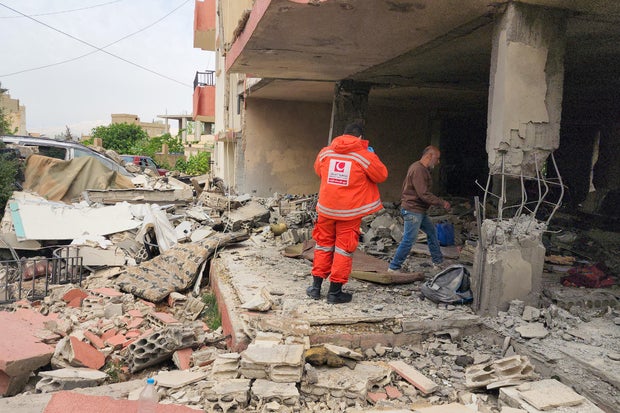
Lebanese President Joseph Aoun, during a meeting with agricultural leaders from the country on Monday, said his government's framework for a wider peace deal with Israel "is based on Israeli withdrawal, a ceasefire, the deployment of the army along the border, the return of displaced persons, and economic or financial aid to Lebanon," according to a statement from his office.
Israeli forces have occupied a significant section of southern Lebanon, along the two countries' shared border, and said residents will not be allowed back to their homes there until the Hezbollah threat is removed.
Iran says it's working with Oman on "mechanism" to ensure safe "transit through the Strait of Hormuz"
Iran says it's in talks with fellow Strait of Hormuz coastal nation Oman "to develop a mechanism" to ensure "transit through the Strait of Hormuz is conducted in the safest possible manner."
Iran has threatened to attack any ships transiting the strait without its permission - and it has rolled out a new domestic "Persian Gulf Strait Authority" which it says will be responsible for coordinating with shipping companies to collect fees for passage.
The regime announced a new account on X Monday that it said the PGSA would use "to provide information on the activities of this organization."
Speaking to reporters in Tehran, Foreign Ministry spokesman Esmaeil Baqaei said Iran was "committed to ensuring that transit through the Strait of Hormuz is conducted in the safest possible manner," and as it "lies within the territorial waters of Iran and Oman," both nations "consider themselves responsible for taking the necessary measures to reassure all countries regarding the safety of maritime transit."
He said Iran was "in continuous contact with Oman and other relevant parties to develop a mechanism capable of fulfilling this responsibility and achieving this objective. Last week, a meeting was held in Muscat between expert-level delegations from Iran and Oman, and contacts between the two countries on this matter are ongoing."
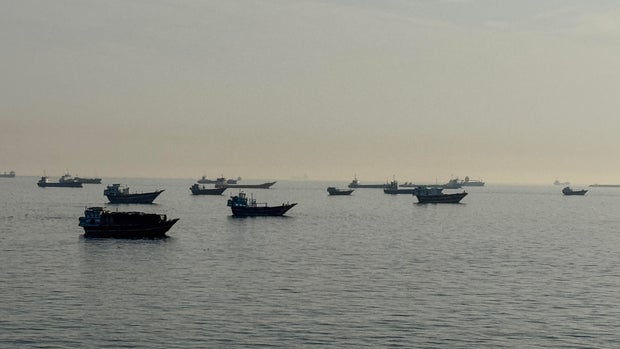
The head of the Iranian parliament's national security commission said Saturday in a social media post that Iran had prepared a plan to "manage traffic" in the strait, under which commercial vessels and parties cooperating with Tehran would be granted passage for "necessary fees."
President Trump told reporters last week during a visit to Beijing that China had offered to help reopen the Strait of Hormuz, but that the assistance wasn't needed. Over the weekend Mr. Trump insisted it is the U.S., not Iran, in control of the vital shipping lanes, despite traffic remaining virtually gridlocked in the strait.
According to a report by Bloomberg, almost two dozen tankers were sitting in and around Iran's main oil export hub of Kharg Island on Monday, which analysts said the Iranian regime had already begun using as a "toll booth" weeks ago.
German leader condemns "renewed Iranian airstrikes" on UAE, says attacks on nuclear facilities threaten "entire region"
Germany's leader Chancellor Friedrich Merz issued a short statement Monday on behalf of the country's government condemning "renewed Iranian airstrikes against the United Arab Emirates and other partners," and calling on Tehran to "enter into serious negotiations with the USA, stop threatening its neighbors, and open the Strait of Hormuz without restrictions."
After a drone strike over the weekend that caused a fire at an Emirati nuclear power plant, which has not been claimed but widely blamed on Iran, Merz said any "attacks on nuclear facilities pose a threat to the safety of people throughout the entire region."
"There must be no further escalation of violence," he said.
Iran says it's pursuing peace "with seriousness," but if attacked again, "will respond with full strength"
Iranian Foreign Ministry spokesman Esmaeil Baqaei said Monday that Tehran is continuing to "pursue diplomacy with seriousness," but that the Islamic Republic "will not be subdued by contradictory behavior and threats from the opposing side."
"We are fully prepared for every scenario," he said, warning that, "in the event of any reckless action we will respond with full strength, and I assure you that our armed forces will definitely have new 'surprises' for the enemy."
Stocks slump, oil prices jump again as markets fear Iran war "re-escalation risks are increasing"
World shares mostly retreated and oil prices jumped Monday after President Trump warned Tehran the "clock is ticking" for a peace deal.
U.S. futures fell and markets in Japan and South Korea pulled back from their records. In early European trading, Britain's FTSE 100 edged up 0.1% to 10,205.31. France's CAC 40 lost 0.9% to 7,883.42, and Germany's DAX dropped 0.1% to 23,925.82.
During Asian trading, Tokyo's Nikkei 225 fell 1% to 60,815.95, a decline led by technology-related stocks. It reached all-time intraday high levels last week above 63,000.
Seoul's Kospi climbed 0.3% to 7,516.04 after trading lower earlier in the day. It crossed the 8,000 mark for the first time on Friday, supported by buying of technology shares driven by the boom in artificial intelligence, but later declined partly on profit-taking by investors.
Hong Kong's Hang Seng lost 1.1% to 25,675.18. The Shanghai Composite index edged 0.1% lower to 4,131.53, after China reported weaker-than-expected economic data for April.
Oil prices rose after Mr. Trump issued his latest warning to Iran in a social media post, saying the regime "better get moving, FAST, or there won't be anything left of them," following a call with Israeli Prime Minister Benjamin Netanyahu.
Brent crude, the international standard, gained 0.7% to $110.05 per barrel early Monday. It was trading at roughly $70 a barrel in late February before the start of the war. Benchmark U.S. crude was trading 1% higher to $106.49 per barrel.
A drone strike over the weekend on a United Arab Emirates' nuclear power plant added to worries over a potential escalation in the conflict.
ING commodities strategists Warren Patterson and Ewa Manthey wrote in a Monday research note that hopes as Mr. Trump visited Beijing last week that China might use its influence over Tehran to "break the deadlock between the U.S. and Iran," were "possibly misplaced."
"If anything, re-escalation risks are increasing," they wrote.
CBS/AP
Iran says it conveyed revised terms for peace deal to U.S., but no discussion yet "regarding nuclear matters"
Iran's government said Monday that indirect diplomacy with the U.S., brokered by Pakistani intermediaries, was "a continuous process" and that it had conveyed its latest positions to Washington as the two sides haggle over terms of a prospective peace deal.
President Trump warned Sunday that "the Clock is Ticking" for Tehran to accept a deal to reopen the Strait of Hormuz and end the war that is now in its 80th day.
"There won't be anything left of them" if Iranian leaders fail to "get moving, FAST" on a peace agreement, Mr. Trump warned.
"Talks and negotiations are a continuous process, not an intermittent one," Iranian Foreign Ministry spokesman Esmaeil Baqaei said Monday.
While Mr. Trump said publicly last week that Tehran's latest proposal had been rejected, Baqaei said Tehran "received from the Pakistani mediator a set of corrective notes and observations from their point of view … which were reviewed over these past days," and he said over the weekend, "our positions were also conveyed to the American side in return."
Baqaei insisted that the talks, from Tehran's standpoint, were focused "on ending the war," and the issue of Iran's "right to [nuclear] enrichment is recognized" as the country is a signatory of the international nuclear non-proliferation treaty.
"We have emphasized that we will not abandon our rights under the Non-Proliferation Treaty," he said. "We have not discussed any details regarding nuclear matters at this stage. At this stage, all focus will be on ending the war."

The Reuters news agency also quoted a Pakistani source as saying Monday that a revised Iranian proposal had been shared with U.S. representatives.
"We don't have much time," the source said, telling Reuters that both sides in the war, "keep changing their goalposts."
Lebanon says Israeli strikes kill 5, including 2 children, as Hezbollah condemns talks
Israeli strikes killed five people including two children in southern Lebanon on Sunday, the Lebanese health ministry said, as Hezbollah called U.S.-brokered talks between the two countries a "dead end."
The Lebanese health ministry published a "preliminary toll" for Israel's strikes on Sunday, with three people killed in the town of Tayr Felsay, including a child, and two killed in the town of Tayr Debba, including another child.
It said 11 people were wounded in those strikes and four more were wounded in strikes in two other southern towns.
The latest exchanges of fire came after envoys from Israel and Lebanon held a third round of negotiations in Washington and agreed to extend the ceasefire, talks that Iran-backed Hezbollah has repeatedly denounced.
"The direct negotiations that the authorities in Lebanon have conducted with the Israeli enemy have ... led them down a dead-end path that will result in nothing but one concession after another," Hezbollah lawmaker Hussein Hajj Hassan said on Sunday.
Trump says "Clock is Ticking" for Iran to agree to a peace deal
President Trump threatened Iran again Sunday as the shaky ceasefire between the two countries continues.
"For Iran, the Clock is Ticking, and they better get moving, FAST, or there won't be anything left of them. TIME IS OF THE ESSENCE!" Mr. Trump wrote on Truth Social.
Screenshots of the post were also shared by the official White House X account.
Iranian foreign minister Abbas Araghchi said Friday that Tehran "cannot trust the Americans at all" and that they are "trying to maintain" the "shaky" ceasefire "to give diplomacy a chance." He described the lack of trust in the U.S. as "the main obstacle to any diplomatic effort."
"Every day brings a different message, sometimes even two different messages in a single day, which deepens mistrust," Aragachi said while speaking at a summit in New Delhi.
Uprising inside Iran still unlikely, former U.S. defense secretary says
Former Defense Secretary Robert Gates said that despite the war in Iran, internal controls in the country "seem very much intact," making it unlikely that a civilian uprising will occur in the near future.
Intense protests related to economic issues broke out in Iran in early 2026, but were harshly quelled. President Trump said tens of thousands of people were killed by the regime. Alleged leaders of those protests have been imprisoned or executed. While Mr. Trump called on the Iranian population to rise up and overthrow its leaders in the early days of Operation Epic Fury, no such efforts have emerged.
"You haven't seen any demonstrations, or very few demonstrations, in the street. People are cowed, they're afraid, and right now they're concerned with how they can eat and live under the current circumstances," Gates said on "Face the Nation with Margaret Brennan."
In an interview that taped Friday and aired Sunday, Gates said that it is possible an uprising will occur after the war ends, but said that protests likely won't lead to regime change.
"What you generally see in regimes like this is not so much a change of regime from the streets, but that the regime itself begins to fracture, and that you have people within the regime who want to take a different tack, and so you have an internal fight for control," Gates said.
Former U.S. defense secretary says U.S. can't "walk away" from Iran war
While diplomatic and military efforts in Iran and the Strait of Hormuz seem to be at a stalemate, the United States can't "walk away" from the conflict, former U.S. Defense Secretary Robert Gates said Sunday.
"I don't think he can walk away," Gates said on "Face the Nation with Margaret Brennan," referring to President Trump. "And no, I don't think the Israelis can settle it. As powerful as they are, they don't have the kind of power the United States has."
In an interview that was taped Friday and aired Sunday, Gates said that while the Trump administration's justifications for the war have shifted, there are a few things "that have been consistent from the very beginning." One main objective, of eliminating Iran's nuclear program, has not been fully achieved, but U.S. and Israeli attacks have "dramatically damaged and set back" the country's efforts to acquire a nuclear weapon, Gates said.
"I don't think that the nuclear program in Iran poses an imminent threat. After all, we bombed it twice," said Gates, who served under former presidents Bush and Obama. Nuclear material has been buried, he said, and the centrifuges that would be needed to enrich it have been "mostly destroyed."
Gates also said that scientists who would have worked on these nuclear projects have been killed. Still, Gates said that likely the only way to completely "bring an end to" Iran's nuclear aspirations "is through a negotiation."
Other stated goals, like eliminating Iran's military capabilities and its ability to support militant groups like Hamas and Hezbollah, have been more successful, Gates said. Still, the Trump administration had "some unrealistic expectations" for when the war might end, Gates said.
"I think it would be hard to say the war is over, I think from either the standpoint of the United States or Israel at this point," Gates said.
Suspicion falls on Iran after drone strike causes fire at UAE nuclear power plant
A drone strike targeted the United Arab Emirates' Barakah nuclear power plant Sunday, setting an electrical generator ablaze on its perimeter and again straining the shaky ceasefire in the Iran war.
No one immediately claimed responsibility for the attack, which caused no radiological release nor injuries, authorities in the UAE's capital, Abu Dhabi, said. However, suspicion immediately fell on Iran, which has been increasingly threatening the UAE over recent days as the country hosted Israeli Iron Dome missile defenses and troops during the war.
The UAE's nuclear regulator said the fire didn't impact the plant safety. "All units are operating as normal," the organization wrote on X.
The UAE statement didn't blame any party for the attack. The Vienna-based International Atomic Energy Agency, the United Nations' nuclear watchdog, said on social media it was "following the situation closely."
The $20 billion Barakah nuclear power plant was built by the UAE with the help of South Korea and went online in 2020. It's the first and only nuclear power plant on the Arabian Peninsula and can provide a quarter of all the energy needs in the UAE. It's also the first commercial nuclear power plant in the Arab world.