U.S. says blockade of Iranian ports "fully implemented" as Trump weighs more talks with Iran
Follow updates on the war in the Middle East for Wednesday, April 15, here. See earlier developments below.
What to know about the Iran war:
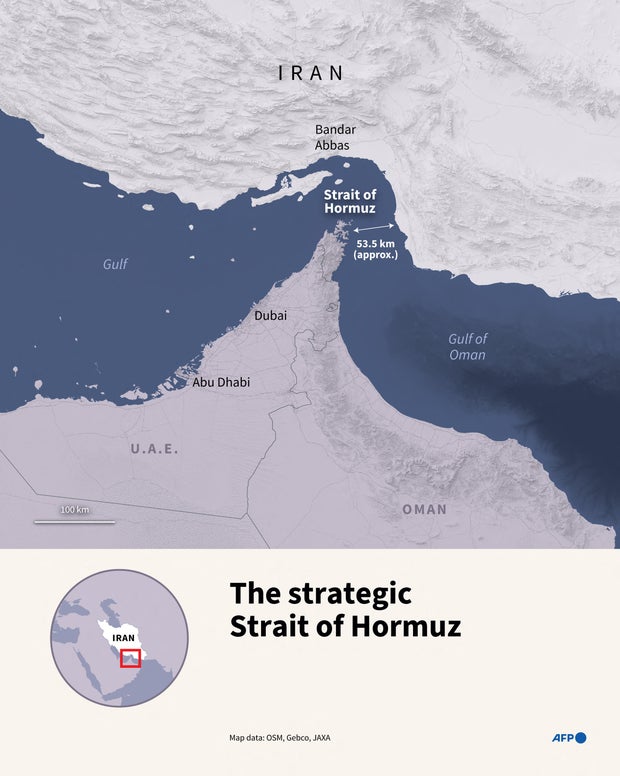
- The U.S. blockade of Iran's ports was "fully implemented" on Tuesday, U.S. Central Command said, as Washington pressures Tehran to relinquish control of the Strait of Hormuz, the critical chokepoint for shipments of oil, fertilizer and other vital commodities. Iran is threatening to retaliate and has said no Gulf ports will be safe if the blockade continues.
- Pakistan is attempting to arrange a second round of U.S.-Iran peace talks after last weekend's marathon session in Islamabad ended without an agreement. The war is now in its seventh week. A two-week truce is set to expire Tuesday.
- Mr. Trump said in an interview that the next round of talks could take place "over the next two days."
- Lebanese and Israeli officials met in Washington, D.C., Tuesday for the first direct diplomatic talks between the two countries since 1993. Secretary of State Marco Rubio took part in the session, which resulted in an agreement to "launch direct negotiations," the countries said in a joint statement.
Trump criticizes pope and NATO again
Among a series of posts on his Truth Social platform overnight, President Trump continued disparaging Pope Leo and NATO.
In one post, he asked, "Will someone please tell Pope Leo that Iran has killed at least 42,000 innocent, completely unarmed, protesters in the last two months, and that for Iran to have a Nuclear Bomb is absolutely unacceptable."
The pontiff has panned the administration's actions in Iran, among other things, and the president has taken exception.
The administration says ending Tehran's nuclear program is one of its key goals in the war with Iran. Rights groups say the Iranian regime killed tens of thousands of people who took to the streets to demonstrate against the Iranian regime earlier this year.
In another post, the president repeated his frequent characterization of the actions of other NATO nations during the war, saying, "NATO wasn't there for us, and they won't be there for us in the future!"
Pakistan keeping pressure on for new U.S.-Iran talks
Pakistan Prime Minister Shehbaz Sharif will travel to Saudi Arabia, Qatar and Turkey this week during a diplomatic push to secure a new round of talks between the United States and Iran, Pakistan's Foreign Ministry said in a statement.
The trip comes days after Islamabad hosted marathon negotiations last weekend that ended without a formal agreement.
Sharif is attempting to facilitate a second round before a fragile ceasefire expires next week.
The ministry said the visits will start Wednesday and conclude on Saturday.
President Trump said Tuesday in clips of an interview set to air Wednesday on Fox Business Network that the war "is very close to over," and he told the New York Post Tuesday that a second round of talks with Iran "could be happening over next two days," in Islamabad again.
Late Tuesday night, ABC News Chief Washington correspondent Jonathan Karl said on social media that Mr. Trump "told me today he isn't thinking about extending the ceasefire. He doesn't think it will be necessary."
Karl quoted the president as saying, "I think you're going to be watching an amazing two days ahead. I really do."
CBS/AP
CENTCOM says blockade of Iranian ports is "fully implemented"
In a statement Tuesday night, U.S. Central Command said a blockade of Iranian ports "has been fully implemented as U.S. forces maintain maritime superiority in the Middle East."
"An estimated 90% of Iran's economy is fueled by international trade by sea," Adm. Brad Cooper, CENTCOM commander, said in the statement. "In less than 36 hours since the blockade was implemented, U.S. forces have completely halted economic trade going into and out of Iran by sea."
U.S. destroyer interdicts 2 oil tankers in the Strait of Hormuz, U.S. official tells CBS News
A U.S. destroyer interdicted two oil tankers on Tuesday in the Strait of Hormuz, a U.S. official confirmed to CBS News.
The official said the two ships were part of the six merchant vessels U.S. forces told to turn back to an Iranian port on the Gulf of Oman in the initial 24 hours of the blockade. Reuters was first to report on the interdiction.
In that same timeframe, more than 20 other ships not from Iranian ports transited safely through the strait, the U.S. official said.
Trump tells Fox he views Iran war "as very close to over"
In a clip released Tuesday night, President Trump told Fox Business' Maria Bartiromo he views the war with Iran "as very close to over."
During the interview, which Fox says will air Wednesday on "Mornings with Maria," Bartiromo asks Mr. Trump, "Well, you keep saying 'was.' Is this war over?"
"I think it's close to over, yeah. I mean, I view it as very close to over," the president said.
"You know what? If I pulled up stakes right now, it would take them 20 years to rebuild that country. And we're not finished, we'll see what happens. I think they want to make a deal very badly," Mr. Trump said of Iran.
Vance on Iran: "I feel very good about where we are"
Vice President JD Vance expressed optimism about the Trump administration's talks with Iran in a Turning Point USA event on Tuesday and suggested he's going to keep pursuing diplomatic efforts, after the vice president returned from negotiations in Pakistan without a deal in hand.
Vance told the audience that negotiators "made a ton of progress" in Pakistan over the weekend. But he said President Trump is not looking for a "small deal" with Iran, and instead wants to strike a "Trumpian grand bargain."
The president is seeking to block Iran from building a nuclear weapon or sponsoring U.S.-recognized terrorist groups, Vance said, in exchange for allowing the Iranian people to "thrive and prosper and join the world economy" — likely a reference to lifting sanctions.
"I'm going to keep on fighting to make it happen," Vance said.
Vance also said there was some "mistrust" between the U.S. and Iran, but his sense was that Iranian negotiators "wanted to make a deal" and he plans to keep negotiating in good faith.
"I feel very good about where we are," the vice president said.
Pakistani official says "our leadership is not giving up" as U.S. and Iran look to continue talks
Pakistan Finance Minister Muhammad Aurangzeb said Tuesday in an interview with The Associated Press that "our leadership is not giving up" on its efforts to help the U.S. and Iran negotiate. He noted the talks marked the first direct discussion between the two nations in nearly 50 years.
"We would very much like to see if we can continue to pursue the dialogue," he added, speaking on the sidelines of the spring meetings of the International Monetary Fund and World Bank. "We'll keep at it, and our leadership is at it."
Aurangzeb said he also this week met with U.S. officials, including Trade Representative Jamieson Greer and Commerce Secretary Howard Lutnick to discuss trade and finance concerns. He plans to meet Treasury Secretary Scott Bessent on Friday.
In a phone call with The New York Post, President Trump said Tuesday a second round of talks with Iran "could be happening over the next two days."
Indian ship captain stuck in Persian Gulf since Iran war: "We are collateral victims"
An Indian ship captain who has been stuck in the Persian Gulf since the war with Iran began at the end of February tells CBS News he and his crew are "collateral victims" in the conflict over the Strait of Hormuz.
"We are collateral victims here … That's the very sad part because we are just sailors. We are just seafarers. We are not trained for war or war-like situations," Captain Raman Kapoor said.
Kapoor said he and his crew are concerned about their safety, but said what's more concerning to them is the uncertainty of the situation. The captain told CBS News he has been requesting relief from his company.
"As a captain, if I want to get down from a ship, I should be relieved by some other captain," Kapoor said. "I cannot just leave the vessel and go. Who would agree to come and relieve me in this particular zone? Nobody."
Israeli ambassador says Israel and Lebanon are "on the same side of the equation" after talks
Following historic direct talks between Israel and Lebanon, the two countries' ambassadors to the U.S. issued separate statements on what they discussed and will continue to discuss in future direct negotiations.
Israeli Ambassador to the U.S. Yechiel Leiter hailed what he called a convergence of opinion about removing Hezbollah's influence from Lebanon, saying he was encouraged by a "wonderful exchange."
"The Lebanese government made it very clear that they will no longer be occupied by Hezbollah," he said. "Iran has been weakened. Hezbollah is dramatically weakened. This is an opportunity."
"We discovered today that we're on the same side of the equation. That's the most positive thing we could have come away with," Leiter said. "We are both united in liberating Lebanon from an occupation power dominated by Iran called Hezbollah."
Lebanese Ambassador to the U.S. Nada Hamadeh Moawad "reaffirmed the urgent need" for an end to the Israel-Hezbollah conflict, "underscoring the principles of territorial integrity and full state sovereignty." She also called for a ceasefire, the return of displaced people to their homes and "concrete measures to address and alleviate the severe humanitarian crisis" resulting from the conflict.
The date and location of the next meeting will be announced when appropriate, she said.
CBS/AP
White House says 103 empty vessels heading to American ports to load U.S. oil
More than 100 empty oil tankers are on their way to U.S. ports to load American crude, the White House said Tuesday.
Boasting record-breaking energy production, the White House said the U.S. is "providing a critical lifeline to the world" amid a global gas and oil crisis triggered by the war with Iran.
Of the 103 empty vessels, 54 are Very Large Crude Carriers capable of transporting approximately two million barrels, the Trump administration said.
Among them were "20 empty tankers under European flags and 20 under Asian flags" that had "recently unloaded elsewhere," the White House said.
In a Truth Social post on Saturday, President Trump said "massive numbers" of empty oil ships were on their way.
"We have more oil than the next two largest oil economies combined - and higher quality. We are waiting for you," he said.
The U.S. is the world's largest crude producer, with an output of 13 million barrels per day before the war began, according to the Energy Information Administration (EIA). It exports roughly 11 million barrels of oil daily, and imports 8 million, making the U.S. a net oil exporter.
Alain Sherter contributed to this report.
Israel and Lebanon agree to "launch direct negotiations" following D.C. meeting, U.S. State Department says
Israel and Lebanon have agreed to "launch direct negotiations" following a U.S.-brokered diplomatic meeting in Washington, according to the State Department.
"The participants held productive discussions on steps toward launching direct negotiations between Israel and Lebanon," U.S. Department of State spokesperson Tommy Pigott said in a statement.
It was not clear when these negotiations would begin or where they would take place, with Pigott saying only that they would occur "at a mutually agreed time and venue."
"The United States affirmed that any agreement to cease hostilities must be reached between the two governments, brokered by the United States, and not through any separate track," the statement said.
U.S. asked Iran to suspend nuclear enrichment for at least 20 years, source tells CBS News
During the U.S.-Iran talks in Pakistan over the weekend, American diplomats suggested a 20-year suspension of Iranian nuclear enrichment, at a minimum, a U.S. official told CBS News.
The United States' request was coupled with "all kinds of other restrictions," according to the official.
As CBS News previously reported, the U.S. and Iran did not reach agreements on several of Washington's red lines — which include Iran ending uranium enrichment, dismantling major nuclear enrichment facilities, allowing the retrieval of its highly enriched uranium and fully opening the Strait of Hormuz without charging passage tolls.
At least 3 ships cross strait despite blockade, tracker shows
At least three ships sailing from Iranian ports crossed the Strait of Hormuz despite the U.S. military blockade, but some vessels taking the route later turned back, maritime tracking data indicated Tuesday.
They were among at least seven Iran-linked vessels that passed through the strait after Washington's blockade came into effect on Monday, according to maritime data provider Kpler.
The Liberia-flagged bulk carrier Christianna crossed the strait after unloading 74,000 tons of corn at the Iranian port of Bandar Imam Khomeini in the Gulf, passing Iran's Larak Island in the strait around 1600 GMT on Monday, Kpler data showed.
A second ship, the Comoros-flagged tanker Elpis, was near Larak Island around 1100 GMT and cleared the strait about 1600 GMT. It was loaded with 31,000 tons of methanol, having left the Iranian port of Bushehr in the Gulf on March 31, Kpler data showed.
"While a ceasefire and the U.S. naval blockade are now in place, flows had already slowed significantly as operators avoided transits amid security concerns," Kepler noted in a social media post Tuesday, adding: "For now, the operating environment remains high risk, limiting any meaningful recovery in flows."
U.N. chief: "Highly probable" that U.S.-Iran talks will restart
U.N. Secretary-General Antonio Guterres said it is "highly probable" that U.S.-Iran talks will restart. He said that was the indication he had after a meeting Tuesday with Pakistan's Deputy Prime Minister Ishaq Dar, who is also the country's foreign minister.
The U.N. secretary-general expressed "enormous admiration" for Pakistan's initiative to bring peace to the Middle East.
"I consider it essential that these negotiations go on," Guterres told U.N. reporters, explaining that it would be "unrealistic" for long-lasting and complex problems between the U.S. and Iran to be resolved in a first negotiating session.
"We need negotiations to go on, and we need a ceasefire to persist as negotiations go on," the secretary-general said.
U.S. offers $10 million for info on Iraqi militia leader
The U.S. State Department is offering a $10 million reward for information on Ahmad al-Hamidawi, the leader of Kata'ib Hezbollah.
The State Department said in a post on X Tuesday that the Iran-backed militia is "responsible for attacks on U.S. diplomatic facilities in Iraq, the kidnapping of U.S. citizens, and the killing of innocent Iraqi civilians."
"Help us stop the violence. Help us stop al-Hamidawi. Send us your tip," the State Department said.
Kata'ib Hezbollah kidnapped American journalist Shelly Kittleson in Iraq two weeks ago. She was freed a week later.
399 U.S. service members wounded in Iran war, military says
Nearly 400 U.S. service members have been wounded during the Iran war.
As of Tuesday, 399 service members had been wounded in action, according to a U.S. Central Command spokesperson. Of those, 354 have returned to duty. Three are currently considered seriously wounded.
The military said over a week ago that as of Monday, April 6, 373 service members had been injured. That figure should have been 381, according to the spokesperson, and the increase is because of delayed symptoms and reporting of traumatic brain injuries.
Hezbollah says it targeted 13 north Israel towns as talks start
Hezbollah on Tuesday said it targeted 13 northern Israeli towns with rockets shortly after the start of Lebanese-Israeli talks in Washington.
The group said in a statement it targeted Kiryat Shmona, Metula and 11 other towns "with simultaneous rocket salvos" at 6:15 p.m. local time.
The Israeli military had warned it expected a rise in Hezbollah attacks as Washington hosted Israeli and Lebanese officials for their first direct diplomatic talks in decades.
Trump says developments "could be happening" over the next 2 days in Pakistan
Further movement on U.S.-Iran peace talks "could be happening over the next two days" in Islamabad, Pakistan, President Trump told the New York Post Tuesday.
Mr. Trump said in a phone call with the publication that talks were happening "a little bit slow." But the Post reported that the president called back 30 minutes later with an update.
"You should stay there, really, because something could be happening over the next two days, and we're more inclined to go there," he said of Islamabad.
Blockade being enforced from Gulf of Oman, U.S. official says
A U.S. official says the blockade on Iran's ports is being enforced from the Gulf of Oman, which means ships can get through the Strait of Hormuz but not far past it.
The Gulf of Oman lies to the east of the Strait and opens to the Arabian Sea.
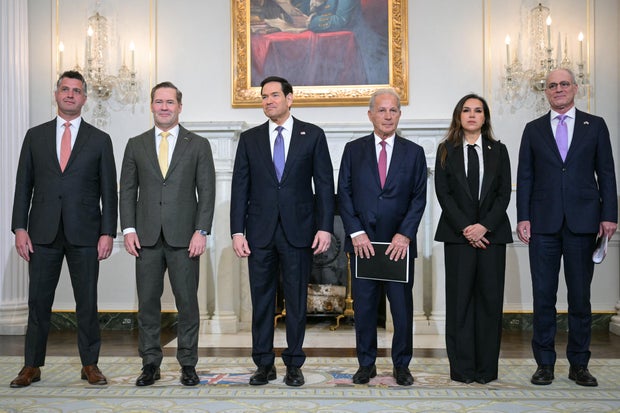
Rubio at start of Israel-Lebanon talks: "This is a process, not an event"
Secretary of State Marco Rubio spoke briefly at the top of talks Tuesday between Israel and Lebanon, flanked by the meeting participants in the Benjamin Franklin room at the State Department. He framed the talks as going beyond an effort to reach a ceasefire.
"This is a process, not an event," Rubio said. "This is more than just one day. This will take time, but we believe it is worth this endeavor, and it's a historic gathering that we hope to build on."
"This is a historic opportunity," he said. "We understand we're working against decades of history and the complexities that have led us to this unique moment and the opportunity here."
Rubio was pictured alongside State Department Counselor Mike Needham, U.S. Ambassador to the U.N. Mike Waltz, U.S. Ambassador to Lebanon Michel Issa, Lebanese Ambassador to the U.S. Nada Hamadeh and Israeli Ambassador to the U.S. Yechiel Leiter.
Lebanon's president hopes Israel talks mark "beginning of the end" of suffering
Lebanon's president expressed hope that direct talks with Israel on Tuesday in Washington would lead to an end of his country's suffering after war erupted again between Israel and Hezbollah last month.
"I hope that the meeting in Washington... will mark the beginning of the end of the suffering of the Lebanese people in general, and those in the south in particular," President Joseph Aoun said in a statement, adding that "stability will not return to the south if Israel continues to occupy its lands".
"The only solution lies in the Lebanese army re-deploying up to the internationally recognized border, and so being solely responsible for the security of the area and the safety of its residents, without the partnership of any other party," Aoun added.
His statement came as Israel's military warned that Hezbollah could increase attacks as talks begin.
"Following a situational assessment, and as part of recent developments, an increase in fire from Lebanon is possible, likely targeting northern Israel," the Israel Defense Forces said Tuesday.
Over 10,000 U.S. service members involved in blockade of Iran ports, CENTCOM says
Over 10,000 U.S. service members are executing the U.S. blockade of Iran's ports, according to U.S. Central Command, which said no ships made it past the blockade in the first 24 hours.
The blockade of Iran's ports and a partial blockade of the Strait of Hormuz, a chokepoint for shipments of oil, fertilizer and other vital goods, began at 10 a.m. ET on Monday.
The U.S. military said Tuesday morning that six merchant vessels "complied with direction from U.S. forces to turn around to re-enter an Iranian port on the Gulf of Oman."
"The blockade is being enforced impartially against vessels of all nations entering or departing Iranian ports and coastal areas, including all Iranian ports on the Arabian Gulf and Gulf of Oman," CENTCOM said. "U.S. forces are supporting freedom of navigation for vessels transiting the Strait of Hormuz to and from non-Iranian ports."
The U.S. service members who are carrying out the mission include sailors, Marines and airmen. More than a dozen warships and over 100 surveillance and fighter aircraft are involved, according to the military.
U.S. treasury secretary says economic pain "worth taking"
As the Iran war drives up the cost of energy around the world, U.S. Treasury Secretary Scott Bessent told a group of reporters Tuesday that "a small bit of economic pain for a few weeks is worth taking off the incalculable tail risk of either a nuclear Iran or a nuclear Iran that uses that weapon."
Asked about the impact of soaring gas prices on consumers, Bessent said "there is nothing more transient than what we are seeing now."
"So the conflict will end, prices will come down, and then headline inflation will come down, and with that, gasoline prices will come down," Bessent said.
The average price for a regular gallon of gas in the U.S. was $4.12 on Tuesday, according to AAA.
17 nations call for Lebanon to be included in de-escalation efforts
The foreign ministers of the U.K., Australia, France, Sweden and other countries called on Tuesday for Lebanon to be included in regional de-escalation efforts, and said they welcome direct talks between Lebanon and Israel.
"Direct negotiations can pave the way to bring lasting security for Lebanon and Israel as well as the region," the foreign ministers said in a joint statement. "We stand ready to support them. We therefore call upon all parties to urgently deescalate and seize the opportunity offered by the ceasefire between the United States and Iran."
The foreign ministers – also from Belgium, Croatia, Cyprus, Denmark, Finland, Greece, Iceland, Luxembourg, Malta, Norway, Portugal, Slovenia and Spain – condemned Hezbollah's attacks against Israel, as well as the wave of Israeli strikes on Lebanon last Wednesday that killed hundreds of people.
They also said they "commend the decision of the Lebanese government to ban Hezbollah's military activities, as well as its decision to reinforce the full imposition of state authority over Beirut and to have the sole monopoly on weapons, and we encourage full and swift implementation."
Italy suspends military partnership with Israel
Italian Premier Giorgia Meloni said Tuesday that her government has suspended the automatic renewal of a defense agreement with Israel, citing "the current situation."
The agreement, ratified in 2005, includes ongoing cooperation between the two countries' defense ministries and armed forces. It is automatically renewed every five years.
Meloni and other Italian government officials have strongly condemned Israel's air and bombing campaign in Lebanon, which has hit civilians as well as an Italian convoy that is part of a U.N. peacekeeping force.
House Republicans postpone hearing with military leaders on Iran war
House Republicans on the Armed Services Committee postponed a planned hearing with senior Pentagon officials testifying on the Iran war, pushing the session from April 21 to May 19, a source familiar with the planning confirmed.
The hearing was set to include Adm. Brad Cooper and Gen. Dagvin R.M. Anderson.
It is unclear whether a separate Senate hearing scheduled for April 23 with the same officials will take place.
The delay was first reported by The New York Times.
IMF cuts Mideast, North Africa economic growth forecast to 1.1%
The International Monetary Fund sharply reduced its 2026 growth forecast for the Middle East and North Africa to 1.1% on Tuesday as war chokes Gulf oil and gas exports.
Iran, Iraq and Qatar will be particularly hard-hit, the IMF's World Economic Outlook warned, predicting a 6.1% slide for the Iranian economy. Qatar was tipped to drop 8.6% and Iraq 6.8%.
Growth should rebound next year, as long as energy production and transport are "normalized" over the next few months, the IMF predicted. The region's economies grew 3.2% in 2025, it said.
Iran's interior minister orders border governors to counter maritime blockade threats
Iran's Interior Minister Eskandar Momeni said Tuesday that any attempts at sanctions or maritime blockade "will lead nowhere," Iranian state television reported.
Momeni instructed governors of border provinces to make full use of their delegated special powers to "neutralize the threat" of a maritime blockade and ensure that adversaries fail on this front as well.
No further details were provided on how provincial authorities are expected to counter or mitigate the blockade threat.
Israel says it wants "peace and normalization" with Lebanon ahead of talks in Washington
Israel's Foreign Minister Gideon Saar said his country is seeking "peace and normalization" with Lebanon, as the two countries prepared to meet later Tuesday in Washington for their first direct talks in decades.
"We want to reach peace and normalization with the state of Lebanon," Saar said at a press conference. "Israel and Lebanon don't have any major disputes between them. The problem is Hezbollah," the Iran-backed militant group whose opposition is dampening hopes of any breakthrough at the talks.
Israel's ongoing military campaign in Lebanon is threatening to derail the fragile US-Iranian ceasefire agreement announced a week ago.
Macron calls for resumption of U.S.-Iran ceasefire talks
French President Emmanuel Macron said he spoke with President Trump and Iranian President Massoud Pezeshkian on Monday, and "urged the resumption of the negotiations suspended in Islamabad, the clearing up of misunderstandings, and the avoidance of any further escalation."
In a social media post, Macron said he deemed it essential for the ceasefire to include Lebanon and for the Strait of Hormuz to be reopened unconditionally.
"Under these conditions, negotiations should be able to resume quickly, with the support of the key parties concerned," Macron said.
Macron said France and the U.K. would host a conference in Paris on Friday for "non-belligerent countries ready to contribute, alongside us, to a multilateral and purely defensive mission aimed at restoring freedom of navigation in the strait when security conditions allow."
"The Islamic Republic of Iran is ready to continue talks solely within the framework of international laws and regulations and with the aim of protecting the rights of the Iranian people. And Europe can play a constructive role in encouraging the United States to adhere to these frameworks," Pezeshkian told Macron, according to an Iranian readout of the call.
Israel says 10 soldiers wounded in fighting in key Lebanese town
The Israeli military said Tuesday that overnight clashes between Israeli soldiers and Hezbollah militants left 10 soldiers wounded in the strategically significant southern Lebanese town of Bint Jbeil, which Israeli forces have encircled.
The escalation of fighting in the town comes as Israeli and Lebanese officials were to hold talks in Washington Tuesday aimed at ending the war.
According to the military, Israeli troops have now fully surrounded the town, marking a notable advance in their ongoing ground offensive in southern Lebanon.
On Monday, the military said its forces killed more than 100 Hezbollah fighters in and around the town over the past few days.
Just three miles from the Israeli border, Bint Jbeil has long been both a symbolic and strategic flashpoint in confrontations between Israeli forces and Hezbollah.
The Israeli military also said Tuesday that a soldier had been killed in combat in southern Lebanon, the first since a U.S.-Iran truce went into effect -- a truce that Israel insists doesn't include the country where it's fighting Tehran-backed Hezbollah.
CBS/AFP
Iran says war reparations among issues raised in talks with U.S. in Islamabad
Iranian government spokesperson Fatemeh Mohajerani told Russian media that one of the topics discussed in talks with the United States in Islamabad last weekend was the issue of war reparations, Iran's state news agency IRNA reports.
She said Iranian economic officials are assessing the extent of the damage from attacks, noting that losses must be evaluated on multiple levels.
According to Mohajrani, some damage is the physical destruction of buildings while other damage stems from the shutdown or disruption of oil and petrochemical production facilities.
Iran has been charging vessels it lets through the Strait of Hormuz a fee as one way of raising revenue.
But now the U.S. is blockading traffic through the strait that comes from Iranian ports, effectively cutting off both oil revenue and transit income.
Iran-linked vessels appear to transit Strait of Hormuz despite U.S. blockade, tracking data shows
Tracking data appears to show a number of Iran-linked ships passing through the Strait of Hormuz in the hours after the U.S. blockade of the waterway began on Monday.
The U.S. military said its blockade would apply to "all maritime traffic entering and exiting Iranian ports," but that it would "not impede freedom of navigation for vessels transiting the Strait of Hormuz to and from non-Iranian ports."
One ship that crossed the strait after the blockade began on Monday - the Christianna - had previously been stopped at the Iranian port of Bandar Imam Khomeini, data shows.
Another ship, the Ladonna, had been at Bandar Imam Khomeini for a week before turning on its transponder Tuesday and journeying into the Persian Gulf.
The Murlikishan, which is under U.S. sanctions over its connections to Iran, journeyed west through the strait overnight, tracking data shows, along with another tanker, the Peace Gulf, which is not sanctioned by the U.S. but made a port call in Iran in December 2025.
The Rich Starry, a tanker that is sanctioned by the United States under a different name, sailed through the strait overnight Monday, while the Elpis, another sanctioned tanker, sailed through the strait after the blockade began, having apparently come from the Iranian port of Bushehr, according to tracking data.
CBS News cannot confirm that the ships have not been broadcasting false location reports - called spoofing - to conceal their true whereabouts.
Vance says "ball is in the Iranian court"
Vice President JD Vance told Fox News in an interview Monday that the U.S. made its red lines clear in talks with Iran, and that it's now up to Tehran to take action.
"I really think the ball is in the Iranian court, because we put a lot on the table. We actually made very clear what our red lines were," Vance said.
Vance said the U.S. is willing to be accommodating, but Iran cannot have the ability to enrich uranium and that the "nuclear dust" needs to be removed from Iran, preferably by the U.S. Another red line is nuclear weapons, the vice president said.
"It's one thing for the Iranians to say that they're not going to have a nuclear weapon. It's another thing for us to put in place the mechanism to ensure that's not going to happen," Vance said.
On the Strait of Hormuz, Vance said there's been an "uptick in traffic coming through the strait," but that it hasn't been fully reopened. The vice president added that if the Iranians don't make progress on the vital waterway, it will "change the negotiation."
Vance also said Iran "tried to move the goalposts" on the strait during the talks in Pakistan. He said the U.S. now has the cards, militarily and economically, in the Strait of Hormuz, and it's up to the Iranians to decide how they're going to move forward.
CBS/AFP
Rubio to participate in Israel-Lebanon talks Tuesday
Secretary of State Marco Rubio will be participating in the Israel-Lebanon talks that are scheduled to be held Tuesday in Washington, D.C., CBS News has confirmed.
The Israeli and Lebanese governments are engaging in direct, high-level diplomatic talks – the first such talks since 1993 – brokered by the U.S., a State Department official said.
CBS News previously reported on this upcoming meeting, with two sources familiar with the matter and one Lebanese official saying they'll be led by U.S. Ambassador to Lebanon Michel Issa along with Lebanese Ambassador Nada Hamadeh Moawad and Israeli Ambassador Yechiel Leiter. The State Department official told CBS News Monday that Issa, Leiter and Hamadeh would be participants in tomorrow's meeting.
Shortly after Israel and the U.S. began the war with Iran, Hezbollah fired rockets into Israel in a show of solidarity with Tehran. Israel then launched a new offensive against Hezbollah, and invaded much of southern Lebanon.
The White House and Israel's government say Lebanon was never part of the two-week ceasefire with Iran announced last week.
Hezbollah's leader urges Lebanon to cancel Israel talks in Washington
Hezbollah leader Naim Qassem on Monday urged Lebanon to cancel a planned meeting with Israel in Washington, reiterating his group's rejection of direct negotiations with Israel.
"We call for a historic and heroic stance by canceling this negotiating meeting," Qassem, whose Iran-backed terrorist group has been at war with Israel since March 2, said in a televised address.
The Lebanese and Israeli ambassadors to the United States are scheduled to meet on Tuesday.
U.S. blockade of Iran ports threatens already crippled oil supply
Washington's decision to blockade Iranian ports on the Strait of Hormuz is sending tremors through global energy markets, raising fears of a fresh oil shock by threatening supplies to Asia.
Iran had continued to pump crude to Asia since the start of the Middle East war, partly shielded by its elusive "dark fleet."
Roughly one-fifth of the world's oil normally flows through the vital waterway. Iran has already tightened the screws in recent weeks, sharply slowing maritime traffic.
Now, the blockade of Iran's ports ordered Sunday by President Trump threatens to land another blow to global oil and gas supplies after the fighting damaged energy facilities in the Gulf states and blocked their exports through the strait, said Amir Handjani of the U.S.-based Quincy Institute for Responsible Statecraft.
Just days after launching the war against Iran along with Israel on Feb. 28, the U.S. temporarily eased some sanctions on Tehran to prevent an abrupt energy shock — particularly for Asian economies.
Iranian crude had been helping to meet demand so far, Handjani told AFP, but he warned that the blockade now threatens that fragile balance.
"What is the U.S. Navy going to do? They're not going to confront Chinese, Indian and Pakistani merchant ships" loading in Iranian ports, he said. "That's an act of war."
China remains the world's largest importer of Iranian crude, and on Tuesday Beijing called the U.S. blockade "dangerous and irresponsible."
Oil prices, already climbing, will continue to surge, Handjani predicted.
Russia's oil export revenues nearly doubled during Iran war, IEA reports
Russia nearly doubled its earnings from oil exports in March as Moscow was granted sanctions relief in a bid to offset soaring energy prices during the war in the Middle East, the International Energy Agency said Tuesday.
The country earned $19 billion last month as crude and oil product exports rose to 7.1 million barrels per day, an increase of 320 thousand barrels a day from February levels.
The United States eased some restrictions on sales of Russian crude imposed over its war against Ukraine, allowing countries to purchase oil that was already at sea until April 11.
Trump tells CBS News Pope Leo should stay out of politics following Iran war criticism
President Trump told CBS News senior correspondent Norah O'Donnell on Monday that Pope Leo is "wrong on the issues" after previously lashing out at the pontiff late Sunday, calling him "WEAK on Crime, and terrible for Foreign Policy" in a lengthy Truth Social post.
In a phone interview, Mr. Trump confirmed that he had watched "60 Minutes," which highlighted Pope Leo's disapproval of mass deportations and the Iran war, before firing off the post. When asked if he plans to call the pope directly, Mr. Trump gave a firm "no."
"He's wrong on the issues," Mr. Trump said of Pope Leo. "I don't think he should be getting into politics. I think he probably learned that from this."
Mr. Trump also said he wasn't sure whether Pope Leo, the first U.S.-born pontiff, would visit the U.S. during his presidency. "I have no idea," he said. "It's up to him, not up to me."
-Keith Sharman, Callie Teitelbaum, Roxanne Feitel