Westmoreland County community "powdered" by dust from quarry, raising health concerns
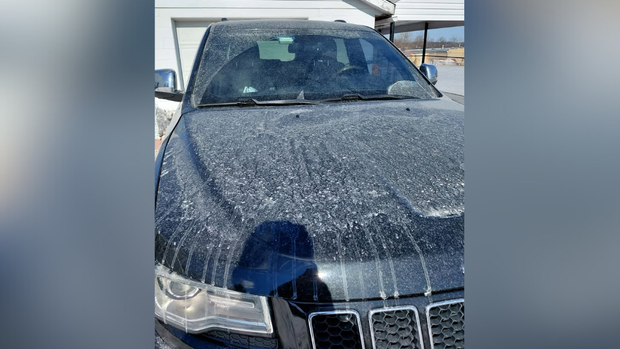
From freshly washed cars to air conditioning units to entire porches, dust is blanketing one Westmoreland County neighborhood.
Charlie Sherba is in a constant battle with dust from the nearby quarry. He says even his black cat Jessie comes back inside looking gray.
"Basically, you get up one morning, and it's like somebody just powdered everything with dust," Sherba said.
He says the Derry Stone SMT site opened a new crushing facility a few years back. Its website says it's "mostly sandstone with whitish grey color that is now state approved."
The site adds that it will save on fuel by hauling the stone a shorter distance to the plant, since this spot is closer to the mine pit. But Sherba now thinks it's too close — about 1,000 feet from his and his neighbors' backyards.
"We're left to deal with it," Sherba said.
Bill Feldbusch lives on Isabella Street, right at the border of Westmoreland County, across the river from Blairsville.
"We don't know how hazardous the dust is for us," he said.
"We're just a small community and a few houses and stuff, but we're people too," he added.
With the sandstone dust not easing up, they started calling doctors and getting lung X-rays.
"You have trouble breathing. If I'm outside in the summer cutting grass, or he's cutting grass, by the end of the evening, you can hardly breathe," Sherba said.
Expert weighs in on potential health effects
KDKA Investigates asked Dr. Bob Cohen, a professor at the University of Illinois's School of Public Health, about the potential health effects of this dust.
"Actually, what we tell people is that the dust that you can't see is the stuff that's the most dangerous, because the smaller particles, the really, really fine stuff, is very hard to see with the naked eye," he said.
Cohen treats workers who breathed in high amounts of this material in the mines for decades, causing irreversible damage. But he says these neighbors should do everything they can to control the dust, keep it out of their homes and prevent overexposure.
"The number one thing is prevention, prevention, prevention," Cohen said. "Because when people develop these diseases, they're untreatable. We can't cure them. We can't reverse them. I've had a number of patients occupationally exposed who've gone to lung transplant. So we have to prevent these diseases."
Quarry offers to meet with residents
KDKA Investigates stopped by the quarry, hoping to ask what management is doing to control the dust. Its attorney Joseph Bucci reached out in response, saying it'll gladly meet with the impacted residents to talk about how the quarry can address their concerns.
"Derry Stone has always operated its facilities in compliance with applicable regulations and laws and submits to regular inspections to confirm its compliance, which has always been achieved as determined by the authorities exercising jurisdiction over our quarry," the statement said.
Neighbors say the quarry also kept operating this winter without working sprinklers. They showed alleged text messages where the quarry manager said the water lines froze, but they would turn the water back on shortly.
Dust leaves questions for DEP
KDKA asked the Pennsylvania Department of Environmental Protection whether that constitutes a violation, and what the quarry's permit requires to keep the dust down. KDKA also sent a list of 10 questions about the quarry's inspection records, air quality monitoring, and dust suppression measures.
The DEP replied, saying it could not answer the questions by airtime, saying the office has been "very busy" with the secretary's budget hearings last week and this week.
Cohen says the medical evidence is clear.
"They can cause a lot of inflammation in the lungs, they can cause scarring of the lungs," Cohen said. "Silica also causes obstructive lung disease that is like chronic bronchitis and emphysema, and sadly, it's a human carcinogen. It's a Class IARC human carcinogen. So silica is a pretty nasty dust when you talk about all the dust."
These neighbors say they just want to see action to protect their health.
"Better control, like dust screens," Feldbusch said.
"They make curtains, I've looked it up myself," said Sherba. "Out in the Midwest, they use these screens to contain the dust. I can't see why they can't do it here."