It's hot in Pittsburgh, but it won't hit 100 degrees. Here's why we rarely see triple digits.

Pittsburgh is in the middle of a heat wave, and while temperatures will be high and the humidity will be stifling, it's not likely the area will hit 100 degrees.
Since record-keeping began in 1875, the available records show Pittsburgh has only hit 100 degrees or greater 21 times. The most recent occurrences were July 16, 1995, and three times during the summer of 1988.
North Platte, Nebraska, is roughly about the same latitude as Pittsburgh but has managed to hit 100 degrees or greater the same number of times as Pittsburgh since August 3, 2022. Why does North Platte, Nebraska, hit triple digits more frequently than Pittsburgh, despite both being at the same latitude? It's all about topography and land surface.
How is the earth's atmosphere heated?
The sun does not warm the air directly. Air is a poor conductor of incoming solar radiation. The sun's energy reaches the ground, which then warms the air through the process of conduction and convection.
At the earth's surface, the energy budget or balance is made up of three components: 1) conduction from the soil; 2) sensible heat; 3) latent heat flux. Conduction involves a direct transfer of heat from the soil or ground with the layer of air nearest to the surface.
This is why standard air temperature is measured at 2 meters or 6.5 feet above ground level. Convection involves turbulent eddies of warm air rising from the ground into the atmosphere above, and latent heat involves the absorption or release of energy from a phase change without the temperature changing.
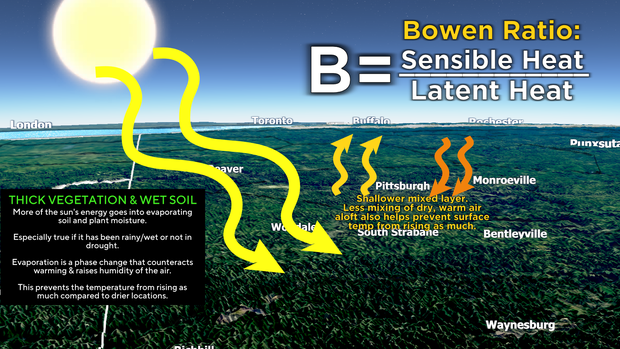
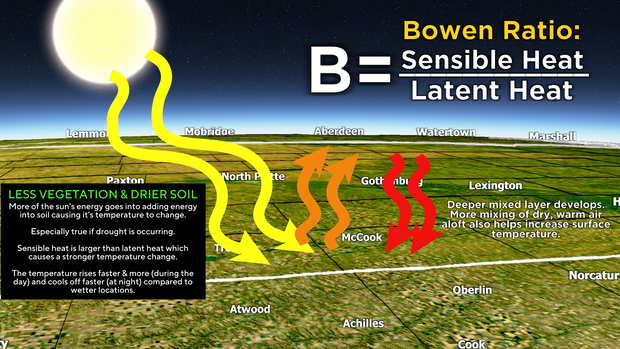
To understand how the sun's energy is being partitioned out at the surface, we use the Bowen Ratio. This measures the contribution of energy that goes into latent heat (evaporation, condensation, freezing, melting, etc.) versus sensible heat (conduction and convection). The Bowen Ratio is sensible heat over latent heat. A larger value for the Bowen Ratio indicates more of the sun's energy goes into sensible heat while a smaller portion goes into latent heating.
So how do we know what environments allow more of the sun's energy to go into latent heat versus sensible heating?
How the landscape of Pittsburgh differs from other places
Pittsburgh and much of western Pennsylvania have thick vegetation, a large tree canopy, and relatively wetter soils. This area currently has no drought either, so soil moisture is normal and above normal. This means more of the sun's energy goes into evaporating plant and soil moisture as opposed to causing the temperature to rise. Evaporation is a phase change that counteracts warming temperatures and raises humidity in the air.
In North Platte, Nebraska, vegetation is much sparser with drier soils. This area is also much more prone to drought development and is currently in a severe to extreme drought. This means more of the sun's energy goes into actually heating up the soil with conduction and convection, allowing the air temperature to rise faster. This also allows the mixed layer of air to grow deeper, which can bring warm air aloft and raise the temperature further.
Compared to North Platte, Nebraska, Pittsburgh on average would see a much smaller value for its Bowen Ratio.
What would it take to break record highs or hit triple digits?
For Pittsburgh to hit triple digits and even break records during a summer heat wave, it would take a combination of several factors.
We would need widespread, severe drought working in conjunction with an exceptionally strong/record-breaking upper-level high or heat dom. Exceptionally high or record-breaking levels of warm air at the top of the mixed layer of air connected with the earth's surface would also be needed to contribute to the mixing and raising of temperatures near the ground.
The KDKA weather team takes all of these factors into consideration when putting together a forecast. This is one of the reasons why you'll see our forecasts tend to be more conservative than a generic weather app on your phone or another source.


