Apples, motion, and inertia | Hey Ray
One of my favorite things about physics is that the result that seems to make the most sense on the surface isn't the result you get. One of the properties that can result in a seemingly weird result is inertia.

Inertia is the tendency of an object to maintain its state of motion, or lack of motion, unless it is acted upon by external forces.
You may have heard this stated as one of Sir Isaac Newton's laws of motion. More specifically, that an object at rest remains at rest, and an object in motion remains in motion at constant speed and in a straight line unless acted on by an unbalanced force.
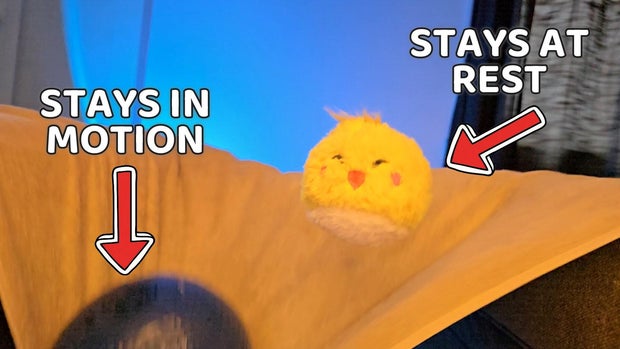
Now that we've got the learning part out of the way, let's do our experiment.
For this, you will need a wooden dowel, a hammer or mallet, and, since most people think of Isaac Newton being hit in the head with an apple, we will use one of those, too.

The setup for this experiment is very simple. Just stick the dowel through the apple. Hold the stick and tap on that stick with the hammer.
What do you think is going to happen?
Will the apple move down the wooden dowel? Will it move up, will it fall off, or will nothing happen?

I gave you a hint at the beginning, saying that sometimes things do the opposite of what seems normal when it comes to physics. When you hit the dowel, the apple moves higher and higher with every whack!
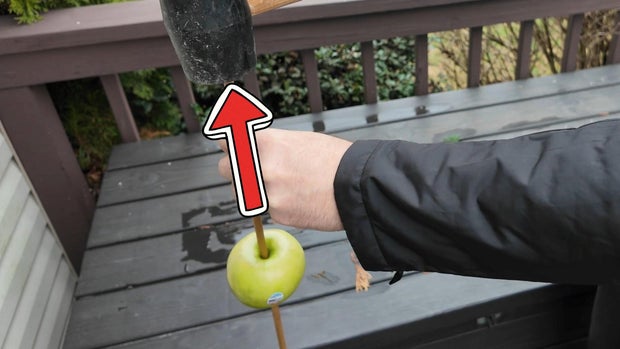
That is where the apple's inertia comes into play. Since the apple is in a state of rest, it wants to remain in that state. The apple also has more mass than the wooden dowel, so it takes more force and energy to move it.
When you tap the dowel, it is forced downward, but the apple wants to stay put because, you know…inertia.
While it looks like the apple is moving upward, you are actually pounding the stick farther down through the apple, while the apple is trying to stay put. Eventually, you run out of space on the wooden dowel, finishing the experiment.

So the next time you aren't in motion, and you want to stay that way, blame inertia!