Do DC 33 members make a living wage? Philadelphia workers' union strike by the numbers

Higher wages were a key sticking point during Philadelphia's AFSCME District 33 union's eight-day strike. A tentative labor agreement was reached with the city early Wednesday morning, a contract that, if ratified by union members, will result in a total of 14% in raises during Mayor Cherelle Parker's first term.
DC 33 is the city's largest municipal workers' union, representing about 9,000 blue-collar workers in Philadelphia. DC 33 members include sanitation and water department employees, 911 dispatchers, crossing guards, airport staff and more.
The union went on strike at 12:01 a.m. July 1, seeking higher pay and health care benefits for all members. During the eight-day strike, mountains of trash have piled up throughout city neighborhoods, and some members were court-ordered to return to work.
Contract negotiations can be confusing with percentages thrown around without proper context. To help understand what's happening with the Philadelphia strike, we analyzed data using the Massachusetts Institute of Technology Living Wage Calculator and other online resources to provide context for the situation.
Where negotiations stand between DC 33, the City of Philadelphia
Union leaders and members of Mayor Cherelle Parker's administration returned to the negotiating table Tuesday afternoon and, hours later, reached a tentative deal.
Before Tuesday's negotiations, DC 33 was asking for a 5% yearly pay increase over three years. The union's original request was 8% year over year, but DC 33 President Greg Boulware said they've come down to 5%.
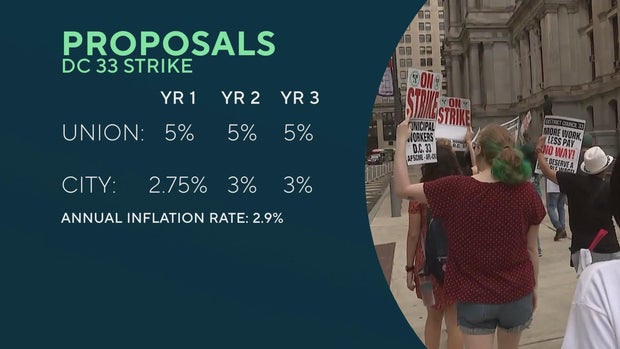
The Parker administration hadn't budged from its offer on wages. The city is offering 2.75%, 3% and 3% increases over a three-year contract — the Consumer Price Index's annual rate of inflation for the Philadelphia region is 2.9%.
Parker maintains she's offering the union the "largest one-term pay increase" of any first-term mayor in over 30 years. The mayor has repeatedly promoted the offer as a 13% increase, touting a 5% raise the union received in the first year of her administration.
While the full breakdown of the deal wasn't immediately available, the union appears to have accepted the mayor's offer on wages.
What is a "living wage"?
A "living wage" is the wage needed for a worker to cover basic expenses, including housing, food, health care, child care and paying their taxes, according to the Brookings Institution. A living wage doesn't account for savings and extra expenses such as eating out and entertainment.
"At its simplest, a living wage is what one full-time worker must earn on an hourly basis to help cover the cost of their family's minimum basic needs where they live while still being self-sufficient," MIT says.
What is the annual average salary of a District Council 33 member?
District Council 33 represents about 9,000 municipal workers in Philadelphia. According to the union, the average annual salary of a DC 33 member is $46,000, which breaks down to a $22.12 hourly wage.
According to Indeed, the average salary of a sanitation worker in Philadelphia is $42,574, which is nearly $6,000 below MIT's living wage for a single adult without children in the city.
What is the living wage in Philadelphia?
According to the Massachusetts Institute of Technology, the current average salary of a DC 33 member ($46,000) is more than $2,000 below the wage needed for a single adult without children to live in Philadelphia ($48,387).
The gap widens when you add children to the mix, as well as a non-working adult and a working adult to the equation.

So, what would it look like for DC 33 members after three years, based on the latest known proposals? We're accounting for a single household with no children, and we're not factoring in inflation. It's important to note that a $46,000 salary today may not hold the same value it will in 2028.
Under DC 33's offer, the average union worker would see their salary rise to approximately $53,000 after three years. Under the city's proposal, the average would be roughly $50,000.
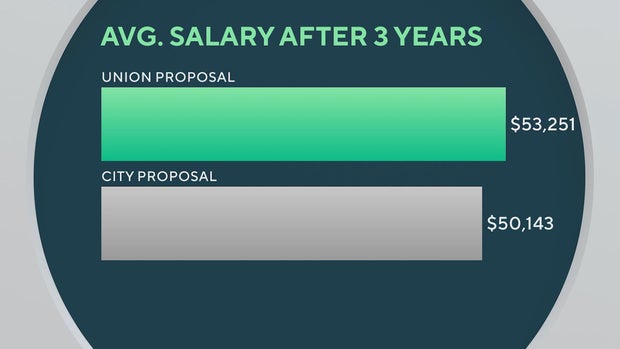
Based on the current MIT living wage and not accounting for inflation, DC 33 workers would earn approximately $4,600 more than MIT's living wage at the end of the union's proposal. Under the city, the workers would make just about $1,600 more than the current living wage.


