New exhibit connects fight for LGBTQ+ rights to Declaration of Independence, Philadelphia

A special exhibit at Philadelphia's Museum of the American Revolution is highlighting how the words of the Declaration of Independence have inspired generations of Americans in their pursuit of equality, including the LGBTQ+ rights movement.
The exhibit, "The Declaration's Journey," explores how the ideas of liberty, equality and self-government outlined in one of our nation's founding documents have influenced social and civil rights movements for more than two centuries.
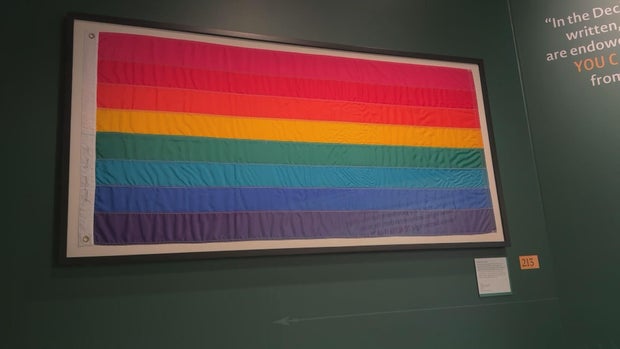
Inside the gallery, visitors will find an early version of the Pride flag created in 1978 and signed by its designer, Gilbert Baker. The artifact is on loan from Philadelphia LGBTQ+ activist and Philadelphia Gay News founder Mark Segal.
The exhibit also features a fragment of the ceiling from New York's Stonewall Inn and a brochure distributed during the Fourth Annual Reminder Day demonstration outside Independence Hall in 1968, a year before the Stonewall Uprising.
Museum officials say the exhibit is designed to show how Americans have continued to invoke the Declaration's ideals — of life, liberty and the pursuit of happiness, and that all men are created equal — in the fight for expanded rights and equality.
"Some of the 20th-century stories that we share here that include the gay civil rights movement, that include African American civil rights, show that a lot of this history is very recent," Matthew Skic, the Museum of the American Revolution's director of collections and exhibitions, said.
Skic said the LGBTQ+ rights movement demonstrates how the Declaration's principles continue to resonate today.
"The LGBTQ+ movement is so important because it shows the nation has a founding principle based on liberty, equality and self-government stated in the Declaration," he said.
Throughout the exhibit, visitors can trace connections between America's founding and later movements for civil rights. One display pairs a chair that belonged to Thomas Jefferson in 1776 with a bench associated with Dr. Martin Luther King Jr.'s imprisonment in Birmingham, Alabama.
The museum also highlights Philadelphia's central role in the story, including one of the first printings of the Declaration of Independence produced in the city on July 4, 1776.
According to Skic, the exhibit illustrates how the Declaration's influence extended far beyond the Revolutionary era and became part of the argument for expanding civil rights to more Americans.
"That rights movement of the LGBTQ+ community has used the Declaration to strengthen its arguments to show that we are advocating for rights for all people regardless of sexual orientation, regardless of their beliefs, regardless of who they love," Skic said.
Museum leaders hope visitors leave with a deeper understanding of how the Declaration's promise of equality has been interpreted, challenged and expanded by generations of Americans.
A reminder, they say, the Declaration's journey and the pursuit of equality it inspired is still being written.


