What makes for a great Christmas song?

Every year at this time, some of the greatest songs in the world pop up in our playlists. Most of them are decades old, or even centuries. If anyone knows what makes a Christmas song immortal, it's Berklee School of Music forensic musicologist Joe Bennett. He's analyzed the holiday pop charts to learn exactly what makes popular Christmas songs popular – "to try and figure out what are the musical characteristics that listeners keep coming back to again and again over the years," he said.
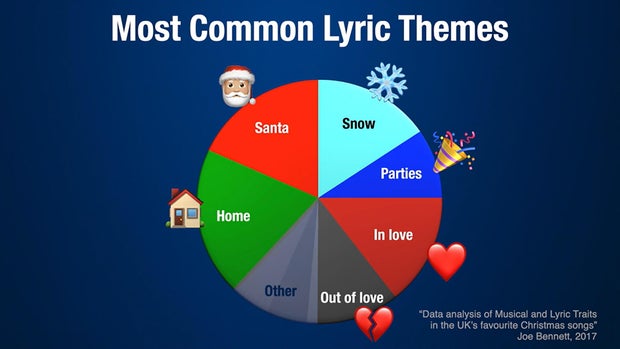
In fact, Bennett found that most commercial Christmas hits are about one of only six things. Those thematic characteristics include "home for the holidays" (the most common one), weather-themed songs (like "Let It Snow"), the myth of Santa Claus, parties, being in love, and being out of love.
Which brings us to the #1 Christmas hit of recent years: from 1994, Mariah Carey's "All I Want for Christmas Is You." Bennett says the song is remarkable because it hits most of the Christmas-themed tropes: "We get Christmas presents, and the tree, and Santa Claus, and the snow. That lyric is so well-loved as a holiday celebration song, 'cause it's literally got it all."
A few years back, "Sunday Morning" visited Walter Afanasieff, who wrote that song with Carey. "Hey, I have a #1 hit every year, but it's the same song every year!" he laughed.
"We just kind of, like, go bouncing off of each other, like at a jam session," he said. "No one in a million years would've thought, 'Yeah, we're gonna release this and it's gonna be a big hit.'"
Musical elements
And what does Maria Carey's hit have in common with most other Christmas hits? Sleigh bells! "We found that more than 65% of the songs in the corpus had sleigh bells playing eight to the bar," said Bennett.
He said the inspiration came from galloping horses: "In the mid-1800s, the horses would actually wear sleigh bells to warn people that they were coming. So, you can imagine the sort of leather across the horse's mane there, and it's gonna make a heck of a noise – you're not gonna miss that deadly sleigh coming up behind you! You can imagine a horse trotting to that, and it's eighth notes. Da-da-da-da. Unwittingly pre-composing Christmas music from 100 years afterwards!"
Major Key
Then there are the technical aspects of a piece of music, like the key. According to Bennett, about 98% of the songs in the data set that he looked at were in a major key. "On a surface level, Christmas music tends to be cheerful," he said.
"The other characteristic that Christmas music has is, you want every generation to be able to sing it," he added. "So that's why kids' songs are often very simple and go over smaller intervals" – like "Jingle Bells," which is comprised of five notes. "And that's why kids find it easy to sing!"
And sure enough: Almost every popular Christmas song on Earth has an easily singable range of nine notes or fewer: Among them, "White Christmas," "12 Days of Christmas," "We Wish You a Merry Christmas," "O Christmas Tree," "The Christmas Song (Chestnuts)," "Do You Hear What I Hear?" "Silver Bells," "Rudolph the Red-Nosed Reindeer," "Frosty the Snowman," "Little Drummer Boy," and "Hark! The Herald Angels Sing."
Bennett points out one more common characteristic: a surprising number of Christmas melodies go right up or down the scale, as in "Joy to the World," "Let It Snow" and 'Winter Wonderland."
I asked, "Why do you think that so many Christmas songs wound up with these characteristics? It's not like the composer sat down and said, 'Four-four, major key, swing'?"
"No, it's the selection effect – that is, we only know the Christmas songs that we know and love," Bennett said. "We ignore the experimental ones that just died in the marketplace."
A Christmas debut
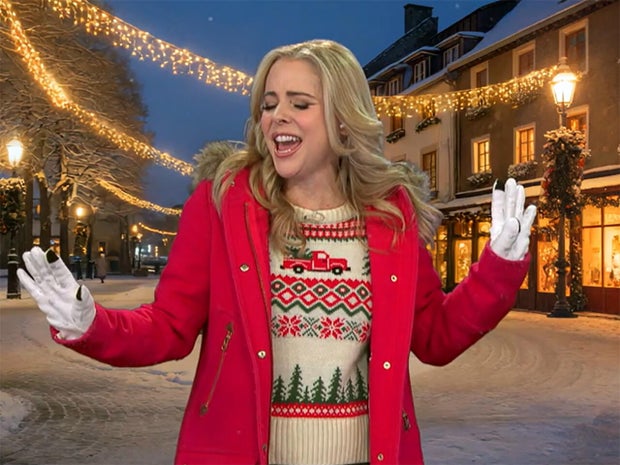
Now, based on the data I have studied on what makes a great Christmas song, I've written one – and Kerry Butler has gracefully agreed to sing it for us!
Butler is a veteran of 12 Broadway shows, including "Hairspray," "Mean Girls" and "Beetlejuice." She knows her way around a song – and the holidays hold a special meaning for her. "My whole family is obsessed with Christmas," she said. "We had our decorations up way before Thanksgiving."
Asked what a Christmas song does for her emotionally that a pop song doesn't, Butler replied, "I think it's the nostalgia. It brings back all these memories when we were little, singing them with our parents, and now we're older and we're singing them with our kids."
Now, songwriter Walter Afanasieff and Joe Bennett both say that just including all the traditional musical ingredients doesn't automatically make a song great. "It's not, like, a formula or an algorithm," said Afanasieff.
And Bennett made an obvious point: "If it were easy, a lot more people would be doing it!"
But, I had to give it a shot! And so, "Sunday Morning" presents the world premiere of "The Sound of Christmas." It's got sleigh bells, in a major key, with a singable range, and a melody going down the scale.
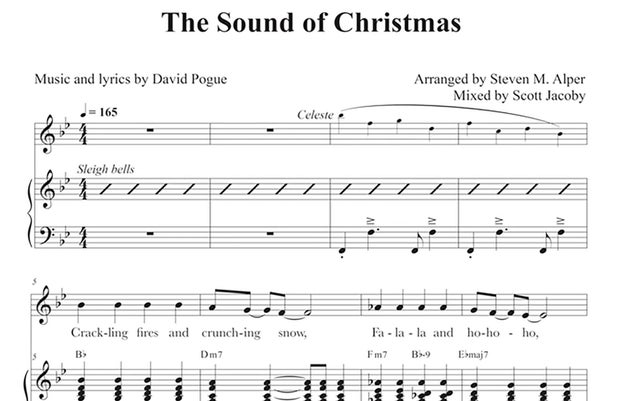
Crackling fires and crunching snow,
Fa-la-la and ho-ho-ho!
Listen! Oh, I love the sound of
Christmas!
Caroling and jingle bells,
"Silent Nights" and "First Noels,"
All around,
I love the sound
Of Christmas
Listen!
It's Christmas time!
For more info:
Story produced by Gabriel Falcon. Editor: Ed Givnish.
See more:
- "Christmas Time Is Here," a classic holiday song ("Sunday Morning")
- The story of Handel's "Messiah" ("Sunday Morning")