"Mr. Irrelevant": David Corenswet on playing a real-life superman

Want a feel-good movie for the holiday season? It would be tough to beat the new film about a pro football player named John Tuggle (at least for the first half of it). And who better to play this real-life superman than David Corenswet, who just brought the comic-book version of Superman to the screen?
Asked what pulled him into the story of Tuggle, Corenswet said it was about "a man who defined himself by his ability to get back up and keep fighting. He loved playing the best with the hand he was dealt, and in some ways getting dealt a bad hand was even more exciting."
For this hero's journey, Corenswet said Tuggle is "most importantly a symbol for other people of how it is possible to be in the face of great adversity."
In 1983, Tuggle was the NFL's "Mr. Irrelevant," the nickname given to the last player drafted each year. The movie "Mr. Irrelevant" (produced by Skydance, the parent company of CBS News) documents Tuggle's place in football history as the first Mr. Irrelevant to ever make an NFL team: the New York Giants.
Before Leonard Marshall became an all-time Giant great as a defensive lineman, he was Tuggle's roommate in training camp. "I remember the first time we met at minicamp. He came in, he said, 'Hey man, I'm Mr. Irrelevant, I'm John Tuggle,'" Marshall said. "I said, 'Nice to meet you, John. What's your plan?' He said, 'I plan to make the team.' I said, 'Okay.' He goes, 'Piece of cake!'"
Marshall recalled when Tuggle got the news: "Oh, I remember it. He said, 'You know, I think I made it – I'm gonna get my shot!'"
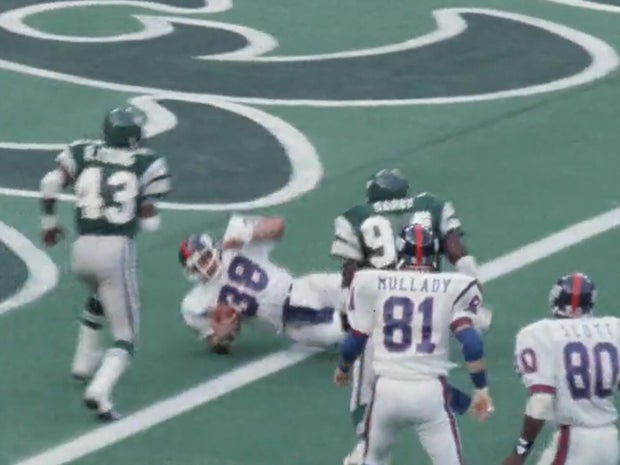
Director Jonathan Levine, who was from New York, knew the Giants, but did not know about Tuggle: "This was solid gold: a story of an ultimate underdog who kept getting knocked down – and kept getting back up – that had never been told before.
"Given the way we all consume sports, I can't imagine having a story that not everyone knows about," Levine said. "We think about it, we post about it, we gossip about it. And to think that there's, like, an undiscovered character who is such an inspiring person, and that person has not been explored? To me that's like, Wow, I want to tell people that story."
That would've been an easy, feel-good movie to make. But that's just the first half of the story. At 23 years old, John Tuggle was diagnosed with cancer.
"It's killer, bro, killer for me," said Marshall. Asked how he had to process it, he replied, "Being a 22-, 23-, 24-year-old kid and having to face that, watching the rug of your dreams be pulled from underneath you? Tough. Tough. Woke me up."
Levine described the brutal twist of this underdog story: "We just wanted to let life unfold the way life unfolds, because it is a movie about life. It's a movie about humanity. It's a movie about the messiness of life."
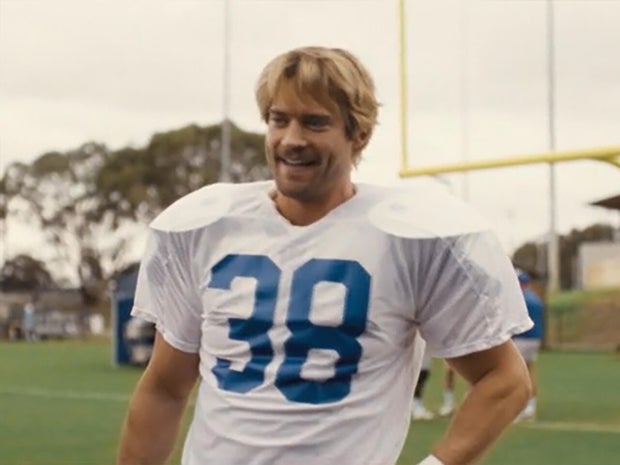
And it's a movie about confronting death, which for Tuggle meant refusing to stop living his life, even down to his daily trips to the Giants weight room. Even after he got sick, he would go there every day, until he was told he could not any more. Tuggle's toughness impressed the entire team, especially its then-second-year head coach Bill Parcells (portrayed in the film by Michael Shannon). While Parcells would one day win two Super Bowls and enter the NFL's Hall of Fame, when he coached Tuggle, he was struggling through a 3-12-1 season.
Marshall said, "Tuggle showed him perseverance. If I'm gonna go down, I'm gonna go down fighting and doing it my way."
John Tuggle died in 1986. Five months later, his #38 was on every helmet as the Giants won their first Super Bowl in team history. Asked why it was important to Parcells for Tuggle's number to be on every helmet, Marshall replied, "John Tuggle taught Bill Parcells something about himself that he didn't quite know. I think Tuggle shaped Parcells big time."
While Tuggle's story has a lot of things, one critical thing it's missing – as far as Hollywood goes these days – is a happy ending. "When you test a movie, you have to have a good ending," said Levine. "I know some people are heartbroken at the end of the movie, but I do feel that the message of the movie is, we're all in this boat together."
As for the man who plays "Mr. Irrelevant," David Corenswet couldn't think of a more ironic title – or an ending packing a more important lesson. "Ultimately what the movie is about is not about losing something wonderful; it's about the impact that he had on the world around him," he said. "None of us get out of this alive. But it's possible and worthwhile to still make the most of it, and to still carry humor with you and carry love and be connected with each other."
"Mr. Irrelevant" shows it doesn't have to have a "happy" ending to be a deeply meaningful and moving story. "And what a great way of describing life," said Corenswet. "Life doesn't have to have a happy ending to be a deeply meaningful and moving thing."
To watch a trailer for "Mr. Irrelevant" click on the video player below:
Story produced by Gabriel Falcon. Editor: Jason Schmidt.
For more info:
- "Mr. Irrelevant" (Paramount) opens in theaters December 25