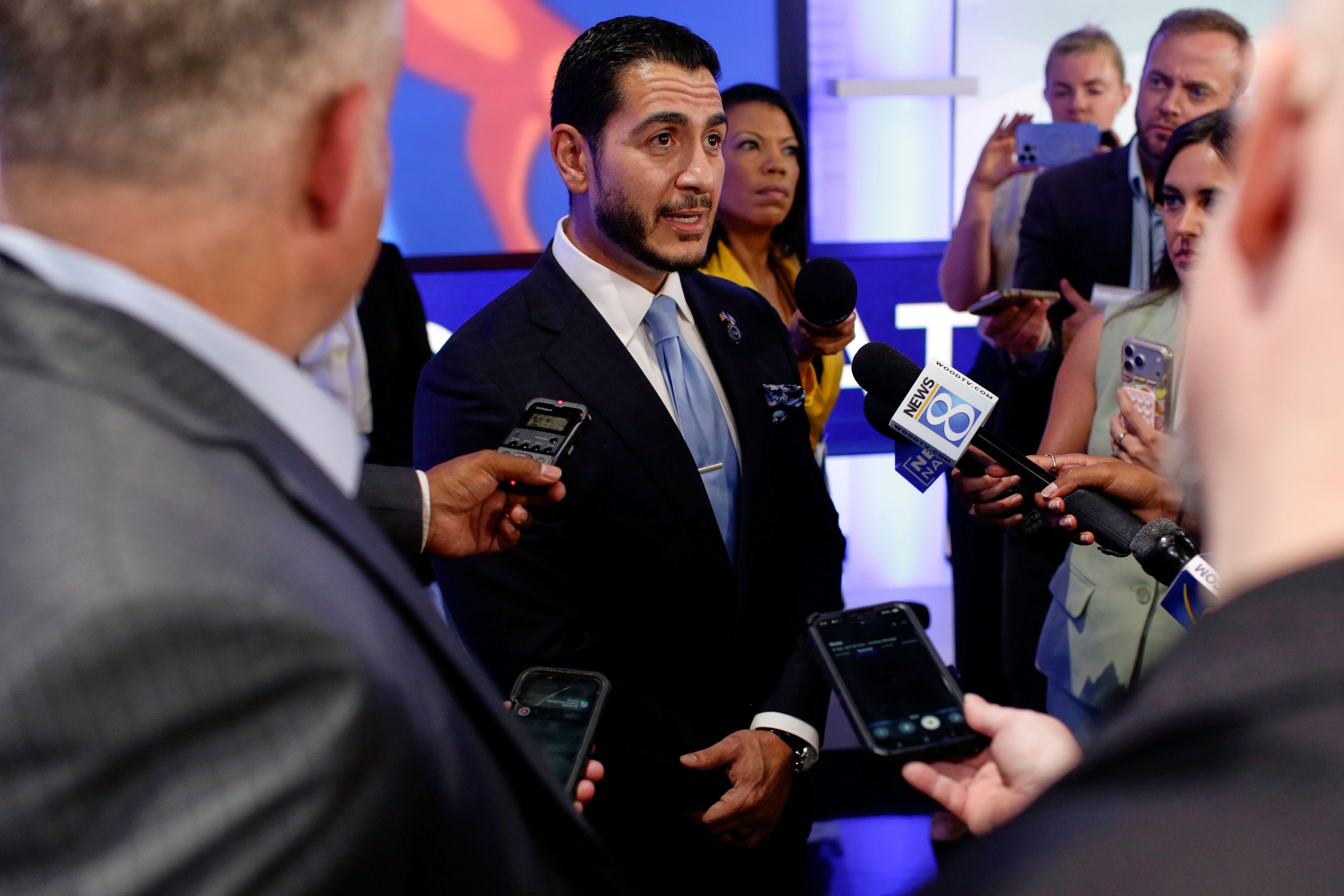
Abdul El-Sayed and Mike Rogers are fighting to represent Michigan in the Senate. Here's what they say.
Control of the U.S. Senate after Tuesday's midterm elections could come down to Michigan, where a close and contentious battle has been playing out between Democrat Abdul El-Sayed and Republican Mike Rogers.
The test for Rogers, 63, is whether a Republican can win in the shadow of inflation, war and President Trump's negative approval ratings. The test for El-Sayed, 42, is whether ideas that thrill the progressive wing of the Democratic Party are what Middle America wants right now.
Who is Abdul El-Sayed and what's he campaigning on?
El-Sayed is the son of Egyptian immigrants. After a Rhodes Scholarship and a medical degree from Columbia University, El-Sayed went straight into public health administration and then politics.
He won Michigan's state Democratic primary against a more centrist rival by a margin of less than a percentage point. El-Sayed now has ambitions not just to beat his Republican rival Mike Rogers, but to remake the Democratic Party. He's running on transformation: busting monopolies, passing "Medicare for All" and an arms embargo on Israel.
El-Sayed is often associated with the Democratic Socialists of America, but he isn't a member, and he keeps his distance from the label. He describes himself as a capitalist, but one prepared to take on monopolies and oligopolies, that is, producers that either have exclusive control over a particular market, or a market situation where a handful of producers can have an outsized effect.
"I'm a capitalist who understands the idea that you should have guaranteed healthcare in the country, anybody who tells you that's anti-capitalist is not really understanding how capitalism works," El-Sayed said.
He's promising a version of Medicare for All that he says would leave private health insurance options intact. El-Sayed would fund it, in part, with a sweeping tax on billionaire wealth.
On the trail, though, he says healthcare is no longer voters' top concern. El-Sayed says the most important issue he hears concerns about from voters is artificial intelligence.
"One is students saying, 'So I just took $60,000 in loans and the job that I was supposed to have on the back end doesn't exist anymore or might not exist in 10 years,'" El-Sayed said. "Or it's folks in rural communities who say, 'They're trying to put a data center in my backyard. I already can't afford my utilities and I'm worried about what it's going to mean for our water.'"
El-Sayed wants a Cabinet-level agency to regulate AI and a "full-on pause" for the frontier AI research that some fear threatens the human race.
Who is Mike Rogers and what's he campaigning on?
While El-Sayed sometimes sounds like a candidate for president, Rogers is trying to keep things local.
"This is a change election in Michigan," he said, referencing the fact that Michigan hasn't elected a Republican senator in decades. "That's why I don't really care what's happening around the country. I need to fix Michigan."
In a populist era, Rogers can sound like a throwback Republican. His platform sometimes channels the "compassionate conservative" rhetoric of former President George W. Bush.
Rogers is a former Army officer and FBI agent. He is also a former congressman. Rogers left the House of Representatives in 2015 after 14 years, shortly before the start of the first Trump administration.
The candidate said he wants to focus on literacy, an issue he says that came to his attention during the pandemic.
"Patriotism runs deep in our family. One of the big reasons they were missing recruiting during COVID and other places was that kids weren't reading well enough to pass the test in America in 2026," Rogers said. "If we don't change that, we are all in trouble."
Rogers has spent time during his campaign visiting predominantly Black neighborhoods that rarely see a Republican candidate's outreach, trying to persuade African American voters that El-Sayed is taking them for granted.
At a gathering of supporters, Rogers called out El-Sayed for campaigning with Rep. Alexandria Ocasio-Cortez.
"He went to New York with AOC to talk about how they're going to change the world in 2028. You know what I want to do? I want to take care of Flint," Rogers said at the event. "I want to take care of every Michigander who has kids and grandkids who want to stay in this state."
The candidates and Trump
One of El-Sayed's attack lines is that a vote for Rogers is effectively a vote for Mr. Trump. The president's trade wars, especially the tariffs on Canada — Michigan's neighbor and trading partner — have cost the state an estimated $23 billion since January 2025, according to the National Taxpayers Union Foundation.
Rogers has said he doesn't like the tariffs, and that he's raised his concerns to Secretary of Commerce Howard Lutnick. He said Lutnick told him: "I'll get back to ya."
When asked by 60 Minutes why other Republican senators can't fix the tariff woes when there's a Republican majority in the Senate, Rogers said, "Well, you need one more Republican senator there. That's how you do it."
If it came down to it, Rogers said he'd support efforts to override the president on tariffs.
On another national issue, Rogers had supported Mr. Trump's unpopular war with Iran, but said in September that it needs to wind down.
Rogers, a former FBI agent who worked on organized crime and public corruption cases, chooses his words carefully when asked if the Trump administration has a corruption problem.
"I'm going to act as a United States senator with the best interests of Michigan. I can tell you that right now," Rogers said, adding, "I'll take the facts as I see them and I'll make a decision based on that."
He also said he wouldn't have accepted a plane from a Middle Eastern nation as Mr. Trump did, but "I don't think it's illegal for the president to do that."
It's a delicate relationship. Mr. Trump needs Rogers to flip the seat. Rogers needs the president to turn out the party base.
They campaigned together in Port Huron, Michigan, last week, where Mr. Trump trained his fire on El-Sayed.
"I'm here to keep a jihadist Muslim Brotherhood member from becoming a United States senator," Mr. Trump said at the campaign event.
El-Sayed argues Trump is targeting his faith
The president was talking about an Islamist movement whose offshoots in some countries have recently been designated as a terrorist group by the U.S.
Rogers has also accused El-Sayed of having links to the Muslim Brotherhood, citing a 2012 letter that El-Sayed signed after the Arab Spring in support of Egypt's new democratically elected government, which was backed by the Brotherhood.
El-Sayed has declined to comment on the letter, but said he disavows the Muslim Brotherhood. He argues that Republicans are targeting his Islamic faith.
El-Sayed's faith is important to him and has helped shape his politics.
"There is this notion of speak the truth, even if it be against yourself. And I try to be, like, radically honest," he said.
Middle East plays prominent role in Michigan race
In a state with one of the nation's largest Arab American populations — and about 100,000 Jewish voters — the Middle East is territory where the campaigns' national and local elements converge.
El-Sayed has come out against U.S. support for Israel.
"Number one, we have been told that we are pursuing a two-state solution, only to aid, arm, and abet the very people who are trying to foreclose on the possibility of a second state. So it's incoherent on its own terms. Number two, I don't know about you, but I don't pay my taxes to buy another country a bomb or a tank. That's Israel. That's Egypt. That's Saudi Arabia. That's Pakistan," El-Sayed said. "Three, the state of Israel did a genocide."
In the wake of Hamas' Oct. 7, 2023 attack on Israel, El-Sayed has frequently accused Israel of committing genocide in the Gaza Strip. It's a charge Israel denies. Rogers strongly opposes such claims.
"His language is wrong," Rogers said of El-Sayed using the word genocide.
"I passionately defend Israel's right to defend itself and to exist as a Jewish state. That sets me at odds with my opponent right off the bat. He refuses to even acknowledge that Israel has the right to exist," Rogers said.
According to El-Sayed, Palestine has a right to exist, and so does Israel "if there is a shared understanding."
"I believe in equal rights to peace, dignity, and self-determination for Palestinians and Jewish Israelis alike. If the Palestinian people decide and the Israeli people decide that they want two states for two people, and they decide that on equal terms, I'm for it," El-Sayed said. "If they decide that they want one state shared in a different way, I'm for that."
Closer to home, El-Sayed condemned the violence this past March after a terrorist attack on a Michigan synagogue and preschool. But he also added that "hurt people hurt people," seeming to put blame on Israel. El-Sayed later apologized.
Rogers has said his opponent's rhetoric is feeding an atmosphere of antisemitism, and has questioned whether El-Sayed wants to represent Palestine or Michigan.
In a close election, the Rogers campaign hopes that Jewish Michiganders, usually a reliable Democratic constituency, could be one of its keys to victory.
El-Sayed emphasized common ground with Jewish voters, saying, "Wherever our disagreements are when it comes to Israel, there are a lot more things that we agree on here. When it comes to standing up for Jewish Americans, I will be right there."
In a surprise twist, Michigan Rep. Haley Stevens, who El-Sayed beat in the Democratic primary, on Sunday, two days before the election, endorsed Rogers for Senate, because of her disagreement with El-Sayed on Israel policy.
However the Jewish vote breaks, the state's more than 200,000 Arab Americans are expected to turn out to vote for El-Sayed in record numbers. If El-Sayed wins, he'd be the nation's first Muslim senator.
El-Sayed, Rogers on what to expect if they win
Both candidates were asked about the biggest thing to expect to be different in U.S. politics if they won.
"The ability to run a campaign and win against big money by engaging with people. Having a conversation about who we are and who we want to be," El-Sayed said.
Rogers said, "Well, I'm not sure about American politics, but I'm gonna change the politics of Michigan, for sure. Cause you're gonna have somebody who's an advocate for the state of Michigan."