How much silver can I get for $500?
Gold's high price and seemingly endless upward trajectory have been a big draw for investors recently, but it's important to point out that gold isn't the only precious metal that's worthy of consideration right now. Silver has also been on a tear lately, pushing into price territory that would have seemed far-fetched not long ago. Between inflation worries, heavy industrial demand and renewed interest from everyday investors, silver has gone from a quiet portfolio diversifier to a headline-grabbing asset. That, in turn, has led many investors to question how far their funds will go if they buy the metal now.
Every investor's budget is different, but the $500 mark feels like a natural starting point, especially when it comes to more volatile assets like silver. That amount represents a meaningful investment for many people, but it's still relatively achievable for the average person. And, depending on how you choose to buy your silver assets, that amount could allow you to purchase a hefty amount of silver holdings. That said, finding the answer to how much silver $500 will buy isn't as simple as dividing that amount by today's spot price.
That's because when you buy silver, you're not just buying ounces. You're buying premiums, formats and sometimes convenience, and the amount of silver you end up with depends heavily on those choices. So, how much silver should you expect to get in return for a $500 investment in this market? That's what we'll break down below.
Start adding gold and silver to your investments today.
How much silver can I get for $500?
At today's spot price of $91.72 per ounce, a $500 investment would theoretically buy about 5.45 ounces of silver — if you could purchase at spot. In reality, though, physical silver almost always comes with premiums, which vary by product type and market conditions. While spot prices fluctuate daily, the premiums tend to follow more stable patterns, ultimately shaping how far your money goes. Here's how these markups typically break down:
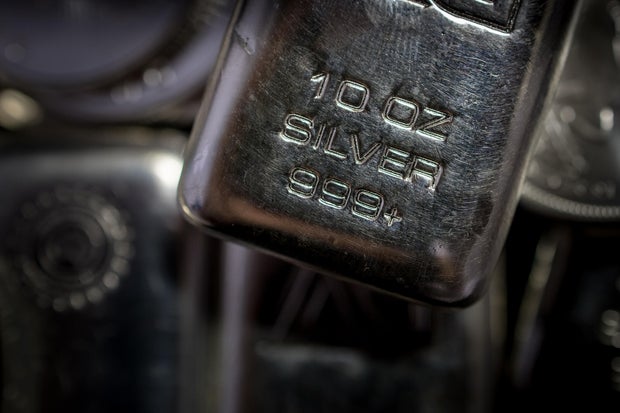
- Larger silver bars (10 ounces and up): These types of silver bars usually carry the lowest per-ounce premiums because they're cheaper to mint and handle in bulk. For example, it's common to see markups of a few dollars per ounce on larger bars. So, if you're a buyer who's trying to maximize how far your investment funds go, this format tends to stretch $500 the furthest.
- 1-ounce silver bars and coins: These smaller silver pieces are popular with retail investors because they're easy to store and resell. That convenience comes with higher markups, though, which are generally several dollars more per ounce than larger bars. You'll still get meaningful exposure to silver if you take this route, just with slightly fewer ounces for the same $500.
- Government-minted silver coins: Collectible and widely-recognized silver coins like American Silver Eagles typically carry the highest premiums. When you purchase these silver assets, you're paying for recognizability, liquidity and trust, not just the metal content. In active markets, premiums on these coins can rise sharply, which reduces how much silver $500 actually buys.
Once you layer today's silver price of $91.72 per ounce into those typical markups, the difference becomes clearer. The spread isn't about the metal; it's about the markup.
Compare your precious metal investing options online now.
What type of silver makes the most sense for a $500 budget?
If you're focused on physical silver, the smartest use of a $500 investment depends on how you balance cost efficiency versus flexibility.
For instance, if your goal is simply to own the most silver for your money, larger silver bars usually win. With this route, you're minimizing the portion of your purchase that goes toward markups and maximizing the amount tied to the metal itself. As a result, this approach tends to work well for long-term holders who don't plan to sell small amounts.
If flexibility matters most to you, 1-ounce silver bars and rounds are often a good middle ground. You'll pay more in premiums for these smaller silver assets, but you gain the ability to sell in smaller increments later. For many investors, that trade-off feels reasonable, especially if the price of silver remains volatile.
If ease of resale and recognizability are your top priorities, government-minted silver coins can still make sense despite the higher premiums. These coins are widely accepted and easy to move in most markets. You'll own fewer ounces of silver by taking this approach, but you're buying convenience and broad market acceptance.
It also pays to shop around, no matter what physical silver assets you're considering. Dealer markups vary, and during periods of strong demand, some sellers will raise premiums more aggressively than others. By comparing a few reputable precious metal dealers, you may be able to meaningfully change how much silver your $500 budget buys.
The bottom line
With today's silver price around $91.72 per ounce, $500 can still translate into a meaningful silver position, but the difference between walking away with closer to 4 ounces or closer to 5 ounces often comes down to premiums, not timing the market. That's because the amount of silver $500 gets you is driven less by the day's spot price and more by average markups tied to what you buy. Larger bars usually stretch your dollars furthest, while smaller pieces and government-minted coins trade ounces for flexibility and recognizability.