Is "antifa" a label, an idea or a terrorist organization?

Fifteen Minnesotans charged for conspiracy to impede or injure federal agents are part of what President Trump considers a terrorist group, prosecutors said.
The president signed an executive order last September that labeled antifa a "domestic terrorist organization." Antifa is short for anti-fascist or anti-fascism. To put it simply, it's people who oppose fascism.
But is it just a label? An idea? Or, as President Trump declared, a terrorist organization?
The Congressional Research Service investigated America's antifa movement in 2020. It called it, "decentralized, consisting of independent, radical, like-minded groups and individuals."
Decentralized means an organization that's not controlled from one place or by one person. Essentially, antifa has no structure, no official membership and those who use the label can have different ideologies.
"Some people might be socialists, some people might be communalists, some people might be anarchists," said Bianca Ho, the North American Assistant Research Manager for ACLED, a research nonprofit focused on political violence and protest. "And they all use this term, anti-fascist, to describe themselves. However, they're not really connected to an overarching ideology. There are some small pockets of like city-level groups who would consider themselves as an antifa group."
That's what Daniel Rosen, the U.S. attorney for Minnesota, highlighted while announcing charges Tuesday, saying the defendants are part of two Minneapolis-based antifa groups that "violently opposed the enforcement of federal law in our state."
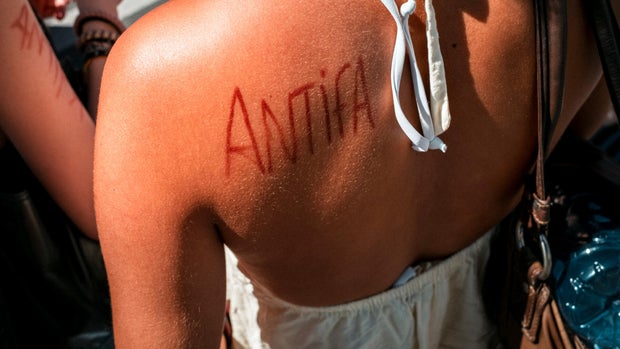
In his executive order declaring antifa as a domestic terrorist organization, Mr. Trump said the federal government should "investigate, disrupt, and dismantle any and all illegal operations … conducted by antifa or any person claiming to act on behalf of antifa."
Despite his executive order, the FBI has not designated any organization as a domestic terrorist organization. The Congressional Research Service said doing so "may infringe on First Amendment-protected free speech. Belonging to an ideological group in and of itself is not a crime in the United States."
"This executive order casts a very large net on who they target, however because this is more of an ideology it is difficult to define membership," said Ho.
In addition to the executive order, Mr. Trump issued National Security Presidential Memorandum 7, which directed the Justice Department to prioritize politically motivated violence.
Rosen mentioned it at the beginning of his news conference announcing the charges on Tuesday.
"To accomplish that mission, the deputy attorney general stood up Joint Task Force Vanguard to enforce a national security strategy to investigate, prosecute and disrupt those who engage in political violence and intimidation," Rosen said.
That's what created the framework leading to the charges against the anti-ICE protestors. Domestic terrorism itself is not a chargeable offense. Prosecutors also can't charge someone for being part of antifa.
Critics of the memorandum feel it would violate free speech and give the federal government "maximum flexibility to pick and choose its targets," wrote Faiza Patel of the Brennan Center for Justice.
Patel said a large swath of identities and ideologies would be prioritized for investigations, including, "labor organizers, socialists, many libertarians, those who criticize Christianity, pro-immigration groups, anti-ICE protesters, and racial justice and transgender activists, to anyone who holds views that the administration considers to be 'anti-American.'"


