Northern Minnesota wildfires burning close to homes, cabins and resorts

Crews are working to keep wildfires burning across northern Minnesota from reaching public and private infrastructure, officials said in a news conference Friday afternoon.
The Minnesota Incident Command System said at least 11 wildfires are burning in areas west of Echo Lake, located in the Superior National Forest, and east of Highway 53. The National Incident Management Organization added that it's responsible for responding to five other fires in the forest.
More than 600 firefighters are coming in from all over the country to battle the blazes.
The Bear Trap Fire, which has burned over 13,000 acres, is about a mile from cabins, homes and resorts along Big Lake and the Echo Trail, according to Loomis.
"We're moving resources over there as efficiently and safely as we can do so," he said.
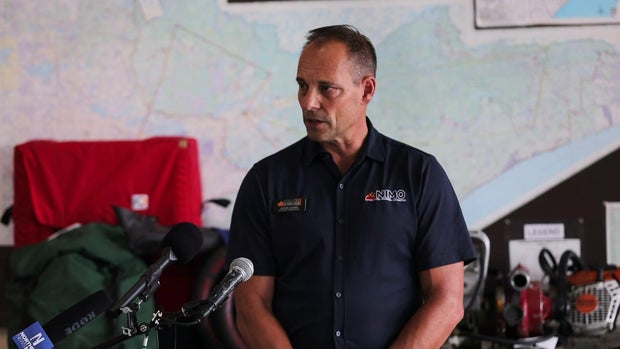
One of the largest active blazes, the Thumb Fire, has burned at least 14,129 acres in the Boundary Waters Canoe Area Wilderness, according to federal officials. It started on July 7 as a result of a lightning strike. Jason Loomis, a commander with the National Incident Management Organization, said Friday that the blaze had moved across the border into Canada.
"We're really trying to coordinate with our Canadian partners to the north as well as the First Nation tribes up there," Loomis said. "Understand that they've been evacuated. Some serious implications associated with that, so that close coordination has been our priority one."
Loomis added that the Thumb Fire, as of Friday afternoon, remains largely unstaffed due to lack of resources and staffing to fight it safely.
"Right now, our priority and our management action is to monitor by air to help us gain that situational assessment as well as intelligence," he said.
Jason Zabokrtsky with the Ely Outfitting Company said Friday that he was preparing to welcome firefighters to the business's bunkhouses, but that it's not normally what they'd be doing in July.
"This should be bustling with clients who are getting outfitted to go on trail," Zabokrtsky said.
The blazes have resulted in officials closing the Boundary Waters.
WCCO asked Drew Stroburg, a deputy forest supervisor with the U.S. Forest Service, if vacations are no longer an option at the Boundary Waters and if people who live in areas near the wildfires will need to have a go bag packed for the rest of the summer.
"So the closure order is in place. We're not sure when that's, when we're going to be able to lift that or to reduce it," Stroburg said. "In all likelihood, it will be a reduction, not a complete lifting. We will have active fire on the landscape, likely for the rest of the summer, until snow flies."
Gov. Tim Walz earlier this week extended a peacetime emergency through mid-September. The order directs additional resources to fight the fires, including the Minnesota National Guard.
"We have never seen anything like this," Loomis said during the news conference. "I'm sure that locals who have been here quite a while have seen events very similar to this, but this is unprecedented."
Phil Manuel, an incident meteorologist with the National Weather Service, said Friday afternoon that the long-duration rain will be needed to help stop the wildfires. Officials believe some of the fires could continue to burn until snow arrives later this year. The extreme heat and lack of rain the state has been facing have made suppression difficult.
Smoke from the wildfires, as well as those in Canada, has poisoned the air quality across Minnesota. While it has since improved, for hours on Thursday, Minneapolis had the worst air quality among all of the world's major cities, according to IQAir. The air in the Arrowhead, near the fires, will remain hazardous until 11 a.m. Monday, according to the Minnesota Pollution Control Agency.
The Minnesota Department of Natural Resources is expected to activate enhanced burning restrictions Monday afternoon for Cook, Koochiching, Lake and northern St. Louis counties, as well as parts of George Washington State Forest and Scenic State Park that extend into Itasca County.
Under the restrictions, recreational fires and campfires are not allowed and no burning permits will be issued except for special exceptions. Prescribed burning will be prohibited, in addition to the use of fireworks outside of municipalities. Only gas or propane camp stoves can be used in the backcountry or at campsites. Charcoal fires will be allowed only in grills designated for that purpose, and at occupied homes, cabins and resorts.


