Minneapolis-St. Paul International Airport's new 3D braille maps are helping visitors help themselves

With all the hustle and bustle, navigating any airport can be a bit confusing. But for some, the hurdles are big.
More than 80,000 people in Minnesota are blind or have severe vision difficulty, according to the Centers for Disease Control and Prevention.
Now, Minneapolis-St. Paul International Airport has created innovative 3D braille maps for people living with blindness and low vision.
Ken Rodgers became blind in his 30s due to a rare retinol disease. He says navigating airport concourses is tricky.
"People standing in places you don't expect them to be standing and talking. My cane might hit their feet or it's kind of an uncomfortable moment," Rodgers said.
What is also uncomfortable is navigating the most personal room in the airport.
"If I'm looking for a sink, I've got my hand down kind of waist size, waist height, because that's where a sink would be," Rodgers said. "And if I am looking for a sink, what other things waist-high might I stick my hand in in a men's room that is not something I want to stick my hands on? Those are just some of the hazards that we just deal with."
For most walking around the airport, if you need to go to the restroom, you just look for a sign. But like Rodgers said, it gets tricky when you can't see. That's why the airport's new maps are so crucial.
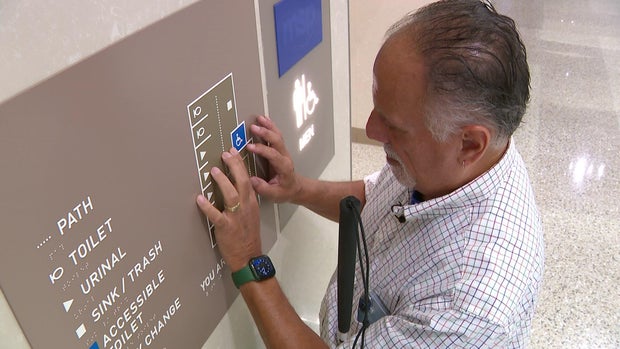
They explain, through touch, where every toilet, sink and urinal are so people living with visual impairments can better navigate.
"We have 149 restrooms in this airport. Only two of those restrooms have identical floor plans," said Phil Burke, MSP Airport's assistant director of customer experience.
MSP's already gotten national praise for the way their bathrooms look, but now it's about how they function after Ken, who's on an advisory board, tipped off airport leaders.
"[Rodgers said] it's all trial and error, and so if we're able to map that out where somebody who is blind or low vision can do their homework, whether it's on our website to know that these signs exist or actually encountering the signs and then, via the map itself, understanding where things are in the restroom, we feel like we're miles ahead," said Phil Burke, the airport's assistant director of customer experience.
Rodgers calls the maps "a total game changer." He just finished a solo trip from Pittsburgh, thanks in part to an addition that allows more people to see and feel things more clearly.
"I don't have to wait to find somebody to take me inside the men's room to find what I need," Ken said. "It gives me a level of independence that I did not have before. That's really important."
Rodgers says for anyone with good vision, if you see someone who is blind at the airport, or anywhere else, don't assume they need help. First, ask if they need any assistance, and if so, how you can help.


