Several species of Minnesota fungi are "effective at killing" emerald ash borer beetles, UMN study finds
The University of Minnesota announced on Tuesday a new study that found certain fungi in the state can kill the invasive emerald ash borer beetle.
Emerald ash borer was first discovered in Minnesota in 2009. It kills trees by tunneling underneath the bark and feeding on the part of the tree that moves nutrients up and down the trunk. It's responsible for nearly wiping out the ash tree species in the state.
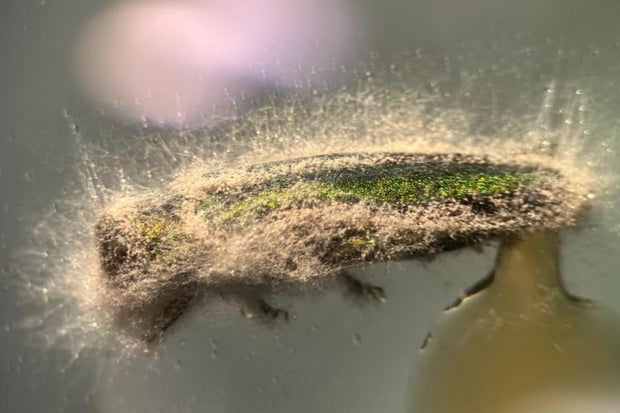
According to the university study, one tool that could help in the fight against the beetle is an autodissemination device that traps the pests and "coats them with spores of insect-killing fungi." The beetles can then fly out of the trap and spread the spores through mating.
The study's lead author is Colin Peters, a graduate of College of Food, Agricultural and Natural Resource Sciences.
"The idea behind the autodissemination device is to let the beetles do the work," Peters said. "They'd be spreading the spores, infecting their neighbors. This would be especially useful in hard-to-access forests, like the black ash marshes of northern Minnesota."
Researchers at the university tested 10 fungi from Minnesota and found that all of them were successful at infecting the beetle, but the lifespan of the beetle varied depending on the species of fungi used. Three of the fungi — as well as a commercially available fungus — "reliably reduced" the beetle's lifespan and were "consistently seen sprouting" from the carcasses of the pest.
"With a billion ash trees in Minnesota, we need to explore all possible methods to try and control this devastating pest. Laboratory studies show that biological control of the beetle using fungi is possible and the next step is to figure out how to get this to work under field conditions," Robert Blanchette, co-author of the study and a professor in the College of Food, Agricultural and Natural Resource Sciences, said.
Researchers say testing fungi from the state prevents the possibility of introducing non-native fungi to the state. Plus, fungi from Minnesota is able to thrive in local conditions.
The university says testing of the four most successful fungal strains is now underway in autodissemination devices located across state parks and forests, with state and private land managers partnering with researchers.