Gabbard, intel officials face more sharp questions on Iran war at House hearing
What to know about the House worldwide threats hearing:
- Director of National Intelligence Tulsi Gabbard faced another round of sharp questions about the Iran war from lawmakers on Thursday, appearing at a House hearing on global threats to the U.S.
- Gabbard reiterated her earlier testimony that President Trump was responsible for determining whether Iran posed an "imminent threat" to the U.S. based on the intelligence community's assessments. She said Iran "maintained the intention to rebuild its infrastructure and nuclear enrichment capability" following U.S. strikes on nuclear sites in 2025.
- The director also fielded questions for the first time about Joe Kent, the former head of the National Counterterrorism Center who stepped down to protest the war. In his resignation letter, Kent accused Israel of deceiving Mr. Trump to launch the war. GOP Rep. Elise Stefanik asked Gabbard if Kent's comments concerned her, and Gabbard said "yes."
- All five intelligence leaders testifying agreed that a 2023 intelligence assessment that concluded it was "very unlikely" a foreign adversary was responsible for Havana Syndrome should be retracted.
- Here are the highlights from Thursday's House hearing:
Gabbard says Iranian leadership's intentions are less clear than before war
Democratic Rep. Jason Crow of Colorado asked Gabbard multiple questions about the new Iranian leadership and their intentions. The president himself has said the status of Iranian leadership isn't clear following the death of Ayatollah Ali Khamenei.
On Khamenei's son, Mojtaba Khamenei, Gabbard said "it is unclear of his status or his involvement." The clerical body responsible for selecting the new supreme leader announced Mojtaba Khamenei as the new leader on March 8, but he has not been seen in public.
"He was injured very severely through one of the Israeli strikes," Gabbard said. "And so the decision-making is unclear about what's happening in the Iranian leadership."
"So we're less certain of the positions of Iranian leadership and their intentions than we were 60 days ago, correct?" Crow asked.
"That's an accurate assessment," Gabbard said.
Gabbard says intelligence community has "high confidence" of location of Iran's enriched uranium
Gabbard told Democratic Rep. Steve Cohen of Tennessee that the intelligence community has "high confidence" about the location of Iran's enriched uranium, but said it's a conversation that should take place behind closed doors. The officials are set to testify in a classified setting following the public portion of the hearing.
Patel says Iran threats mission center "has never been more resourced"
Rep. Steve Cohen, a Democrat from Tennessee, asked Patel why he fired agents, some of whom worked on counterintelligence cases pertaining to Iran. Earlier this month, CBS News reported about a dozen FBI employees, including agents, analysts and support staff, were abruptly terminated after Patel lashed out over the discovery that his phone records and those of White House chief of staff Susie Wiles were subpoenaed by the FBI as part of special counsel Jack Smith's probes into the president.
"As I said earlier, congressman, I don't work on timelines when these terminations occur," Patel said. "They're internal investigations conducted by the careers at the FBI that highlight unethical or inappropriate conduct. And it's up to me to make the decision."
Patel said the FBI's Iran threats mission center "has never been more resourced."
Cohen asked Patel if the fired FBI employees were experts on Iran.
"I don't believe so," Patel said, although he didn't or couldn't say where they worked, citing pending litigation.
Gabbard says "context matters" after she said last year Iran wasn't building nuclear weapon
Democratic Rep. Jimmy Gomez asked Gabbard about her statement last year that Iran was not building a nuclear weapon.
"Context matters with that statement," Gabbard said. "Iran had all of the materials and capabilities to do so."
Gomez interjected, reclaiming his time and calling it an easy answer. Gomez pointed back to a past statement by the president that Gabbard was wrong about that assessment. Gomez asked, "Were you lying or not?"
"I stand by the intelligence community's complete assessment," Gabbard said.
No assessment yet on benefits to Moscow of loosening oil sanctions, Gabbard says
Democratic Rep. Chrissy Houlahan asked Gabbard if the intelligence community has assessed that clearing the way for Russian oil sales with the loosening of U.S. sanctions would benefit Moscow.
"I don't believe there has been a formal IC assessment on this topic yet as it is underway," Gabbard said.
Houlahan encouraged an assessment, "because it feels as though by easing these sanctions we are directly providing the Kremlin with revenue, revenue that will be used directly to kill Ukrainian soldiers and an increased likelihood that Putin will be successful in his war with Ukraine."
Gabbard says Trump was briefed on war's potential impacts on oil and gas prices
Gabbard told Democratic Rep. Josh Gottheimer of New Jersey that the president was informed of potential impacts a conflict with Iran could have on global supply chains and on oil and gas prices. Gottheimer asked if Mr. Trump was briefed "prior to the outbreak of hostilities."
"Were you in any meetings where that came up?" Gottheimer asked.
"Yes, that is the intelligence community's assessments, and those were provided," she said.
Gabbard sidesteps questions about personal views of constitutionality of Iran strikes
Rep. Ami Bera, a Democrat from California, brought up a speech Gabbard gave in January 2020. As a member of the House, she said President Trump "committed an illegal and unconstitutional act of war" when he ordered the assassination of Iranian military commander Qassem Soleimani without congressional approval.
"Director Gabbard, do you still believe that strikes against Iran that don't have congressional authorization constitute an illegal and unconstitutional act of war?" Bera asked.
"Congressman, thank you for the question. The cost of war weighs very heavily upon me and my colleagues here," Gabbard responded. "Especially for those of us who have experienced and seen the cost of war firsthand. My own personal and political views as I mentioned earlier, I was asked and required by Congress and by the president in this role as the director of national intelligence, to check those views at the door to ensure that the intelligence assessments are not colored by my personal views."
Gabbard was asked if she still believes war with Iran would be so costly and devastating that it would make wars in Iraq and Afghanistan look like a "picnic," as she once said years ago.
"Once again, in this role, it is essential that I do not allow any of my personal views on any issues to color or bias the intelligence reporting that we deliver to you and to the president," she said.
Intelligence officials say they support 18-month reauthorization of FISA without reforms
The intelligence officials told GOP Rep. Darin LaHood of Illinois that they are supportive of Mr. Trump's stance on reauthorizing a key surveillance authority, known as Section 702 of the Foreign Intelligence Surveillance Act, for 18 months without any reforms.
The provision, first authorized in 2008, was last renewed for two years in 2024 after a series of abuses by the FBI led it to the brink of expiration.
The spy tool allows the government to collect the communications of noncitizens located outside the U.S. without a warrant, though it can also sweep up the data of Americans who are in contact with targeted foreigners.
Congress has an April 20 deadline to reauthorize the surveillance authority, though it could face hurdles with some lawmakers who want a warrant requirement to access Americans' communications.
Ratcliffe later told GOP Rep. Brian Fitzpatrick of Pennsylvania that "some reforms should be considered," but "a warrant isn't one of them."
"A warrant won't work," Ratcliffe said. "You have to make decisions very quickly, and sometimes in a matter of hours."
Gabbard acknowledges differences in U.S. and Israeli war aims
Democratic Rep. Joaquin Castro of Texas pressed Gabbard on whether the United States' and Israel's goals in the war are aligned.
"I'm thinking carefully here about what can be said in this open setting versus a closed setting," Gabbard said.
"Are the goals aligned?" Castro asked again.
Gabbard said Mr. Trump's objectives "are different" than those laid out by the Israeli government.
"How do they differ?" Castro said.
"We can see through the operations that the Israeli government has been focused on disabling the Iranian leadership and taking out several members, obviously beginning with the ayatollah, the supreme leader, and they continue to focus on that," she said.
"How does that differ from our goals?" Castro said.
"The president has stated that his objectives are to destroy Iran's ballistic missile launching capability, their ballistic missile production capability, and their Navy, the IRGC Navy, and mine-laying capability," she said.
When Castro asked whether Israel is supportive of Mr. Trump's call to make a deal with Iran, Gabbard said she didn't know Israel's position. She also said she did not have an answer for why Israel decided to strike Iranian energy infrastructure despite Mr. Trump's demand that those facilities be off limits.
Stefanik asks Gabbard why she said her testimony doesn't represent her personal views
Stefanik asked Gabbard why she said her testimony doesn't represent her personal views. Stefanik said this is the "first time" she's heard a statement like that in a committee hearing, and if there's anything in her testimony with which she disagrees.
In her opening statement, Gabbard said: "What I'm briefing here today does not represent my personal views or opinions, but rather the assessments of the intelligence community of the threats that are facing the United States, our homeland and our interests," Gabbard said in her opening statement."
"The reason I have said that is twofold," Gabbard said. "Number one is, when I assumed this role as director of national intelligence through the confirmation process and beyond, many members of Congress rightly said your personal views and your politics in this role get checked at the door. And as director of national intelligence, my responsibility is to report the intelligence community's assessments objectively and to make sure that they are not politicized in any way, shape, or form."
Gabbard said some have tried to "mischaracterize" the intelligence community's assessments.
Gabbard fields first question about Joe Kent's resignation
Republican Rep. Elise Stefanik was the first lawmaker in two days of hearings to ask Gabbard about Joe Kent, the ex-head of the National Counterterrorism Center who stepped down this week to protest the Iran war.
Stefanik read a portion of his resignation letter: "Early in this administration, high-ranking Israeli officials and influential members of the American media deployed a misinformation campaign that wholly undermined your America first platform and pro-war sentiments to encourage war with Iran. This echo chamber was used to deceive you into believing that Iran posed no imminent threat to the United States and that you should strike now. There was a clear path to a swift victory. This was a lie and was the same tactic the Israelis used to draw us into a disastrous Iraq war."
The New York Republican said she "cannot say how much I disagree with that statement. Do you agree or disagree with what this letter was put out by former director Kent?"
"He said a lot of things in that letter," Gabbard said. "Ultimately, we have provided the president with the intelligence assessments and the president is elected by the American people and makes his own decisions based on the information that's available to him."
Stefanik asked Gabbard if Kent's statement concerned her.
"Yes," Gabbard responded, without elaborating.
Multiple sources told CBS News on Wednesday that the FBI is investigating Kent in connection with alleged leaks of classified information.
Gabbard, Ratcliffe say evidence of potential Iran attack has to be shared in classified setting
Democratic Rep. Andre Carson of Indiana asked whether there is "any evidence that Iran intended to conduct a preemptive attack on the U.S. prior to beginning this war."
"The answer to this question needs to be reserved for a closed briefing," Gabbard said, adding that it's ultimately the president's decision on "what is an imminent threat."
Ratcliffe added that intelligence officials could go more in depth in a classified setting.
"There's a body of intelligence that we'll be able to cover … that does reflect that in the likely event of a conflict between Iran and Israel that the U.S. would be immediately attacked, regardless of whether the United States stayed out of that conflict," Ratcliffe said.
Patel says he doesn't know how many active investigations there are into noncitizens voting
Himes asked Patel how many noncitizens have been convicted of voting in U.S. elections.
"The conviction stats are with the Department of Justice," Patel said.
Himes asked how many active investigations the FBI has into foreign individuals voting in U.S. elections.
"We have a number of investigations, generally speaking, ongoing about individuals across the country," Patel said. Patel said he doesn't have a number with him, but there are a "number" of investigations.
Asked about Fulton County, Gabbard says intel community "continuing to look into" election interference
Himes, like Democrats in the Senate on Wednesday, brought up Gabbard's presence at the FBI search of the election headquarters in Fulton County, Georgia, where agents seized 2020 election ballots and records. Himes asked if there was credible evidence pointing to foreign interference in that election.
"As you know, over each of the previous elections there is an ongoing effort by different foreign entities —" Gabbard said before Himes interjected.
"We are continuing to look at previous attempts to interfere in our elections and any ongoing threats that may exist for the upcoming elections," Gabbard said.
Himes asked if he can assume the answer to his original question is no.
"We are continuing to look into this matter," Gabbard said.
Intelligence officials say assessment on Havana Syndrome should be retracted
Calling the intelligence community's assessment of Havana Syndrome "deeply flawed," Crawford asked the intelligence officials whether they agreed that the assessment should be retracted.
"I've called for its recall immediately," Crawford said. "I'd like to get a yes or no answer from each of you on whether you agree this [intelligence community assessment] should be retracted."
All five responded, "yes."
Gabbard says Iran "maintained the intention" to rebuild nuclear enrichment capability, a divergence from Senate testimony
Gabbard said Iran "maintained the intention to rebuild its infrastructure and nuclear enrichment capability and continued to refuse to comply with its nuclear obligations, and continued to refuse to comply with its nuclear obligations with the IAEA, refusing them access to key facilities" after last year's 12-Day War.
IAEA refers to the International Atomic Energy Agency.
That differed slightly from her testimony on Wednesday to the Senate, when she said: "Prior to Operation Epic Fury, the IC assesses Iran was trying to recover from the severe damage to its nuclear infrastructure sustained during the 12-Day War and continued to refuse to comply with its nuclear obligations, with the IAEA refusing them access to key facilities."
Top Democrat: "Not one of your agencies has produced a single report saying that Iran posed an imminent threat"
Democratic ranking member Jim Himes of Connecticut said "not one" of the intelligence agencies represented at the hearing has issued a single report finding that Iran "posed an imminent threat" to the United States.
Himes expressed a "deep admiration and appreciation" for the diligence, commitment and sacrifice of members of the intelligence community. But he expressed concerns about the intelligence community's focus, saying Congress isn't receiving the warnings they need about foreign interference in U.S. elections, and criticized the pivot to immigration issues.
On Iran, Himes said "the Constitution, to which every single one of us swears an oath, reserves decisions of war to the representatives of the people." He asked why the U.S. is risking blood and treasure "on a deeply risky venture, one that the president of the United States and the director of national intelligence have spent years telling us is a terrible idea."
Himes said the president's comment that Iran was preparing an imminent attack against the U.S. is "not true."
"As awful as the regime is and always has been, not one of your agencies has produced a single report saying that Iran posed an imminent threat to the United States," he said.
On Wednesday, Gabbard repeatedly said it is the president's decision to decide what constitutes an imminent threat, not the intelligence community.
Himes also doubted the president's comments about Iran possessing a nuclear weapon in short order. Himes said that claim isn't supported. "And it is certainly belied by the repeated claim that Iran's nuclear capability was obliterated mere months ago," he said.
"Let's consider the consequences, as the Congress should have done," he said. "The Congress, not one man, should consider whether our constituents in uniform will live or die. The Congress, not one man, should decide if Americans will spend an additional $30 a week to fill their gas tanks. The Congress, not one man, should consider if it is wise to allow the Russians to sell their oil to India so that they have millions of dollars with which to kill the Ukrainians that we are now begging for help to defend ourselves against Iranian drones."
Gabbard reiterates testimony does not represent personal views
Gabbard reiterated to the House committee that her testimony did not represent her personal views as she read the same prepared remarks that she did before a Senate panel a day earlier.
"What I'm briefing here today does not represent my personal views or opinions, but rather the assessments of the intelligence community of the threats that are facing the United States, our homeland and our interests," Gabbard said in her opening statement.
Crawford accuses intelligence community of Havana Syndrome "cover-up"
Crawford also accused the intelligence community of covering up the circumstances surrounding the debilitating condition known as Havana Syndrome.
"Put simply, it's my clear opinion that individuals in the intelligence community were involved in a cover-up," the GOP chairman said, alleging the manipulation of intelligence processes "to provide a desired outcome rather than a forthright analysis to inform decision makers."
An intelligence assessment in 2023 concluded it was "very unlikely" that a foreign adversary was responsible for the unexplained neurological symptoms that afflicted diplomats, intelligence officers and military personnel in dozens of countries. The conclusion was reaffirmed in January 2025. The Office of the Director of National Intelligence has been conducting a review of the previous assessments.
Crawford said the committee's investigation into the matter "continues to show that the intelligence community assessment was constructed upon flawed analytic tradecraft."
The U.S. government quietly acquired a device in late 2024 that officials believe may be connected to Havana Syndrome, CBS News reported in January, according to multiple sources briefed on the matter.
The Pentagon has been testing the device, which emits pulsed, radio-frequency energy, and contains Russian-made components, for more than a year.
GOP chairman says "Iran is committed to acquiring a nuclear weapon"
GOP Rep. Rick Crawford of Arkansas, the House Intelligence Committee chairman, commended President Trump for taking "decisive action" against Iran in his opening remarks. Crawford said the case for why action was needed was made "clear" to lawmakers in classified briefings.
"Once it was clear that diplomacy would not stop Iran from developing a nuclear weapon or holding the world under threat through ballistic missiles and terrorist networks, President Trump took decisive action to eliminate the threat," he said. "Make no mistake, Iran is committed to acquiring a nuclear weapon."
"There's only one person in America who has the responsibility and the obligation to act when he believes there is a clear and present danger to our safety," he said. "The commander in chief has that duty and I commend his decisiveness in his most difficult decisions."
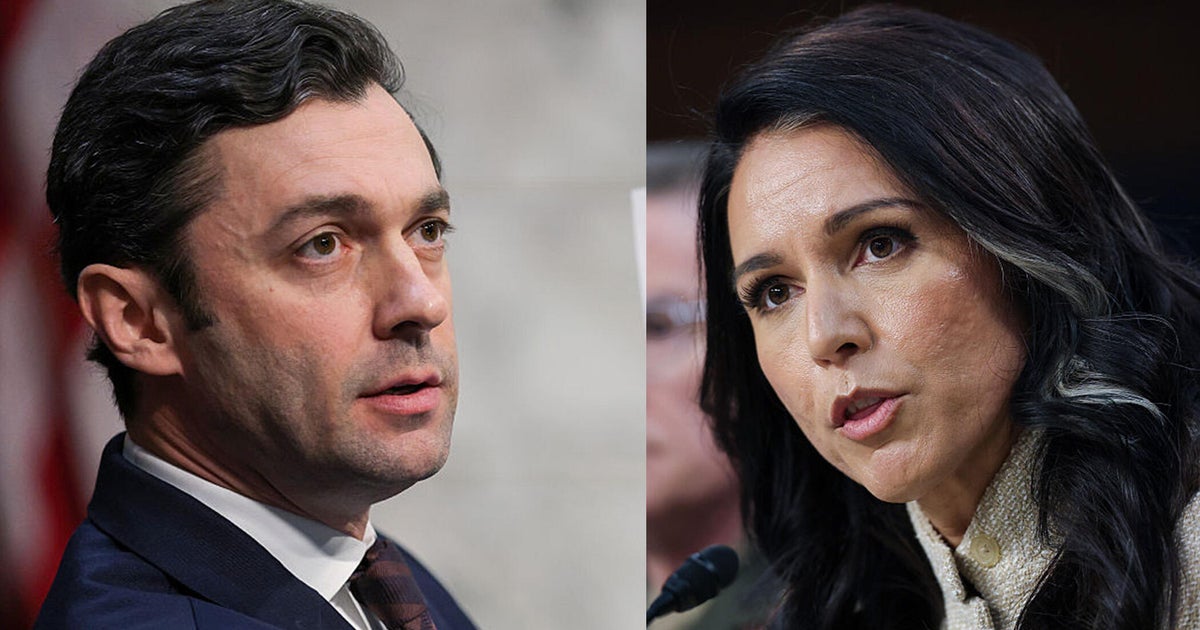
Gabbard told Senate that Iran had not resumed enrichment activities
One of the more notable moments from Wednesday's Senate hearing stemmed from an omission during Gabbard's opening remarks.
According to her written testimony, Gabbard was supposed to say that Iran's nuclear enrichment program was "obliterated" during last year's strikes on three of Iran's nuclear facilities.
"There has been no efforts since then to try to rebuild their enrichment capability," the prepared statement said. "We continue to monitor for any early indicators on what position the current or any new leadership in Iran will take with regard to authorizing a nuclear weapons program."
But Gabbard skipped the passage as she read the remarks at the top of the hearing.
The omission was quickly noted by Sen. Mark Warner of Virginia, the top Democrat on the committee, who asked if she excluded it because President Trump has said the threat posed by Iran was "imminent." Gabbard said she was trying to save time.
"I recognized that time was running long, and I skipped through some of the portion you chose," Gabbard said.
Later in the hearing, Gabbard confirmed to Democratic Sen. Jon Ossoff of Georgia that the passage she omitted was still the assessment of the intelligence community.
Gabbard also told senators the Iranian regime "appears to be intact but largely degraded."
Trump hasn't made up his mind on sending Americans into Iran
President Trump hasn't made up his mind yet on whether he wants to send American forces into Iran and seize the country's nuclear material, which would be a very dangerous operation, sources familiar with the matter told CBS News.
The Pentagon has prepared multiple options for the president as potential next steps in the Iran war.
After the U.S. military strikes on three nuclear sites last summer, the International Atomic Energy Agency, a nuclear watchdog, said it could not account for an estimated 400 kilograms of highly enriched uranium Iran had before the strikes.