3 reasons the Federal Reserve's interest rate pause is worrying investors
The fog from the Iran war is obscuring the Federal Reserve's view of the U.S. economy.
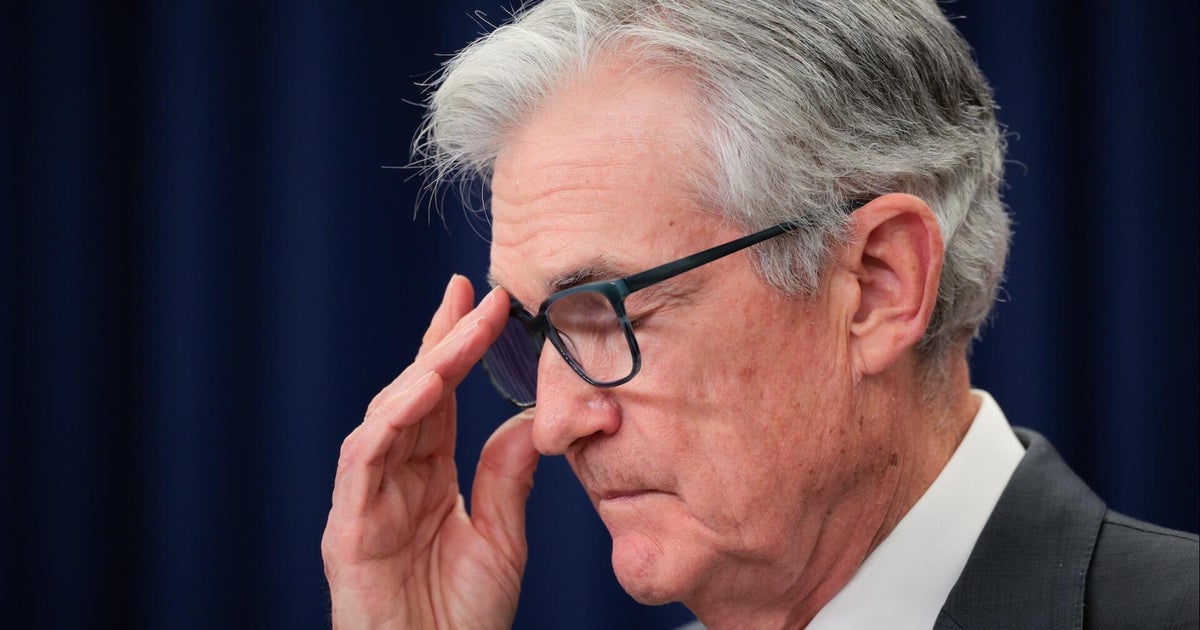
Investors were rattled on Wednesday, when the central bank said it is holding interest rates steady, after Fed Chair Jerome Powell repeatedly underlined the mounting uncertainty caused by the escalating Middle East violence. Stocks slumped during his afternoon press conference, and have continued to drop on Thursday.
"The Fed is frozen," Heather Long, chief economist at Navy Federal Credit Union, told CBS News. "We're in this world where clearly the risks are elevated to the extreme, and the No. 1 question for the economy is when does the Strait of Hormuz reopen — and that isn't really an economic question."
About 20% of the world's oil supply travels through the Strait of Hormuz in the Persian Gulf, which has been effectively paralyzed by the Iran war.
Here are three reasons the Fed's latest economic outlook is causing investors to fret.
The Fed looks frozen
During Wednesday's press conference, Powell used the phrase "we don't know" at least 14 times and said "wait-and-see" another four times. The upshot, according to EY-Parthenon chief economist Gregory Daco: The Fed doesn't want to preemptively adjust monetary policy given the roiling uncertainties around how the Iran war could evolve.
"It seems clear that the Fed was blindsided by recent inflation data and paralyzed by the Iran conflict, leaving [Fed] participants caught like deer in the headlights," Tim Duy, chief U.S. economist at SGH Macro Advisors, told clients in a report.
The Fed on Wednesday also released its latest Summary of Economic Projections, a quarterly report that outlines its members' expectations for everything from inflation to economic growth. The forecast shows that Fed officials expect inflation to be slightly hotter in 2026 than in their December forecast.
At the same time, Powell downplayed his confidence in that outlook, highlighting the unknowns now facing the central bank as oil and gas prices surge due to the Iran war.
"The thing I really want to emphasize is that nobody knows," Powell said. "The economic effect could be bigger, they could be smaller, they could be much smaller or much bigger. We just don't know."
Rate cuts may be off the table this year
Powell's remarks suggest the Fed may opt against lowering its benchmark interest rate in 2026, economists noted. Before the meeting, the Fed had been expected to cut rates once or even twice this year, Long noted.
Now, CME FedWatch, which tracks expectations for the Fed's rate decisions, shows an almost 75% probability of no rate cuts this year.
"That's a pretty big shift," she added.
The so-called "dot plot" — a chart that shows where each Fed official expects the federal funds rate will be in the near future — also signals that Fed members are less confident that additional rate cuts could occur in 2026, noted Bill Adams, chief economist for Comerica Bank.
Seven Fed officials penciled in no rate cuts in 2026, while seven support one, and five policymakers predict two or more.
"Overall, the dot plot of median rate expectations highlights a deeply divided committee," Daco said.
The job market has stalled
The Federal Reserve's dual mandate requires it to keep inflation low while also ensuring full employment.
On Wednesday, Powell noted that the unemployment rate remains relatively low, at 4.4%, but added that job creation has slowed to a standstill. "Effectively, there is zero net job creation in the private sector," he said.
Typically, the Fed cuts interest rates to bolster the job market because lower borrowing costs make it cheaper for businesses to expand and hire new workers. But the central bank is balancing labor market weakness with stubborn inflation, which has remained above the Fed's annual 2% annual target and which is expected to rise because of surging energy prices.
A plus for U.S. workers is that layoffs remain low by historical standards. Still, that doesn't mean the job market is humming, experts noted. The U.S. shed 92,000 jobs in February, an unexpected setback after economists had forecast a gain.
"The United States is in a hiring recession," Long said. "Americans are worried and frustrated about it — it's really hard to get a job right now."