U.S. pauses Iran strikes for second straight night as talks move in positive direction

Follow updates on the war in the Middle East for Monday, July 27, here. See earlier developments below.
What to know about the Iran war today:
- Talks between Oman and Iran on reopening the Strait of Hormuz and their respective territorial waterways have made progress, two regional sources told CBS News.
- The Iranian military said it halted retaliatory attacks against U.S. allies in the Middle East after Washington paused its strikes on Iran for the last two nights. That pause followed 13 consecutive nights of strikes by the U.S.
- A CBS News poll found feelings of uncertainty about the Iran conflict, with most respondents saying it's more difficult than President Trump expected.
Iran's Revolutionary Guard turns back 6 ships in Strait of Hormuz, state TV says
Iran's Revolutionary Guard's navy stopped six vessels trying to transit the Strait of Hormuz through routes not approved by Iranian authorities, state television reported on Monday.
"Last night, six vessels that attempted to transit through a route other than the designated one were stopped by the IRGC Navy with warning shots and turned back," a state television correspondent reported from the Gulf.
Earlier, state TV had said one was involved in an "incident," without elaborating.
On Saturday, the Guards said they'd stopped four vessels that were trying to transit through the southern part of the strait after firing warning shots.
Iran has effectively blockaded the Strait of Hormuz since the start of the Middle East war in late February.
Oil prices fall further from two-month high set last week
Oil prices eased in early trading Sunday, falling further from a two-month high set last week, after the United States and Iran refrained from launching military strikes in the Persian Gulf for a second straight day.
The price for a barrel of Brent crude oil to be delivered in September dropped 4.9% to $92.02 shortly after trading resumed. The decline followed a 3.9% drop on Friday.
Brent crude, the international standard, briefly hit $102 a barrel last week. That was $30 more than the most actively traded contract in the Brent market was going for early in the month, and the highest it had been since May.
Oil prices surged this month because of increased fighting in the Middle East and worries that a return to all-out war would further slow the global flow of crude.
Qatari prime minister holds phone call with United Arab Emirates' national security adviser
Qatari Prime Minister Sheikh Mohammed bin Abdulrahman bin Jassim Al-Thani held a phone call Sunday with Sheikh Tahnoon bin Zayed Al Nahyan, the deputy ruler of Abu Dhabi and national security adviser of the United Arab Emirates, to discuss "bilateral relations and ways to support and enhance bilateral cooperation," said Qatar's Foreign Affairs Ministry in a statement.
"They also addressed the latest regional developments, particularly diplomatic efforts and joint coordination to de-escalate tensions and strengthen security and stability in the region," the statement continued, adding that Al-Thani "stressed the importance of all parties adhering to dialogue and diplomacy" and "ensuring freedom of navigation in the Strait of Hormuz."
Iran threatens retaliation after Ukrainian attack on ship
Iran's Foreign Minister Abbas Araghchi on Sunday warned that his country would respond to a deadly attack by Ukraine on an Iranian ship in the Caspian Sea.
It came after Ukrainian President Volodymyr Zelenskyy said Kyiv had carried out long-range strikes in the Caspian Sea against vessels transporting military cargo involving Iran, underscoring the increasingly international dimensions of Russia's war in Ukraine.
"Zelenskyy has attacked an Iranian commercial vessel, killing a sailor," Araghchi said on X, describing it as "a blatant UN Charter violation done at Israel's behest to drag Europe into its war."
Iran's foreign ministry said the attack caused the ship "to explode, killing one sailor and injuring several others."
The Islamic Republic "has never intervened in the conflict between Russia and Ukraine," the ministry said in a statement.
On Saturday, Ukrainian President Volodymyr Zelenskyy said on social media that armed forces had achieved "very strong results with long-range strikes in the Caspian Sea — including vessels used in military cargo shipments involving Iran, as well as a warship."
Ukraine's intelligence services, for their part, reported on Telegram that drone attacks had been carried out against "cargo vessels under international sanctions that were used to transport military cargo between Iran and Russia."
400 U.S. service members flown out for treatment since Operation Epic Fury began
More than 400 U.S. service members have been flown out of the Middle East for various types of treatment since Operation Epic Fury began, a U.S. official told CBS News. However, most cases were not combat-related, the official said.
Operation Epic Fury, the military campaign carried out jointly by the U.S. and Israel against Iran, started Feb. 28.
Strait of Hormuz's status remains unchanged, Iranian official says
Iran's Foreign Ministry spokesperson, Esmail Baghaei, said on Sunday that the Strait of Hormuz's status remains unchanged, as Iranian and Omani officials continued talks to manage the safe transit of ships through the waterway that passes between both countries.
Baghaei said the talks had made progress. They took place after Tehran asserted
that its interim deal with the U.S. allows it to manage shipping in the strait for now, and objected to U.S. efforts to support a route through the strait that passes close to Oman instead. The strait was considered an international waterway before the war.
The U.S. military on Saturday said its recently reimposed naval blockade against Iran continued, with a dozen commercial ships redirected, two disabled and two boarded. U.S. forces "remain highly vigilant, focused, lethal, and ready," it added.
Israeli Prime Minister Benjamin Netanyahu said Sunday on Fox News' "Sunday Morning Futures" that he supports Mr. Trump's pressure on Iran to end its nuclear program. During his upcoming visit to Washington, Netanyahu suggested he wouldn't share new intelligence with Mr. Trump and instead listen to "what he has in mind, because I think in many ways, it's his decision."
CBS/AP
Netanyahu vows "very forceful" response if Iran attacks Israel
Ahead of his scheduled trip to Washington, D.C., on Tuesday, Israeli Prime Minister Benjamin Netanyahu again warned of the retaliation that would follow any potential attack by Iran.
"If Iran attacks Israel, either directly or through proxies, either with ballistic missiles, or UAVs, or killer drones, it will make a terrible mistake," said Netanyahu on Fox News' "Sunday Morning Futures." "Because our response, Israel's response, will be very, very forceful."
Speaking about dismantling Iran's nuclear program, he suggested that military actions carried out by the U.S. and Israel "pushed them back a good few years" by targeting top Iranian nuclear scientists and nuclear facilities. But, he added, that "doesn't mean that they can't try again."
Talks between Iran and Oman have been constructive, moving in positive direction, official says
Discussions between Iranian officials and their Omani counterparts over the last two days have been constructive, one Iranian official told CBS News on Sunday. Talks to reopen the Strait of Hormuz are also moving in a positive direction, the official said.
This diplomacy aims to reopen waterways around the Strait. It's directly linked to the U.S. halting strikes on Iran for the last two consecutive nights, although President Trump and Defense Secretary Pete Hegseth say the Strait is open already, and the U.S. controls it.
The U.S. Central Command paused bombings Friday and Saturday after 13 straight days of strikes. Tehran also paused bombings on Sunday.
U.S. Ambassador to the United Nations Mike Waltz told "Face the Nation with Margaret Brennan" on Sunday that the pause was aimed at "giving diplomacy some space."
"It's giving diplomacy a little bit of time. The president tried diplomacy last year, tried it this year. He is a president of peace. He is giving diplomacy a chance," said Waltz, who added that the U.S. will gauge how things are going in the coming days. "Make no mistake, assets, additional military assets, are moving into the region. The regime should believe the president when he says they're locked and loaded."
In a letter dated July 10, Trump gave formal notification to Congress that hostilities against Iran resumed on July 7.
U.S. ambassador criticizes reports about munitions supplies amid Iran war
United States ambassador to the United Nations Mike Waltz called reports that the U.S. military does not have enough firepower in the Middle East "nonsense" in an appearance on "Face the Nation with Margaret Brennan."
"Not only do we have what we need in the theater, there's more (assets) moving into the theater," Waltz said.
CBS News has reported that U.S. forces cannot sustain the rate at which it has expended precision munitions. Previous reports showed that the U.S. military was using such munitions faster than they can be replaced. Other reporting has shown a shortage of indicators.
Waltz did not address the specific reporting, but highlighted the impact the Iran war has had on Tehran's munitions supply.
Kuwait, Pakistan formally sign strategic defense agreement
Kuwait has formally signed a strategic defense cooperation agreement with Pakistan, in another signal that Gulf states are steadily broadening security relationships beyond their traditional dependence on the U.S.
The agreement builds on an existing military relationship but expands it to include wider defense and security cooperation.
It comes on the heels of last year's strategic defense pact with Pakistan and Saudi Arabia, which suggests Islamabad is becoming an increasingly important security partner across the Gulf. It also comes just days after the Trump administration concluded its civilian nuclear agreement with Saudi Arabia, a deal that has already raised questions about the future strategic balance in the Gulf and the Kingdom's long-term nuclear ambitions.
The agreement between Kuwait and Pakistan serves as a reminder of how dramatically Pakistan's regional position has changed. Not long ago, Islamabad was widely viewed as diplomatically isolated. Now, with strong backing from President Trump, it has rapidly re-established itself as both a diplomatic broker, especially with Iran, and an increasingly important security partner for Gulf Arab states.
Sen. Bernie Sanders calls for negotiated end to Iran war
Sen. Bernie Sanders, an independent from Vermont, said on "Face the Nation with Margaret Brennan" that the Trump administration should "sit down" and "negotiate with" the Iranian regime to "stop the killing" and "the devastation to our economy."
"That's what we've got to do: Sit down and negotiate, and let's end this war," Sanders said.
Sanders also criticized Defense Secretary Pete Hegseth's request to Congress for $67 billion on an emergency basis to pay troops and restock munitions. He said funds could be better used to build housing or provide healthcare and help "a middle-class, working-class in this country that is struggling."
"The war in Iran is unconstitutional. It is illegal, should never have been started," Sanders said.
CBS News poll finds Iran conflict marked by feelings of uncertainty
Across months of the Iran conflict, the public continues to express three main ideas:
- A perceived lack of clarity about what's happening day to day in the Strait of Hormuz.
- There are plenty of important goals the U.S. could seek, now that we're in the conflict.
- The conflict is not going well.
So today, as fighting escalates again, most Americans pick "uncertain" and "frustrated" as the top ways to describe their personal feelings about it.
Either way, now most are expecting the conflict to take months or even years longer, with a big majority saying it's been harder than the Trump administration anticipated.
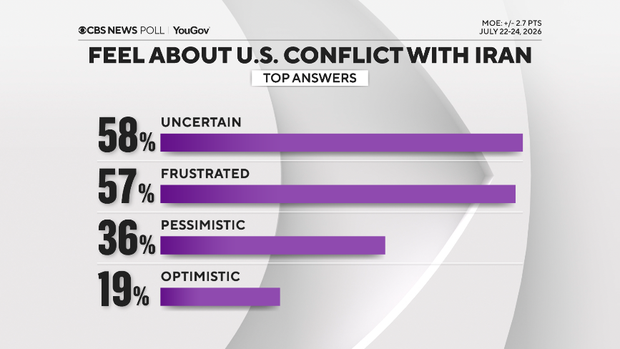
The public's expressed goals have been consistent.
It remains important to most Americans to open the Strait of Hormuz (especially as gas prices rise back home), to stop Iran's nuclear program and to stop Iran from threatening the region.
But that doesn't mean people think it'll be easy, and most suspect the conflict will last months or even years longer.
Incident involving tanker, military in Gulf of Oman reported to U.K. maritime agency
An incident involving a tanker and military forces in the Gulf of Oman was reported Saturday to the U.K. Maritime Trade Operations agency, a British naval center that provides security alerts and coordinates safety information in the Red Sea and Persian Gulf, the agency said. The incident took place Friday, according to the agency, which didn't provide additional details about the circumstances surrounding it.
"Vessels are advised to consider the latest maritime security information and maintain awareness of the evolving operational environment," the agency said in an advisory. "Authorities are aware and relevant investigations remain ongoing."
Lebanese army says Israeli military hindering its deployment in country's south
Lebanon's army on Sunday condemned ongoing Israeli military activities in the country's south, saying Israel's attacks were hindering the full deployment of its forces, as agreed in a framework deal between the two countries reached last month.
"Israeli occupation forces continue their attacks and violations of current understandings and of international laws through the systematic destruction and bulldozing of homes, bombardment and sweeps with automatic weapons in several southern areas," the Lebanese army said in a statement.
It added that "the continuation of these attacks obstructs the army's full deployment according to current agreements and prevents the return of residents to their villages and towns."
Israel and Lebanon agreed in June to establish "pilot" security zones in parts of southern Lebanon, which Lebanese troops would control in hopes of regaining authority in areas previously dominated by Hezbollah. But disputes over the timeline and terms of Israel's withdrawal from the region mean major tensions remain.
CBS/AFP
Iran says it halted retaliatory attacks on U.S. allies in Middle East
Iran said it paused retaliatory attacks on U.S. allies in the Middle East on Sunday, after Washington halted strikes against Iran for two consecutive nights and effectively paused the war now nearing its fifth month. Reports also emerged that concerns over dwindling munitions were restraining plans for further escalation.
"These attacks continued until two nights ago, but over the past two nights the Americans have stopped their attacks," said Iranian army spokesman Mohammad Akraminia. "Since... our strategy has essentially been retaliatory, we have also halted our retaliatory operations."
But the Iranian army warned Sunday that the conflict would expand if the U.S. were to resume its attacks on the country.
Fighting over the strategic Strait of Hormuz derailed diplomatic efforts between Washington and Tehran, but the conflict then expanded beyond the vital energy corridor to include attacks on U.S. bases, regional shipping and Gulf allies.
The recent lull has revived hopes of a return to negotiations after nearly two weeks of consecutive nightly U.S. bombardments, although some have attributed the pause to mounting pressure on stockpiles of Patriot interceptors and other defensive weapons.
CBS/AFP
Diplomatic talks on Strait of Hormuz make progress, sources say
Two regional sources told CBS News that there was progress in the talks between Oman and Iran regarding reopening the Strait of Hormuz and their respective territorial waterways in that area. The two sources indicated that while things are headed in a positive direction, the diplomacy needs more time in order to reach a deal.
Omani officials had traveled Friday to Tehran for talks, and that diplomatic outreach coincided with President Trump's decision to pause U.S. bombing, which the military had carried out for the prior 13 consecutive nights. The regional officials both indicated that the U.S. bombing was intentionally paused so as not to disrupt the delicate in-person diplomacy. The White House and CENTCOM did not reply to requests for comment.
The Omani-Iranian talks are being tracked closely by the U.S. On Friday, Mr. Trump repeated a well-worn line to a captive audience at the White House Correspondents' dinner, saying that Iran would "love to make a deal."
"I don't think they're ready to. I don't think it's time yet, but I'm willing to listen," Mr. Trump continued.
Iran's foreign ministry condemns Ukrainian attack on commercial vessel in Caspian Sea
Iran's foreign ministry condemned what it called a Ukrainian attack Saturday on an Iranian commercial vessel in the Caspian Sea, saying one person was killed and another was hurt and calling it an act of aggression.
Iran's foreign minister, Abbas Araghchi, said he spoke with European Union foreign policy chief Kaja Kallas about it and that Tehran demanded a response.
Ukrainian President Volodymyr Zelenskyy earlier said on X that Ukraine "achieved very strong results with long‑range strikes in the Caspian Sea — including vessels used in military cargo shipments involving Iran."
Ukraine's Zelenskyy accuses Russia of assisting Iran with satellite imagery of U.S. bases in Middle East
Ukrainian President Volodymyr Zelenskyy said on Saturday he will share evidence with the United States showing Russia is assisting Iran target U.S. bases in the Middle East via satellite surveillance.
"Since the beginning of July, we have recorded active Russian satellite surveillance of the Gulf states and U.S. military facilities located there," Zelenskyy said on X. "These images subsequently appear in Iran. At the same time, there is a clear correlation between Russia's satellite imagery of these sites and Iranian strikes — both before the attacks, in preparation for them, and afterward, to assess the damage inflicted."
Zelenskyy's accusations of Russia helping Iran target U.S. troops are not the first. The allegation has lingered in media reports over the last few months, often with China possibly being involved as well.
During a hearing on Capitol Hill earlier this week, Defense Secretary Pete Hegseth was directly asked whether Russia and China were helping Iran. His answer was somewhat unclear, but he did say they were helping Iran.
"There's definitely adversary alignment, attempts to do so, and there are many ways that we deter that. And the depth and extent of it ought to remain classified, and it should," Hegseth said. "But there are ways in which both of those countries are limiting, at different levels, enabling some of the things Iran is doing, yes."
However, just days later, President Trump contradicted his secretary of defense, saying on Truth Social he did not believe they were assisting Iran. He mentioned both Chinese President Xi Jinping and Russian President Vladimir Putin and said they had assured him they were not involved.
"Therefore, two major Countries that people speak of often in terms of Iran are, in my opinion, not participating," Mr. Trump wrote. "If they did, it would be very bad for them — Certainly not in their best interests."
But Zelenskyy on Saturday pointed to specific instances of Russia assisting Iran with targeting bases with U.S. troops.
"On July 19 and 20 alone, four air bases fell within the area of interest of Russian satellites — two in Bahrain, one in Jordan, and one in Kuwait," Zelenskyy continued. "The purpose is clear. None of us in the world should turn a blind eye to one very simple fact: evil always seeks ways to make things worse and spread further. Russia must be stopped. This war must be stopped. Pressure on the aggressor must work."
Iran foreign minister says "no military solution" to Yemen conflict
Iranian Foreign Minister Abbas Araghchi said on Saturday there was no military solution to the escalating conflict between Saudi Arabia and the Tehran-backed Houthi rebels in Yemen, after both sides traded attacks.
"We believe that there is no military solution to the issue of Yemen, Bab al-Mandab, and other regional issues," said Araghchi in an interview published on Saturday by the state-run Iran Daily newspaper, calling for "dialogue."
He said the situation in Yemen "cannot be attributed to Iran" and the incidents in the Bab el-Mandeb Strait were "rooted in old disputes and issues between Yemen, Saudi Arabia and the countries of the region."
Iranian foreign ministry spokesman Esmaeil Baqaei made similar remarks, expressing Tehran's readiness to facilitate any talks between the two sides.
"Returning to the path of dialogue and the full implementation of the agreed roadmap is the only way to end the suffering of the Yemeni people and maintain security and stability in the region," Baqaei said.
Pakistan speaks to Saudi foreign minister by phone in bid to ease tensions with Houthis
Pakistan has reached out to Saudi officials as tensions start to boil over between Saudi Arabia and the Yemen-based Houthi rebels.
Ishaq Dar, foreign minister for Pakistan, spoke to his Saudi counterpart Faisal bin Farhan Al Saud on Saturday hours after the Houthis targeted two Aramco oil facilities in Saudi Arabia, according to Pakistan's Ministry of Foreign Affairs.
"The two leaders exchanged views on the latest regional developments and reaffirmed the close and brotherly ties between Pakistan and Saudi Arabia," according to the foreign ministry. "They underscored the importance of continued diplomacy and shared their commitment to promoting constructive engagement, peace, and stability in the region."
The drone and missile attacks on Saudi-owned Aramco facilities in Jizan and Yanbu on Saturday came in response to Saudi airstrikes Friday on the Red Sea city of Hodeida, a city controlled by the Houthi rebels near the mouth of the Bab el-Mandeb Strait.
The Iran-backed Houthi military had threatened to shut down the strait in solidarity with Iran's shutdown of the Strait of Hormuz. The Houthis fired on two Saudi-flagged oil tankers in the Red Sea late Wednesday.
IRGC says it stopped 4 ships trying to transit Hormuz strait
Iran's Revolutionary Guards said on Saturday their forces stopped four ships attempting to transit the strategic Strait of Hormuz over the past 24 hours.
"Four vessels that had intended to transit through the southern area of the Strait of Hormuz via an illegal and unsafe route were stopped over the past 24 hours after warning shots were fired by the IRGC Navy," the Guards said in a statement quoted by state television, adding that the ships had "altered course."
Iran has in recent weeks hit tankers using a route hugging the Omani coast, sanctioned by the U.S., to traverse the strait, in a bid to strong-arm vessels into using its own waters and pay for safe passage.
Yemen's Houthis announce strikes on Aramco oil facilities in Saudi Arabia
The Houthis, an Iran-backed paramilitary group in Yemen, announced strikes on Saudi oil company Aramco's facilities in Jizan and Yanbu on Saturday.
The Houthis fired "dozens of ballistic and cruise missiles and drones," which successfully hit their targets, according to spokesperson Yahya Saree. The strikes or whether they were successful could not be independently verified.
The group also confirmed the military blockade of the Bab el-Mandeb Strait, the southern exit point of the Red Sea, remains in effect. The Houthis struck two Saudi-flagged commercial tankers in the Red Sea earlier this week, but had not struck any ships since then, bringing some calm to the region.
"We will not hesitate to expand our operations and escalate our actions based on developments in the coming hours and days, within the equation of a blockade for a blockade and an escalation for an escalation," Saree said in a statement.
Ukraine targets vessel carrying military shipments to Iran, Zelenskyy says
The two major ongoing wars crossed paths on Saturday when Ukrainian President Volodymyr Zelenskyy announced his country had struck a ship carrying arms for Iran.
As has become usual, the president ran off a list of long-distance strikes inside Russia, including targeting a weapons plant in Kirov, oil refinery in Tyumen and a logistics facility in Yekaterinburg, among others. But he also mentioned an unusual strike.
"We also achieved very strong results with long‑range strikes in the Caspian Sea - including vessels used in military cargo shipments involving Iran, as well as a warship," Zelenskyy said on X.
It's unclear what the ship might have been carrying to Iran, but Russia is a close ally of the Iranians and vice versa. Iran had provided many Shahed attack drones to Russia in the first couple years of the war, until Iran needed more for their own use of late.
Just yesterday in a Truth Social post, the president claimed he does not believe Russia or China are selling weapons to Iran, writing "two major Countries that people speak of often in terms of Iran are, in my opinion, not participating. If they did, it would be very bad for them - Certainly not in their best interests."
Iran reports no strikes overnight for the first time in almost 2 weeks
Iran reported no strikes overnight into Saturday, an apparent break from nearly two weeks of consecutive nights of U.S. attacks, but tensions remain high in the region.
Iranian Health Ministry spokesperson Hossein Kermanpour posted on X, saying that "Iran had a peaceful night," without any attacks reported. The U.S. Central Command didn't immediately respond to a request for comment. However, unlike the previous 13 nights, it did not announce new strikes.
Sirens sounded multiple times early Saturday in Saudi Arabia's Yanbu and Jizan provinces, which house crucial oil facilities on the Red Sea, according to the Saudi Civil Defense. It said the sirens were because of a "potential danger" that was later lifted, without providing further details. Bahrain also sounded missile alerts early Saturday, but no casualties have been reported.
Trump flew from Turkey on older Air Force One after credible threat from Iran and its proxies
President Trump departed the NATO summit in Turkey earlier this month on the old Air Force One jet — rather than the newer plane donated by Qatar — following a credible threat to the president from Iran and allied proxy groups, U.S. officials told CBS News.
The officials told CBS News that the U.S. detected a credible plot to fire a missile at the plane. Upon receiving the intelligence, the U.S. Secret Service swiftly swapped to a backup strategy.
The news of threats from Iranian proxies was first reported by The New York Times.
U.S. forces disable ship allegedly heading toward Iran
The U.S. military disabled a ship that was allegedly sailing toward Iran, in violation of a blockade of Iranian ports reinstated by President Trump last week, U.S. Central Command said.
"We disabled the tanker after the crew attempted to run the blockade at least four times prior. The crew was repeatedly warned, didn't comply, and U.S. forces on scene disabled the ship after firing into its engine room. The ship is no longer transiting to Iran," Navy Capt. Tim Hawkins, a CENTCOM spokesperson, told CBS News.
—Ryan Sprouse
Trump says "I trust" Xi and Putin when they say they aren't helping Iran
After posting that he takes Chinese President Xi Jinping "at his word" when he said he wouldn't sell weapons to Iran, President Trump said he trusts both Xi and Russian President Vladimir Putin that they wouldn't assist Iran.
That's despite Defense Secretary Pete Hegseth saying China and Russia, "at different levels," are "enabling what Iran is doing."
"Well, I don't know that they're enabling," the president said Friday. "I will tell you that President Xi said he will not partake, and President Putin said the same thing. I think you know, I trust them. They've had a long-term relationship, there could be some things they do. But thus far, at least, it has not been major. I don't think they'd want to have me disappointed."
Trump declines to say whether blowing up bridges and power plants is a war crime
In the Oval Office Friday, President Trump declined to say when asked if blowing up power plants and bridges – something he's threatened to do in Iran – is a war crime.
A reporter asked: "You're talking about blowing up civilian power plants and bridges. Much of the civilized world would consider that a war crime. Do you?"
"Uh, I won't respond to that question," Mr. Trump said. "Who are you with?"
"The New York Times," the reporter responded.
"Figured so," Mr. Trump said. "Failing New York Times."
Crossings continue to fall in Strait of Hormuz, but rise in Bab el-Mandeb, data shows
Traffic through the Strait of Hormuz fell to a trickle on Thursday, but the number of commercial vessels passing through the Bab el-Mandeb Strait increased, according to data from intelligence firm Kpler.
Only six ships passed through the Strait of Hormuz on Thursday after 15 passed through a day earlier, according to the data. Five used the northern route designated by Iran, as opposed to the U.S.-sanctioned route to the south, Kpler said.
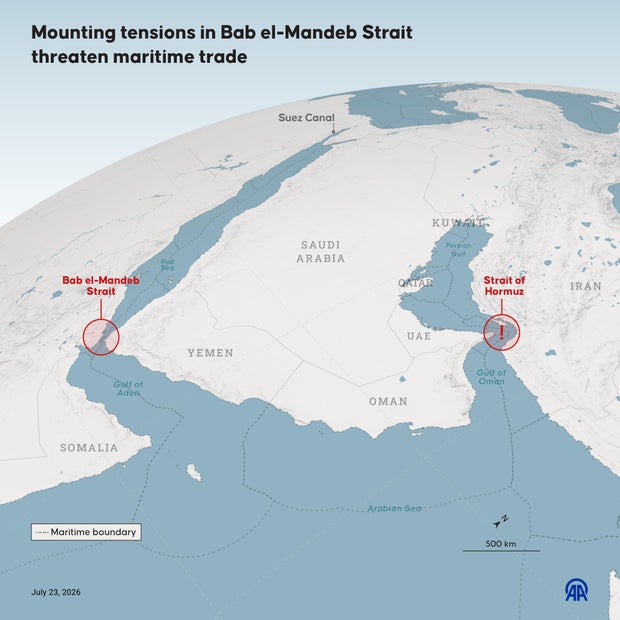
Traffic was better in the Bab el-Mandeb Strait, which is the southern exit to the Red Sea that passes by Yemen. The Iran-backed Houthi militia based in Yemen targeted two Saudi-flagged ships in the strait late Wednesday into Thursday after threatening to shut down traffic.
Forty-nine vessels traveled through the Bab el-Mandeb on Thursday, according to Kpler, just below the number of ships that previously traveled through the waterway on an average day. Only 29 transited the strait on Tuesday after the Houthis threatened to target ships, Kpler said.
"Several ships that had previously reversed course in the Gulf of Aden and Red Sea completed their crossings, while others remain on hold following earlier U turns," Kpler said on X. "The data points to a cautious but selective return to transit activity as operators continue to assess security conditions."
On Friday, the Houthis said they were only targeting Saudi vessels.
Oil prices fall back under $100 following sharp rise
The cost of Brent crude, the international benchmark price for oil, fell back under $100 on Friday after a rough rise throughout the week.
The cost dipped about 4% as of 2 p.m. ET to about $96. The cost had reached $101 on Thursday, its highest level since May. Costs were still up about 8% this week.
The continued closure of the Strait of Hormuz due to Iranian threats on shipping vessels combined with the Iran-backed Houthis targeting two Saudi-flagged oil tankers in the Bab el-Mandeb Strait, at the southern end of the Red Sea, had caused further panic in the industry. But the Houthis have not targeted any ships since the initial two, possibly bringing some calm back to investors.
Prices had fallen from well over $100 into the $70 range after the U.S. and Iran agreed to a memorandum of understanding in June and reopened the Strait of Hormuz.
Americans are currently paying $4.11 per gallon of regular on average nationwide, according to AAA, up from $3.16 at this time a year ago.
Netanyahu to meet with Trump next week
Israeli Prime Minister Benjamin Netanyahu will meet with President Trump in Washington next week, according to the prime minister's office.
Netanyahu will leave for Washington, D.C., on Monday and meet with the president at the White House on Tuesday, his office said.
The prime minister will also attend the funeral for Sen. Lindsey Graham, who he described as "a friend of Israel." Graham often served as a conduit on behalf of the U.S. to the Israeli government and wider Middle East.
Netanyahu last visited the U.S. in February. He met with Mr. Trump at the White House on that visit as well, just days before launching the initial strikes on Iran.
U.S. issues sanctions against notorious Iranian billionaire for enabling regime
The U.S. has issued new sanctions against Babak Zanjani, an infamous Iranian billionaire who is now allegedly helping Iran avoid previous sanctions and fund the Islamic Revolutionary Guard Corps.
"Today's action targets four individuals and nine entities tied to Zanjani's operations," Tommy Pigott, a spokesperson for the U.S. State Department, said in a press release. "Zanjani's re-emergence as a regime-linked financier — despite previously receiving a death sentence in Iran for embezzlement — demonstrates the lengths to which Iranian state-affiliated elites will go to preserve access to the international financial system so that they can enrich themselves, even as they mismanage the Iranian economy."
Zanjani was sentenced to death for allegedly embezzling millions from the National Iranian Oil Company, but that sentence was commuted in 2024 and he emerged as a major backer of the regime last year, according to the U.S. Treasury Department.
"The Iranian regime continues to pay a steep economic price for its reckless behavior, with the rial plunging to another record low and inflation up massively," Treasury Secretary Scott Bessent said in a statement. "Under President Trump's leadership, Treasury will continue cutting off economic access for corrupt Iranian regime elites, along with their financiers and facilitators."
The sanctions target Zanjani's Dot One conglomerate, which the U.S. says is involved in everything from telecommunications and transportation to airlines and digital assets, like cryptocurrency.
EU sanctions Iranian judges, leading cyber group figure
The European Union has announced sanctions on five Iranian judges, as well as a leading cyber group figure, for human rights offenses.
"While the world's attention is on the war in the Middle East, we can't lose sight of Iran's repression against its own people," the EU's top diplomat, Kaja Kallas, said in a post Friday on X.
In a statement, the European Council said it was including five judges "of Iran regional Revolutionary courts who have presided over trials targeting religious minorities and political dissidents ... on the basis of vaguely defined national security and religious charges."
"They have imposed death sentences and long prison sentences, flogging, fines or supplementary punishments on political dissidents and human rights activists," the bulletin added.
The council said it was also targeting an Iranian hacker and computer engineer called Nima Salehi, "the founder and a leading figure within the 'Ashiyane' cyber group," which "cooperates closely with the EU-listed Cyber Police (FATA) and the Islamic Revolutionary Guard Corps (IRGC) and is responsible for intensive cyber-attacks on both domestic opponents and reformists and foreign institutions, thereby assisting the regime's crackdown against the opposition."
Trump says he doesn't believe China and Russia are giving weapons to Iran
President Trump said Friday that he does not believe Russia or China are providing weapons to Iran.
In a post on Truth Social, Mr. Trump said that while he was in Beijing in May, Chinese President Xi Jinping said he would not "under any circumstances" provide weapons to Iran, including arms from Chinese companies.
"Considering our relationship, I take him at his word and, besides, l am doing him very big favors, also," the president wrote.
Mr. Trump said Russian President Vladimir Putin also said he would not sell weapons to Iran.
"He understands that I do not sell Weapons to Ukraine, but to NATO Countries. They pay full price, and how those Weapons are distributed, I have no idea," the president said.
"Therefore, two major Countries that people speak of often in terms of Iran are, in my opinion, not participating," Mr. Trump wrote, adding: "If they did, it would be very bad for them — Certainly not in their best interests."
CBS News has reported that Russia and China have both supported Iran during the war, which was launched jointly by the U.S. and Israel on Feb. 28.
Multiple sources told CBS News in March that Russia was providing intelligence to Iran about U.S. military positions in the Middle East.
Analysts at the Defense Intelligence Agency, which is the Defense Department's military intelligence arm, assessed soon after the start of the war that China was considering providing Iran with advanced radar systems, multiple sources familiar with the matter told CBS News at the time. Such technology would help Tehran better detect and track incoming threats, such as low-flying drones and cruise missiles.
U.S. intelligence assessments also indicated that China had previously provided Tehran with satellite imagery, which the theocratic Islamic regime used during the war, two U.S. officials familiar with the matter said in April.
The Financial Times reported in April that Iran's Islamic Revolutionary Guard Corps had used a spy satellite it purchased from Earth Eye Co., a Chinese company, to target U.S. military bases in the Middle East.
Houthis say they aren't seeking to close Bab el-Mandeb Strait: Blockade "only affects the Saudi side"
A spokesman for the Houthi rebels in Yemen said Friday that the Iranian-backed group was not seeking to block all traffic through the strategic Bab el-Mandeb Strait, just Saudi traffic. The group declared a maritime blockade earlier this week of Saudi Arabia, a long-time foe of both the Houthis and Iran.
"There is no closure of Bab el-Mandab as some are suggesting," said Mohammed Abdusalam, a top Houthi negotiator, in a post on X, adding that the group's actions - which have included attacking two vessels this week - were "limited to a maritime blockade that only affects the Saudi side."
Like the nearby Strait of Hormuz, the Bab el-Mandeb is a key transit point for global energy supply. On Wednesday, the Houthis said they had struck two Saudi tankers in the Red Sea.
On Thursday, President Trump warned that if they did it again, both Iran and the Houthis would face "major military punishment."
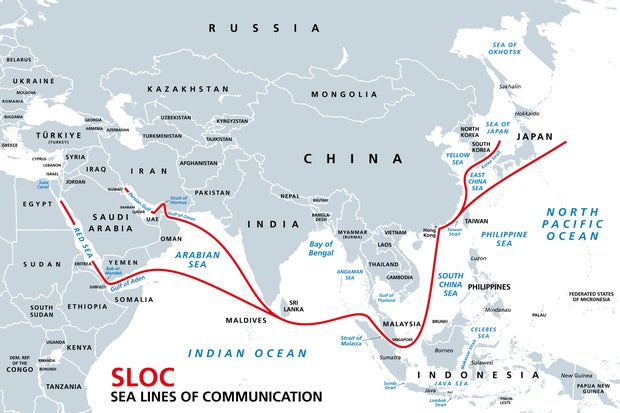
Two super tankers carrying Saudi oil did pass through the waterway Thursday, having previously turned away from the Bab el-Mandeb, after changing their listed public details to declare them as owned and operated by China.
CBS/AFP
Drones downed over Erbil, northern Iraq, Kurdish forces confirm
Kurdish forces said the U.S.-led coalition in the area shot down five drones Friday over Erbil, the capital of Iraq's northern Kurdistan region, which has been repeatedly attacked since hostilities between the U.S. and Iran resumed in early July.
An AFP news agency journalist reported earlier seeing drones over Erbil before air defenses were activated, resulting in explosions and visible smoke near the city's airport, which hosts U.S. forces and a U.S. consulate.
A clip posted on X by Kurdish broadcaster Rudaw showed a drone flying through the sky before being struck and falling to the ground in a trail of fire.
Kurdish counterterrorism forces told AFP that "the coalition forces downed five explosive-laden drones over Erbil between 9:32 and 9:45 a.m." local time on Friday.
No casualties were reported, the officials told the news agency.
Since the start of the U.S.-Israeli war with Iran on Feb. 28, Iran and its proxy groups in Iraq have repeatedly targeted U.S. forces based in the northern Kurdish region of Iraq, as well as in other countries across the Middle East.
Pro-Iran groups in Iraq have not claimed any new attacks targeting U.S. interests in the country since the renewal of hostilities, however.
Iran has also been accused of targeting exiled Iranian Kurdish rebels in Iraqi Kurdistan during the war.
CBS/AFP
Jordan's military says 7 Iranian missiles and 6 drones intercepted
Jordan's military intercepted seven missiles and six drones launched by Iran on Friday, it said, as Tehran pressed its attacks on U.S. allies across the Middle East.
The military said the interceptions by air defense systems and air force planes "resulted in no casualties or material damage."
Having largely ignored Jordan for months, Iran is now hitting the kingdom with daily strikes, appearing to test air defenses to see which projectiles get through.
Three U.S. soldiers were killed Friday and Saturday by an Iranian missile attack on an air base in southern Jordan.
CBS/AFP
U.S. strikes on Iran have killed 59 and wounded 666 in past month, says Iranian health ministry
The last month of U.S. strikes on Iran have killed 59 people and wounded 666, the Iranian health ministry said Friday.
The figures related to casualties registered between June 27 and July 24, according to Hossein Kermanpour, the ministry's spokesperson.
In a post on X, he wrote that of the 59 killed, six were women and three were minors.
The U.S. military has struck Iranian positions for 13 consecutive nights.
In total, Iranian officials have reported over 3,500 fatalities caused by U.S. and Israeli attacks during the 21-week war.
Spokesman blames data error as Pentagon website continues listing incorrect casualty toll for U.S. forces
An official U.S. Department of Defense website still showed incorrect figures for the number of American forces killed and wounded during the war in Iran on Friday, with an official blaming a "temporary data disruption" for the error.
Earlier this week, the Pentagon had updated the death toll to 18 U.S. service members, with 482 others wounded in action, but at some point Thursday, the figures changed to 14 troops killed in action and 420 wounded. The New York Times first reported the change, citing four military officials as giving "conflicting explanations" for the discrepancy.
18 U.S. service members have been killed in the region since the U.S. and Israel launched their joint war against Iran on Feb. 28.
17 of those fatalities were troops serving in Operation Epic Fury, the campaign against Iran, while one – a soldier killed over the weekend during the "controlled detonation" of a downed Iranian drone in Iraq – was technically serving under Operation Inherent Resolve, the ongoing campaign against ISIS in the region.
"Our Pentagon Press Office gave the New York Times a courtesy off-the-record phone call explaining in detail that the site errors on the Defense Casualty Analysis System (DCAS) were due to a temporary data disruption," Pentagon spokesperson Sean Parnell said in a post on X, calling the Post's article "one of the worst instances of the Fake News media manufacturing lies out of thin air."
He said the "site anomalies are currently being resolved."
Friday morning, however, the incorrect data was still displayed on the Defense Department website.
Video appears to show drone interceptions near U.S. base in northern Iraq
Video appears to show at least one drone being intercepted Friday near a U.S. base in northern Iraq, as a series of explosions were heard in the area.
A clip posted on X by Kurdish broadcaster Rudaw shows a drone buzzing through the sky before it is struck and falls to the ground in a ball of flames.
A series of explosions was heard near Erbil airport, which hosts American forces at Erbil Air Base as well as an American consulate.
It is the same base where the Pentagon said U.S. Army Sgt. Michael Emmanuel Swinton was killed on Sunday during the "controlled detonation" of a downed Iranian attack drone.
An AFP news agency journalist said the explosions were heard after air defenses were activated. They also reported seeing drones flying above the city and smoke near the airport.
Iran's IRGC warns civilians in Middle East to stay away from U.S. forces
Iran's Islamic Revolutionary Guard Corps on Friday warned civilians in the Middle East to stay away from U.S. bases.
"We warn the general public in countries where American soldiers are stationed to immediately stay out of a radius of 500 meters [yards] from the places where American soldiers are hiding, in order to be safe," the IRGC said in a statement.
The warning came after several Persian Gulf states and Jordan reported ongoing Iranian missile and drone attacks, with interceptions also being reported near a major U.S. base in Erbil, northern Iraq.
U.S. strikes Revolutionary Guard base in northern Iran
The United States has struck an Iranian Revolutionary Guards' (IRGC) base in the northern province of Gilan, according to a statement from the local governor's office.
The U.S. struck the IRGC's Seyyed al-Shuhada naval headquarters in Zibanekar on Friday morning, according to the statement.
Ali Bagheri, deputy governor for the province, told state media that the strike "damaged some of the equipment in the complex."
Explosions heard near U.S. base in Iraq as Iran says it attacked American facilities in Bahrain, Jordan and Kuwait
Iran's military said on Friday it carried out drone strikes against several American military facilities and bases in Bahrain, Jordan and Kuwait in retaliation for the latest U.S. attacks, while explosions were heard near an American base in northern Iraq.
"This morning, the fuel tanks, large equipment warehouses and silos and the barracks of the U.S. terrorist army forces at the Isa Air Base in Bahrain were targeted by Arash kamikaze drones," the army said in a statement carried by state TV. Bahrain's interior ministry said on Friday that air raid sirens were sounding.
The Iranian army also claimed drone attacks against Jordan, targeting "aircraft hangars, aviation maintenance hangars and a barracks" at Al-Azraq base.
Jordan has not reported any strikes in the last few hours.
In a separate statement, the Iranian army said it had launched drones at U.S. equipment warehouses in Camp Udairi and the site of American military personnel in Camp Doha and Camp Arifjan in Kuwait.
Meanwhile, the Islamic Revolutionary Guard Corps, the ideological arm of Iran's military, said it had targeted the Ali Al Salem Air Base in Kuwait, claiming to have destroyed an ammunition depot and inflicted casualties among U.S. personnel.
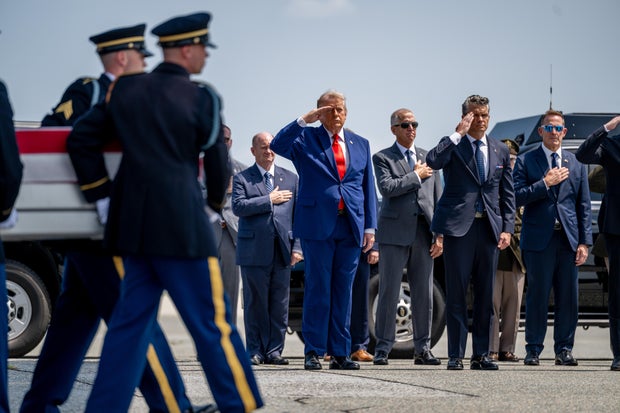
In northern Iraq, a series of explosions were heard near a military base hosting U.S. forces. The same base where Sgt. Michael Emmanuel Swinton died over the weekend in a "controlled detonation" of an Iranian attack drone.
Tehran argues that any facility or base in the Middle East that the U.S. military uses for strikes on Iran is considered a legitimate target for retaliation.
CBS/AFP
Iran says U.S. strike kills at least 4
An overnight U.S. attack on Iran's southwestern province of Khuzestan killed at least four people and injured several others, Iranian state media reported Friday.
"Following the missile attack by the terrorist U.S. enemy on areas around the city of Ahvaz, four of our compatriots were martyred and five others were injured," Valiollah Hayati, deputy governor of the province, was quoted as saying by the official IRNA news agency.
AFP
U.S. military strikes Iran for 13th consecutive night
The U.S. military completed its 13th straight night of strikes on Thursday, U.S. Central Command said in a statement.
In a social media post accompanied by a video of airstrikes, CENTCOM said it targeted Iranian drone sites, command centers and other targets "to further diminish the threat Iran poses to civilian mariners and commercial vessels transiting the Strait of Hormuz," which it insisted was "open for transit" despite the minimal traffic passing through.
Iran's state broadcaster IRIB reported that U.S missile strikes struck Ahvaz, Bandar Abbas, Omidiyeh, Qeshm, and Andimeshk.
Rapid pace of interceptor and precision-guided weapons use worries Trump administration
The rapid pace at which the U.S. is expending some of its most advanced air-defense interceptors and precision-guided weapons in the Middle East is a point of great tension inside the Trump administration as President Trump's war with Iran ratchets up again, according to U.S. military and intelligence officials familiar with internal assessments. And it's raising broader concerns about America's readiness for a potential conflict in the Indo-Pacific.
The dwindling stockpiles of defensive interceptors and long-range missiles have become a pressure point for top military and civilian leaders who are weighing the demands of the war with Iran against maintaining readiness to deter other adversaries, including China.
The U.S. officials, who spoke to CBS News on condition of anonymity given the sensitivity of the topic, said the U.S. cannot sustain the rate at which it expended precision munitions early in the campaign against Iran.
Trump says U.S. will use Iranian money to pay for damage to ships
President Trump wrote on Truth Social that "any and all damages" to ships struck by Iran "will be paid for by Iranian Money that the United States has in its possession, and controls."
Mr. Trump did not specify the exact source of money, but billions of dollars' worth of Iranian assets are currently frozen due to U.S. sanctions. The two countries had previously discussed unfreezing those assets if Iran implements the terms of a deal with the United States.
"These damages may be very substantial but, nevertheless, this is the fair and equitable thing to do," the president wrote.