Michigan to mark Severe Weather Awareness Week with statewide tornado drill


Communities across Michigan are participating in a statewide tornado drill on Wednesday and reminding area residents how local emergency alert systems work as part of the Michigan Severe Weather Awareness campaign.
Severe Weather Awareness Week this year is March 15 through 19.
"This time of year is chosen because Michigan is entering its spring and summer severe weather season, when tornadoes and strong storms are most likely, so officials want people to be prepared before dangerous weather becomes more frequent. Testing in early spring also helps identify any problems with sirens after the winter months and ensures communities are ready when storms can develop quickly with little warning," CBS Detroit meteorologist Vytas Reid said.
Statewide tornado drill
A voluntary statewide tornado drill is set for 1 p.m. Wednesday.
The tornado drills are designed to make sure sirens and emergency systems are working properly and to give residents a chance to practice what they would do during a real tornado warning.
That being said, whether Southeast Michigan communities will conduct outdoor emergency siren tests at the statewide tornado drill time is a case-by-case situation.
For example, the City of Warren said it will test its outdoor sirens at 1 p.m. on Wednesday. Livingston County says it will not run the outdoor siren tests on Wednesday because of the cold weather, but will test its Public Alert System that uses phone calls and emails. And Lenawee County Emergency Management said its county-wide tornado siren test will take place at 5:55 p.m. on March 19.
In keeping with the campaign, local emergency management and first responder agencies also have reminded area residents to sign up for the text message, phone call, email and mobile app services that provide local emergency notifications in their communities.
"Remember that outdoor sirens are mainly meant to alert people who are outside, so you should always rely on multiple warning methods to stay safe," Reid said.
Threat of tornadoes in Michigan
Michigan saw one of its most active tornado seasons on record during 2025, with 33 tornadoes confirmed in the state throughout the year. The 2026 severe weather season has already proven to be an active one, with tornadoes touching down in Southwest Michigan on March 6. Four people died as a result of that outbreak.
"While the average lead time is 10 to 15 minutes, tornadoes can strike with little or no warning, meaning everyone needs to be ready to react quickly," the Michigan State Police, Emergency Management and Homeland Security Division, said.
"The importance of severe weather awareness is clearer than ever following last week's deadly tornadoes," Michigan Gov. Gretchen Whitmer said. "I encourage every Michigander to take time now to make a plan, build an emergency kit, and sign up for local emergency alerts. Preparing today can save lives when minutes matter. Let's work together and stay safe."

Emergency preparedness kits
State and federal emergency officials urge those who live in communities where severe weather is possible to prepare emergency kits to keep within reach for their families and pets.
While each family's needs vary, the checklists and recommended supplies are meant to fill in for basic needs during disruptions such as power outages.
Suggestions on the Michigan.gov website include: drinking water, nonperishable food, flashlight with batteries, first aid kit, local road maps, spare clothing, medication, infant diapers when needed and rain gear.
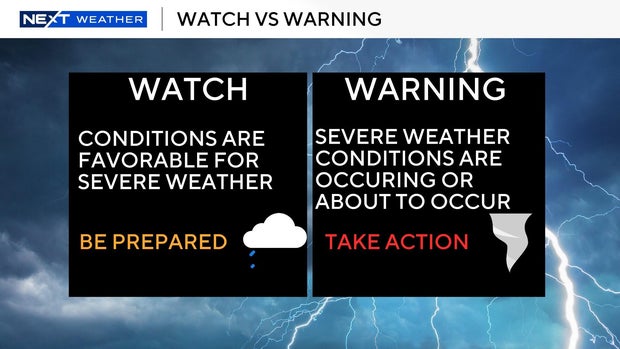
Watch vs warning
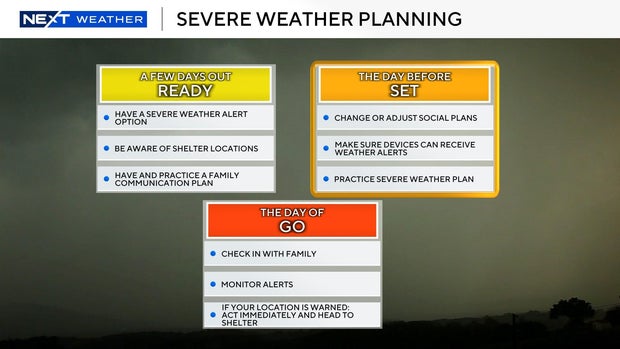
The National Weather Service says a severe weather watch means "be prepared." It is possible that the weather will reach severe levels during the time frame specified.
A severe weather warning means "take action," that severe weather conditions have been reported by spotters or can be detected on radar. People are asked to take shelter indoors, away from windows.
Along with the National Weather Service announcements, there are visible changes in the weather that those in the path of a tornado have often said they noticed. Those signs include a dark, often greenish sky; large hail; a large, dark and low-lying cloud, along with a loud roar that some have described as like a freight train sound, the Michigan Emergency Management and Homeland Security Division said.
The NWS also offers a Skywarn Spotter training course.
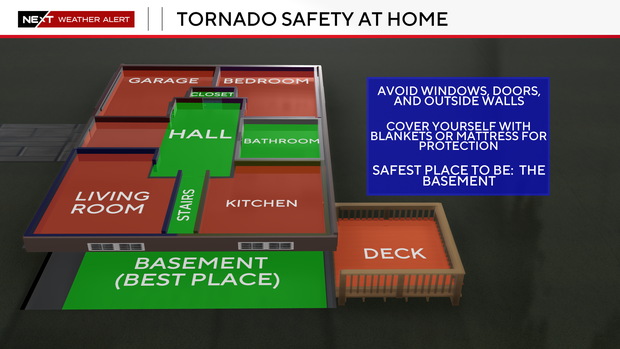
Taking shelter during a tornado
The best place to take shelter during a tornado, according to the NWS, is a room on the lowest level of your house that is away from windows. The recommended sites include a basement or storm cellar, a hallway or an interior room.
If you are outside when the tornado warning is issued, the NWS says to seek shelter in a sturdy building. Being in a vehicle during a tornado is not safe. "If you are unable to make it to a safe shelter, either get down in your car and cover your head, or abandon your car and seek shelter in a low-lying area such as a ditch or ravine," NWS says.
Stay informed
If there is a warning issued, the CBS News Detroit weather team will be live-tracking the storm. You can follow the reports on air, online, on our mobile app and on our social media accounts such as YouTube.
If you wish to share photos or videos after a storm passes through, please join our Weather Watcher Network.