Heat dome to scorch major U.S. cities this week. Maps show the forecast and warnings.
A long and dangerous heat wave will blast a large swath of the United States this week, the National Weather Service said, with temperatures rising ahead of the July Fourth holiday and feeling even hotter because of the high humidity that's arriving with it.
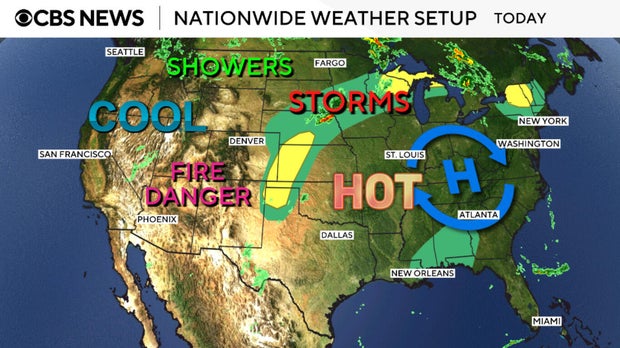
The heat dome is expected to build over the eastern two-thirds of the country, with New York City, Philadelphia, Baltimore and Washington, D.C., among cities expected to see record highs into the 100s, according to CBS News meteorologist Nikki Nolan.
More than 100 record highs are expected to be set through Saturday night, along with about 250 record-warm overnight lows.
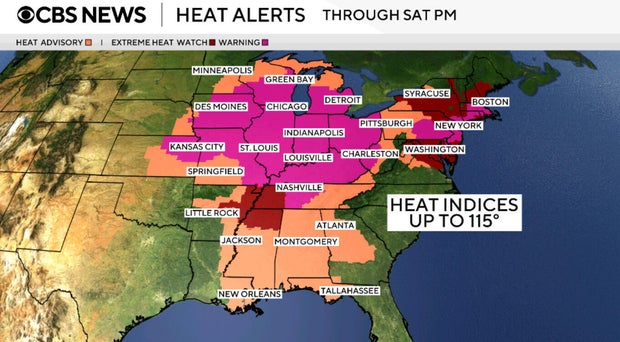
Map shows heat alerts
Extreme heat warnings are in effect for major cities in the central part of the U.S., including Nashville, St. Louis, Cincinnati, Kansas City, Des Moines, Chicago, and Detroit. Extreme heat watches are in effect for much of the Northeast, with temperatures over 100 degrees expected through Saturday.
Southern cities, including Dallas, Little Rock and Memphis, will also see dangerously high temperatures.
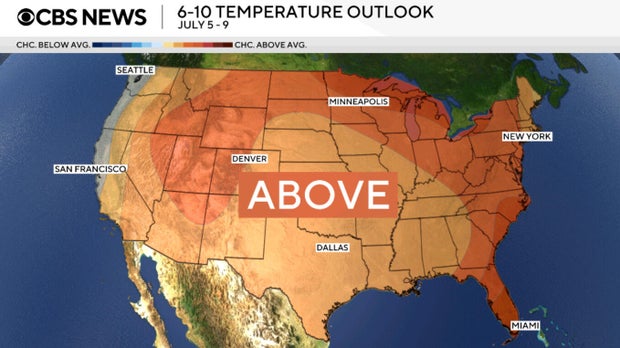
High heat is forecast to last into next weekend across the Great Plains, the Southeast and the Mid-Atlantic.
The heat wave — defined as high temperatures reaching or exceeding 90 degrees for three consecutive days or more — is expanding across the central and eastern states. Almost the entire country will experience above-normal temperatures over the next week to 10 days.
Dangerous fire weather conditions
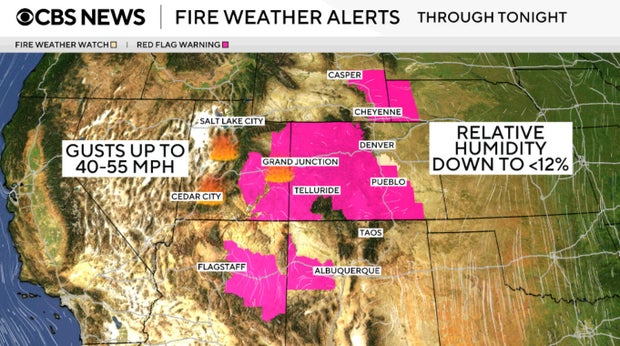
In the West, the Four Corners area of Utah, Colorado, New Mexico and Arizona remains under dangerous fire weather conditions. Three firefighters died Saturday and two sustained burn injuries when they were overcome by flames from fast-moving wildfires in hot, windy conditions near the Colorado-Utah border.
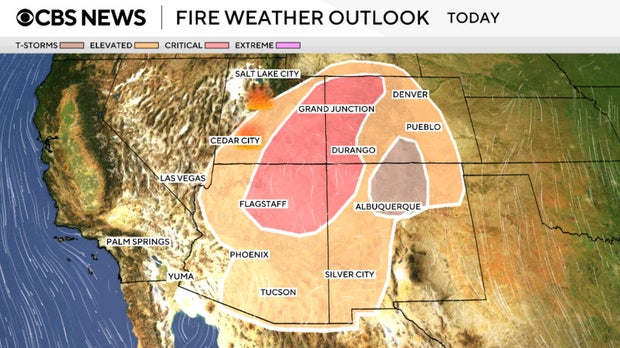
The National Fire Information Center described the conditions as "extremely critical fire weather" that is rare for late June, with "high potential for new large fires."
Storm threat and heat index
Severe thunderstorms remain a threat across parts of the northern Plains and Upper Midwest and New England, with flooding possible.
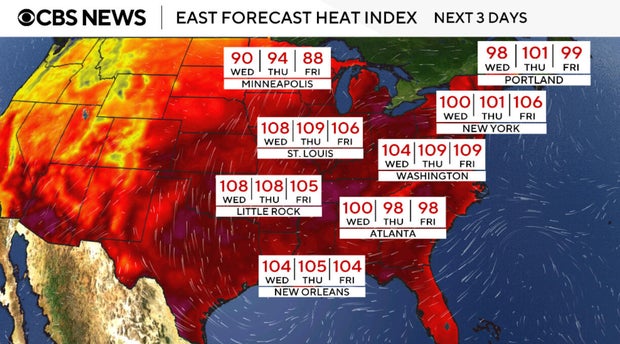
As temperatures climb, high humidity will lead to the heat index reaching 100 to 110 degrees Fahrenheit (40 to 43 Celsius), and even as high as 115 F, according to the weather service. Nightly lows in the 70s F (21 to 26 C) won't provide much relief.
The heat index, which factors in humidity as well as the actual temperature, provides a sense of how hot it really feels — and what's dangerous for prolonged exposure or strenuous activity.
Parts of the U.S., especially Phoenix, Las Vegas, central Texas, and much of the Southwest, were already experiencing temperatures around 100 degrees.
Health hazards in a heat dome
The first widespread heat wave of the summer will put millions of Americans under a heat dome, or areas of very strong high pressure that trap heat over a large area. The stagnant weather pattern results in weak winds and increased humidity. The phenomenon can last for days to weeks, making the heat feel insufferable and dangerous because the human body can't cool off as effectively if sweat stays on the skin.
During extreme temperatures, people are advised to limit outdoor activity, stay hydrated and ensure access to air-conditioning and other cooling areas, the weather service said.
The Centers for Disease Control and Prevention says heat can impact anyone. Signs of overheating include muscle cramping, dizziness, unusually heavy sweating, shortness of breath, headaches, weakness and nausea.
The heat comes after Europe has been sizzling in a deadly heat wave for days. In France, more than 1,000 additional deaths were reported last week, the nation's public health agency said, along with dozens of drowning deaths as swimmers turned to the water for relief from the heat. Other countries including Germany, Switzerland, the Czech Republic and Denmark have also been facing a long stretch of unusually high temperatures.
"Of all climate-related impacts and hazards, heat is the biggest killer," Ine Vandecasteele, an urban adaptation expert with the European Environment Agency, told CBS News.
Vandecasteele said simply installing more air conditioners can offer vulnerable people like those in hospitals and elderly people immediate relief, but she said that isn't a long-term solution.
"In the longer term, what happens is, installing more air conditioning actually emits more heat into our environment, so it will actually increase the speed of warming," she said.