Three firefighters killed, two injured in Colorado "burnover"
Three wildland firefighters died Saturday during their response to a pair of Colorado wildfires, federal agencies announced early Sunday morning.
Two other firefighters were injured and flown out by helicopters to area hospitals.
"Our immediate focus is on supporting their families, friends, and fellow crewmates during this incredibly difficult time," the U.S. Wildland Fire Service stated in a 12:30 a.m. social media post.
The five fighters were caught in a "burnover," according to a press release from the U.S. Department of Interior. A burnover occurs when firefighters are overtaken or trapped by a wildfire and take cover under protective shelters carried in their packs. Firefighters are trained to use their limbs to hold the corners of the shelters to the ground and create the best possible seal from heat and gases as flames pass over them.
Other than being members of the U.S. Wildland Fire Service and U.S. Forest Service, no information about the identities of the firefighters was provided.
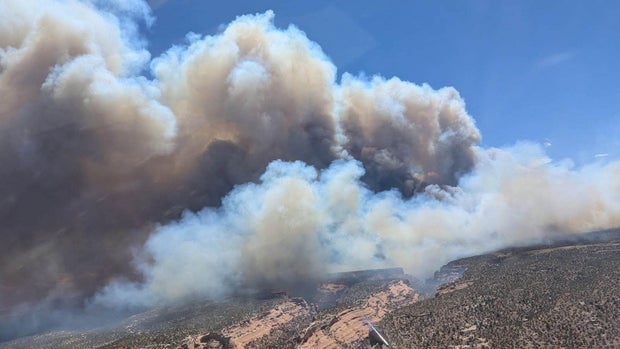
The firefighters were assigned to work on the Knowles and Gore fires. The Knowles Fire was reported at 9:30 a.m. Saturday near Knowles Canyon in the southern section of the McInnis Canyons National Conservation Area southwest of Fruita. The fire is presumed at this time to be naturally caused, according to U.S. Forest Service maps. That term usually indicates lightning ignited it.
Saturday afternoon, the Gore Fire was shown on one federal agency map located immediately south-southeast of the Knowles Fire, located about miles away.
Both fires have been overtaken by the Jones and Snyder Mesa blazes that started on the western side of the Colorado-Utah border Saturday and burned their way into Colorado. They became one fire, now called the Snyder Fire.
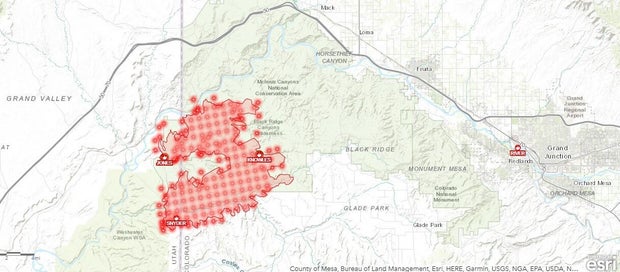
The latest estimate of the Snyder Fire's size is more than 28,000 acres. There is no containment.
The McInnis Canyons National Conservation Area was immediately closed and residents from Glade Park to the Utah border were put on pre-evacuation notice Saturday afternoon. That pre-evac area was expanded Sunday morning to include neighborhoods near the town of Loma.
Colorado Gov. Jared Polis issued a disaster declaration after news of the firefighters' deaths.
Travelers along Interstate 70 have been warned to expect smoky conditions and use their headlights while entering low-lying canyon areas.
An air quality advisory has been issued by the state due to wildfire smoke for western and northern Colorado.
An evacuation center was initially set up at the former Faith Heights Church in Grand Junction, but has been moved to Grand Junction High School, located at 1400 N. 5th Street.
Earlier Saturday, Upper Colorado River Interagency Fire Management reported Colorado wildfire agencies were battling eight confirmed wildfires - the Jones, Snyder, Knowles, Gore, Red Rock, McInnis, Mee and Black Ridge fires - following lightning-rich storms that moved through western Colorado the previous day.
On Sunday evening, the agency said the Red Rock Fire is approximately 341 acres and is now 60% contained. Despite the high winds, crews managed to keep the fire from growing throughout the day. They said firefighters will remain on-site throughout the night to continue suppression efforts.
Colorado Parks and Wildlife has closed public access to the Horsethief State Wildlife Area and the Loma Boat Launch State Wildlife Area. The boat ramp at the Fruita section of James M. Robb-Colorado River State Park is also closed to all downstream traffic.
Similar weather conditions to Saturday's are expected on Sunday. The National Weather Service has issued red flag warnings for most of southwestern Colorado. The NWS described the conditions as "particularly dangerous" for new fire starts and growth of existing fires.


