Israel, Lebanon agree to renew ceasefire as Iran launches deadly attack on Kuwait airport
Follow updates on the war in the Middle East for Thursday, June 4, here. See earlier developments below:
What to know about the Iran war:
- Kuwait said Wednesday that an Iranian missile and drone attack hit its international airport, killing one person and wounding dozens more, as the ceasefire between Iran and the U.S. looked increasingly fragile after yet another exchange of fire.
- Iran claims it launched a retaliatory attack on U.S. military bases in Kuwait after another set of airstrikes by American forces, which Central Command called "self-defense strikes" on Iranian military positions.
- Before the latest exchange of fire, President Trump on Tuesday denied reports by Iranian state media that the regime in Tehran had suspended its indirect negotiations with the U.S. over Israel's ongoing war with Hezbollah in Lebanon. Mr. Trump insisted talks were "going on continuously."
- Israel and Lebanon agreed Wednesday to renew their fragile ceasefire and create a number of "pilot" security zones inside Lebanon where Hezbollah would be banned. But Lebanon's state-run National News Agency reported Israeli drone strikes at several south Lebanon locations Thursday.
Iran's supreme leader says Israel, U.S. trying to promote "division" in Iran
Iran's supreme leader accused the U.S. and Israel Thursday of trying to sow "division" among Iranians after suffering a "decisive blow" during the Middle East war.
In a written message, Mojtaba Khamenei said "the malicious enemy" was seeking to "plant the seeds of doubt, despair, fear, mistrust and division" among the public.
"In confronting these ill intentions, everyone must, through steadfastness, insight, preserving unity and cohesion ... neutralize their sinister plot," his message said.
U.N. says peacekeeper killed in south Lebanon
The United Nations peacekeeping mission in Lebanon — the U.N. Interim Force, known as UNIF — said Thursday that a peacekeeper was killed and two others wounded when shelling hit their base in the country's south the previous night.
"A UNIFIL peacekeeper died early this morning from critical injuries sustained when mortar shells struck his position," a statement from the force said, adding that an investigation had been launched.
Serbia later said the peacekeeper was one of its nationals.
Israeli defense minister says military would strike Beirut if Hezbollah attacks
Israel's defense minister said Thursday that the ceasefire agreement with Lebanon grants the Israeli military the "freedom" to strike Beirut if Hezbollah attacks Israeli communities, adding that Israeli operations in southern Lebanon would continue.
"The IDF will, at this stage, continue its fire and ground operations, remain in the security zone in Lebanon up to the Yellow Line -- including in the Beaufort area -- and without the return of the population, while continuing to dismantle terrorist infrastructure on the ground," Israel Katz said in a statement hailing the ceasefire renewal deal reached on Wednesday.
He said Israeli forces retained the "freedom of action, with American backing, to strike in Beirut in response to fire on Israeli communities and territory."
Separately, Israel's far-right National Security Minister Itamar Ben Gvir called the renewal a "serious mistake," adding in a social media post that "the pipe dreams of advisers are dragging the prime minister (Benjamin Netanyahu) to wrong decisions."
CBS/AFP
Lebanon news agency reports Israeli strikes after truce renewal announcement
Lebanese official media reported Israeli strikes on the country's south on Thursday morning, hours after an announcement that Israel and Lebanon had agreed to renew a ceasefire following talks in Washington.
The state-run National News Agency (NNA) reported Israeli drone strikes along roads at several south Lebanon locations, saying at least one resulted in a couple and their daughter being wounded in an attack on their car.
Iran's foreign minister says "no tangible progress" in peace talks with U.S.
Iranian foreign minister Abbas Araghchi said Wednesday that "no tangible progress" has been made in negotiations to end the Middle East war.
Araghchi said lines of communication with the U.S. were still open, but warned that any Israeli attack on the Lebanese capital Beirut as part of its campaign against Iran-backed Hezbollah would trigger a "full-scale resumption" of the conflict.
"Communications with the Americans have not been cut off, and messages have been exchanged regarding the need to stop aggression against Beirut, but no tangible progress has been made in the negotiation process," Iran's Tasnim news agency quoted Araghchi as telling Lebanon's Al Mayadeen TV.
"Any attack on Beirut will have grave consequences and will lead to a full-scale resumption of the war," he said. "Our armed forces are ready to strike Israel if it attacks Beirut."
Israel and Lebanon agree to renew ceasefire, create security zones that will exclude Hezbollah
Israel and Lebanon agreed Wednesday to renew their fragile ceasefire and create a number of "pilot" security zones inside Lebanon from which the militant group Hezbollah would be banned.
In a joint statement released by the U.S., Lebanon and Israel after a fourth round of U.S.-mediated talks at the State Department in Washington, the two sides said the ceasefire "is contingent on a complete cessation of Hezbollah fire and the evacuation of all Hezbollah operatives" from areas south of the Litani River.
It was not immediately clear how the security zones would be established, but the agreement calls for the Lebanese army to take full control of those areas.
"These steps will enable progress towards a comprehensive peace and security agreement," the statement said. "All countries reaffirmed that the future of the relationship between Israel and Lebanon must be decided by the two sovereign governments. They rejected any attempt, by any state or non-state actor, to hold Lebanon's future hostage."
The latter is a reference to Iran, which supports Hezbollah and has insisted that Israeli attacks on Lebanon be halted as part of a possible agreement with the U.S. to end the conflict with Iran. Hezbollah is not part of the Israel-Lebanon talks.
House votes to rein in Trump on Iran as war loses GOP support
The House on Wednesday passed a measure that would force President Trump to end the war with Iran without congressional authorization, marking the first time the lower chamber has defied the White House on the conflict.
The House voted 215 to 208 to narrowly approve the war powers resolution with the help of four Republicans. Democratic Rep. Jared Golden of Maine, who has voted against the three previous failed attempts, also dropped his opposition and voted for the measure, giving his party unanimity on the issue.
The vote was supposed to take place before lawmakers left for the Memorial Day recess, but House GOP leaders abruptly pulled the vote when it became clear they did not have the numbers to block it. Several Republicans were absent and others were expected to support it.
The Senate advanced a similar measure in May to rein in Mr. Trump on Iran after four Republicans joined all but one Democrat to push it forward. It's unclear when they plan to vote on the House version.
Trump defines a Middle East ceasefire as "shooting in a more moderate manner"
In the Oval Office Wednesday afternoon, a reporter asked President Trump how he defines a ceasefire, given continued conflict with Iran.
"Pretty much the way it is," he said. "That's a different part of the world. You know, I'd say in that part of the world, a ceasefire is when you're shooting in a more moderate manner."
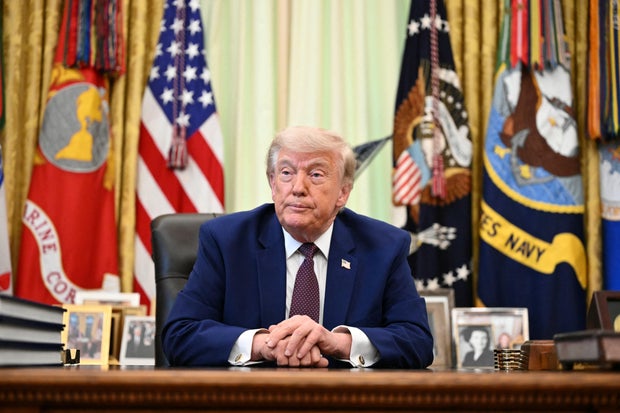
Asked if ceasefire is still on, Trump says, "there's a reason for everything"
President Trump brought reporters into the Oval Office Wednesday afternoon and took some questions. One reporter asked if, given Iran's latest attack on Kuwait, the ceasefire with Iran is still ongoing.
"Well, you know, there's a reason for everything," Mr. Trump said. "And we hit them pretty hard the night before and actually last night … We've been hitting them pretty hard."
The president said the U.S. "nipped it in the bud" pretty quickly.
Mike Johnson calls on U.S. allies to help reopen the Strait of Hormuz
Speaker Mike Johnson said he spent three hours at the White House with President Trump, Vice President JD Vance and Secretary of State Marco Rubio, as Mr. Trump is working on "that final piece" to reopen commerce.
"I am, all of us, are calling on our allied nations and friends — the Arab states in the region, and NATO partners and everyone else," the Republican told reporters at the Capitol about the Monday meeting. "The entire world has an interest in the Strait of Hormuz being reopened for commerce. That's what he's working on."
Johnson also defended the president for suggesting the war's unpopularity and the resulting high gas prices ahead of the U.S. midterm elections aren't impacting his decision-making. The speaker said Mr. Trump, who fielded phone calls from reporters during the lengthy meeting, is "laser focused" on domestic issues.
Enriched uranium key issue in Iran talks, no deal yet, Rubio says
The fate of Iran's highly enriched uranium stockpiles is at the center of talks with Washington, and Tehran has not yet agreed to a peace deal, U.S. Secretary of State Marco Rubio said Wednesday.
Washington insists that Iran must turn over its near-weapons-grade enriched uranium, agree to curb its nuclear activities and re-open the Strait of Hormuz for any peace agreement to take hold.
"I think now, in some of the papers that have been exchanged back and forth, it's clearly addressed, but we … still don't have final sign off from their system as of this morning," Rubio told the House Foreign Affairs Committee.
Rubio also doubled down on his assertion that the war in Iran was over, even as Iran attacked Kuwait's airport, killing one and wounding 63 people on Wednesday, in a significant escalation.
"We're no longer conducting sustained strikes inside of Iran to degrade their military, because Epic Fury is over," Rubio told the panel, asserting that the U.S. has scored a victory.
"We define victory as destroying their defense industrial base, significantly reducing the number of missile launchers that they possess, significantly reducing their stockpile of drones," Rubio said. "And we achieved all those, in addition to destroying what they had left of an air force and wiping out their entire conventional navy."
Iran's chief negotiator vows "decisive" response to any attack
Iran's chief negotiator Mohammad Bagher Ghalibaf said Tehran would meet any attack with a strong response, local media reported Wednesday, after its Revolutionary Guards said they had targeted Kuwait in retaliation for U.S. attacks.
"Today, the Iranian nation, in its battle with America and the Zionist regime, showed that the era of free-of-charge Iran threats is over and that any aggression will be met with a decisive, regrettable, and proportionate response," Ghalibaf said, according to local news agency ISNA.
Iran foreign minister says military conducting "self-defense strikes"
Iranian foreign minister Seyed Abbas Araghchi said Wednesday that the country's military is "conducting self-defense strikes on sites the U.S. is permitted to use to attack civilian shipping and violate the ceasefire."
Alongside his remark, Araghchi included a short video clip of U.S. Secretary of State Marco Rubio saying, "Our allies in the region have been very cooperative, some obviously very aggressively cooperative, like the U.A.E. as an example. Kuwait's been fantastic."
Araghchi said that "any hostile act will be met with an immediate, decisive response."
"What sanctions and war failed to achieve won't be won with more war," he added.
The U.S. military said earlier that it had carried out its own "self-defense strikes" against Iran.
Energy supply disruption into next year would slam global economy, report says
A prolonged disruption of energy supplies from the Middle East due to the war would deal a severe blow to the global economy, sending some countries into recession and spreading inflation and higher unemployment, the Organization for Economic Cooperation and Development said in a report Wednesday.
Hardest hit would be Asian economies that depend on crude oil, fuel and natural gas from the Persian Gulf, and poorer countries where people spend more of their incomes on fuel and food, the OECD said. The report analyzes two scenarios:
- Prolonged disruption: Global growth slows from 3.4% last year to 2.1% this year and 1.8% in 2027, potentially pushing some economies into or close to recession.
- Time-limited disruption, in which energy production and Gulf shipments start to return to pre-war levels in the middle of this year: Growth would slow to 2.8% this year and rebound to 3.1% next year.
U.S. forces have redirected 125 vessels amid blockade, CENTCOM says
The U.S. military has redirected 125 commercial vessels amid its blockade on Iranian ports and vessels, Central Command said Wednesday.
It has disabled another six "to ensure compliance," CENTCOM said on social media.
Trump: Iran's supreme leader involved in peace talks
President Trump said Iran's supreme leader Mojtaba Khamenei is "involved" in peace talks for ending the war.
"They have a lot of respect for him," Mr. Trump said in an interview with The New York Post's "Pod Force One."
He said Khamenei is not doing well due to injuries sustained in an airstrike, but "they say he's giving approval because that's the way it has been for a long, long time."
The president added, "We seem to be getting along quite well," but said he had not previously thought about meeting with Khamenei until he was asked about the possibility in the interview.
He said he hopes one day to meet the supreme leader, "and we probably will meet at some point, depending on how it all works out."
Mr. Trump said the U.S. had gone through two "sets" of Iranian negotiators who were now gone, as well as some of the third set of Iranian negotiators.
Flights resume at some Kuwait airport terminals after deadly Iranian drone and missile attack
Kuwait's Directorate General of Civil Aviation said Wednesday that flights were resuming at two of Kuwait International Airport's terminals after an early morning Iranian missile and drone attack seriously damaged Terminal 1, killing one person and wounding dozens more.
The missiles and drones were intercepted, but debris from the Iranian weapons fell to the ground, causing the destruction. Iran claimed its attack targeted U.S. military bases in retaliation for U.S. attacks on an Iranian island and an Iranian vessel overnight that Central Command described as "self-defense strikes."
All Kuwait Airways flights at the airport's Terminal 4 and all Jazeera Airways flights to and from Terminal 5 were resumed after teams "completed damage assessments and implemented the necessary safety measures," the airports authority said in a series of social media posts.
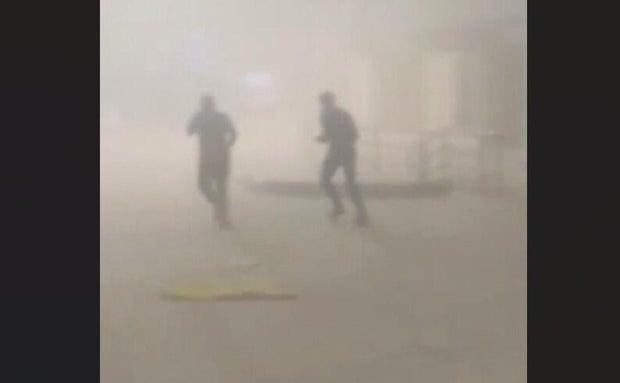
Earlier the DGCA said emergency plans were implemented, including all flights in and out of Kuwait International being suspended, "after Building (T1) was subjected to targeting by drones and missiles from the Iranian aggression, resulting in significant damage to several airport facilities, in addition to recording human injuries."
Netanyahu says Trump "respects me, and I respect him"
Speaking Wednesday in an interview with CNBC, Israeli Prime Minister Benjamin Netanyahu dismissed President Trump calling him "f***ing crazy" during a heated telephone conversation earlier in the week as the kind of "tactical disagreements" typical of even "the best of families."
"Sometimes, as in the best of families, we have these tactical disagreements. We always find a way to work them out. We can disagree in the morning, and we have a common action by the afternoon," the Israeli leader said.
Mr. Trump confirmed earlier, speaking with a New York Post podcast, that he had leveled the sharp criticism at his Israeli counterpart during a tense phone call, as the president said he had become "a little bit perturbed" about Israel's fight with Hezbollah in Lebanon holding back U.S. peace talks with Iran.
"My relationship with Trump is the same. He respects me, and I respect him. We always find a way to work out our differences," Netanyahu said Wednesday.
He didn't offer a full-throated backing for diplomatic efforts to end the U.S.-Israeli war on Iran launched more than three months ago, but said Mr. Trump believed he could "solve the enrichment problem" - referring to Iran's nuclear program - "with diplomatic pressure and tough negotiations. I think he should be given a chance."
But the Israeli leader did not back down on his country's plans to ensure that Iranian-backed Hezbollah, based in neighboring Lebanon, no longer poses a threat to his country.
"If we want to save Lebanon, if we want to get a Lebanese-Israeli peace — as I do — we have to disarm Hezbollah and we have to demilitarize Lebanon. This is a goal Trump and I share," he said. "You can't have these genocidal terrorists taking over this poor country of Lebanon, using it to try to invade Israel — the way that Hamas invaded us, murder our civilians, kill our men, rape our women. No country would accept that."
Lebanese and Israeli officials were set to meet for another round of direct talks in Washington on Wednesday, aimed at bolstering a U.S.-brokered ceasefire they agreed to weeks ago, but which Hezbollah and Israel have both accused each other of violating daily since Mr. Trump announced it.
Oil price creeps back toward $100 per barrel, stocks largely flat
Oil prices crept back toward $100 per barrel Wednesday following the latest flare-up in fighting to threaten the U.S.-Iran ceasefire, and U.S. stocks held near their records, but were largely flat or slightly down.
The S&P 500 slipped 0.2% from its all-time high. The Dow Jones Industrial Average was down 122 points, or 0.2%, as of 9:35 a.m. Eastern time, and the Nasdaq composite was 0.3% lower.
Weighing on the market was a climb of 1.6% for the price for a barrel of Brent crude oil, the international standard, which brought it back to $97.51. It rose after Iran fired missiles at Kuwait and Bahrain, causing serious damage, one death and dozens of injuries at Kuwait International Airport as debris from interceptions rained down.
The war with Iran has already sent oil prices and inflation higher, cranking up the pressure on the global economy. But oil prices still remain below their peaks from earlier in the fighting, and hope seems to be remaining on Wall Street that the U.S. and Iran will ultimately reach a deal to reopen the Strait of Hormuz to oil tankers. That would improve the global flow of crude and hopefully lower its price.
Such hopes, along with strong profit reports from U.S. companies, have helped launch the U.S. stock market on a tremendous rally to records. If the S&P 500 can turn around and finish the day with a gain, it would be the 10th straight for the index, which would be its longest such streak in more than three decades.
Trump confirms he called Netanyahu "f---ing crazy," says he was "perturbed" by Israel's actions in Lebanon
President Trump, in an interview for a New York Post podcast released Wednesday, confirmed an earlier Axios report that he had criticized Israeli Prime Minister Benjamin Netanyahu as "f---ing crazy" in a Monday phone call, saying he was "a little bit perturbed" that Israel's fighting of Hezbollah in Lebanon was holding back peace talks with Iran.
Mr. Trump has yet to show clear progress in talks to resolve the war with Iran and cement his goals of that country agreeing to abandon its development of nuclear weapons and reopening the Strait of Hormuz for oil and natural gas shipments.
"We've worked very well together. I like Bibi a lot. And I work very well with him," Mr. Trump told the Post's "Pod Force One," using a common nickname for the Israeli leader.
Mr. Trump has emphasized in the past that he wanted to be a president who brought peace, but his comments suggested his affinity with Netanyahu reflects their mutual connection over being on a war footing.
"I'm a wartime president," Mr. Trump said. "He's a wartime prime minister."
CBS/AP
Kuwait expels 2 Iranian diplomats over "Iran's criminal attacks" on airport
Kuwait's Foreign Ministry said Wednesday that it had summoned Iran's top envoy in the country to lodge a formal protest, and expelled two lower ranking diplomats after an Iranian missile and drone attack killed one person and wounded dozens more.
A statement from the ministry said it had handed Acting Chargé d'Affaires of the Iranian Embassy in Kuwait, Hamid Hamid Yaqoubi Far, "an official protest note regarding the ongoing Iranian attacks and informed him of its decision to reduce the size of the Iranian diplomatic mission in Kuwait."
The ministry said "two members of the Iranian diplomatic staff were declared persona non grata and ordered to leave Kuwaiti territory within a maximum of 24 hours."
Kuwait's Deputy Foreign Minister explained to Far that the decision "comes in response to the continued Iranian attacks involving ballistic missiles and drones, which resumed at dawn today and targeted several civilian facilities and vital installations, including Kuwait International Airport."
The Deputy Foreign Minister reiterated Kuwait's strong condemnation of what it described as "Iran's criminal attacks" and he stressed Kuwait's "categorical rejection of the use of its territory or airspace for hostile actions against any country," the ministry said.
Iran said earlier that it had targeted U.S. bases in the region Wednesday in retaliation for the latest American attacks on Iran, which U.S. Central Command described as "self-defense strikes."
The Kuwaiti ministry said the deputy foreign minister had emphasized to the Iranian envoy "that Iran's allegations are baseless, unsupported by evidence, and cannot in any way justify attacks against Kuwaiti territory or its civilian and strategic facilities."
Lebanon's army says soldier "killed after being targeted by a hostile Israeli airstrike"
"Amid the ongoing brutal Israeli attacks on Lebanon, a Lebanese Army soldier was killed after being targeted by a hostile Israeli airstrike while traveling on the Nabatieh–Kfar Tebnit road," Lebanon's army said Wednesday, not long after it said one officer and one soldier had been wounded in an Israeli drone attack.
The army earlier accused Israel's military of deliberately targeting Lebanese army forces during the ongoing Israeli offensive against Iranian-backed Hezbollah militants.
Kuwait says Iranian attack included 13 missiles and 17 drones, confirms death of 1 Indian national
Kuwait's defense ministry said Wednesday that the country's forces had "monitored and engaged" at least 13 ballistic missiles and 17 attack drones launched by Iran since dawn.
The missiles "were intercepted over several residential areas, resulting in falling debris," ministry spokesperson Colonel Staff Saud Abdulaziz Al-Attwan said in a statement, adding that Kuwaiti forces "also monitored and engaged 17 hostile drones."
"This malicious Iranian aggression resulted in the targeting of civilian and vital facilities, including Kuwait International Airport, which led to the death of a resident of Indian nationality and injuries to several people, in addition to significant material damage," he said.
Kuwaiti authorities confirmed the death earlier, but had not said what country the victim was from. The country's health ministry said at least 63 people were wounded, including seven who required major, urgent surgeries.
Lebanon's army says Israel deliberately targeting troops amid operation "aimed at displacing residents"
Lebanon's army has accused Israeli forces of "deliberate targeting of army personnel, vehicles, and positions," saying an officer and one soldier were wounded Wednesday by Israeli drones operating near the southern city of Nabatieh.
Israel has ramped up its war with Iranian-backed Hezbollah in recent weeks despite a ceasefire brokered by the Trump administration between the Israeli and Lebanese governments. Both Israel and Hezbollah — which was not party to the ceasefire — accuse each other daily of violating the truce.
Israeli forces have pushed miles into southern Lebanon, seizing control of a large swath of the neighboring country and forcing tens of thousands of civilians to flee, declaring the area an active combat zone.
In its statement Wednesday, the Lebanese army said the attack that wounded its soldiers "coincides with ongoing Israeli attacks on Lebanon, particularly in the south, which have led to fatalities and injuries among civilians and military personnel, as well as extensive destruction of property and infrastructure, amid systematic hostile operations aimed at displacing residents from their villages and towns, reflecting the true objectives behind the escalation of Israeli attacks."
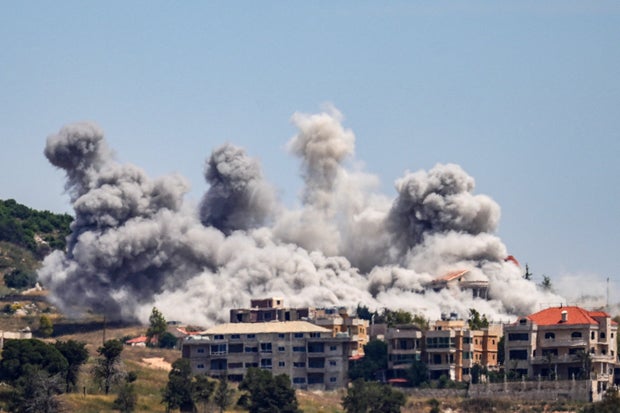
Israeli political leaders have said the country's operations against Hezbollah, and the occupation of southern Lebanon, will continue until the Iranian-backed, U.S.- and Israeli designated terrorist group no longer poses a threat to Israeli civilians.
Hezbollah has long been a powerful political and paramilitary force in Lebanon, and it dragged the country into the regional war by launching attacks on Israel just days after Israel and the U.S. started attacking Iran.
UAE presidential advisor calls for Persian Gulf nations to stand unified against "Iranian aggression"
A former foreign minister of the United Arab Emirates, who is now a senior advisor to the country's president, called Wednesday on all Persian Gulf nations to stand unified against "Iranian aggression."
"In light of the repeated Iranian aggression against the sisterly State of Kuwait and the sisterly Kingdom of Bahrain, there must be a firm, unified, and cohesive Gulf position," Anwar Gargash said in a post on social media.
"No Gulf state should be left to face targeting alone, as the security of the Arab Gulf states is interconnected, their interests are shared, and their destiny is one. This aggression does not target a specific country alone; it targets all of us," said Gargash.
Trump says yet to make decision on Iran deal, but if "it all works out," hopes to meet new supreme leader
President Trump has told the New York Post that he has yet to make a decision on a potential agreement to extend the current, fragile U.S. ceasefire with Iran, but that he hopes one day to meet the Islamic Republic's new supreme leader, "depending on how it all works out."
"I would like to meet him, and we probably will meet at some point, depending on how it all works out," Mr. Trump told the Post's "Pod Force One."
"We're working on a deal and if that happens, fine, if it doesn't happen, that's okay too. We'll do it the other way," Mr. Trump said, adding that he still needed to "make a determination: Do we sign a deal or do we do it the other way, and the other way is not nice."
Mr. Trump said Friday that he was gathering his Cabinet at the White House to make a "final determination" on a potential agreement with Iran, but then officials said revisions to the draft had been sent back to Tehran. Iran, this week, has said it suspended indirect negotiations with the U.S. days ago, but Mr. Trump insisted Tuesday that dialogue was ongoing.
Asked what handling the standoff with Iran "the other way" would achieve, Mr. Trump told the Post's podcast: "It would be over. There wouldn't be any bullshit, there wouldn't be any talking, there wouldn't be any delays. But I'd rather do it the nice way from a humanitarian standpoint."
Bahrain confirms its air defenses shot down "3 missiles and a number of drones" fired by Iran
Bahrain's military condemned on Wednesday what it called Iran's ongoing "systematic hostile approach through its sinful attacks using missiles and drones targeting civilian objects," hours after the U.S. military said it launched strikes on an Iranian military facility in retaliation for Iranian missiles fired at Kuwait and Bahrain.
Central Command said earlier that U.S. and Bahraini forces had intercepted missiles aimed at Bahrain, after Iran's Revolutionary Guard Corps claimed to have targeted the headquarters of the U.S. Navy's 5th Fleet, which is based in Bahrain, and another country in its attack, without naming Kuwait.
Bahrain's military command said it stood ready to repel any further attacks with "strong will and high combat readiness," confirming that its air defense systems "were able to intercept and destroy 3 missiles and a number of drones" fired by Iran overnight.
Kuwait says at least 63 people wounded in Iranian attack on airport
Kuwait's health ministry said Wednesday that "a full-scale health emergency was declared" after at least 63 people were wounded by an Iranian drone and missile attack on the country.
The Kuwaiti foreign ministry confirmed earlier that one person was killed in the Iranian attack.
Ministry of Health spokesman Dr. Abdullah Al-Sanad said in a statement released by the agency that "63 injured individuals" were admitted to hospitals in Kuwait City and seven "urgent major surgical operations" were carried out after the attack, which included weapons hitting the capital's main airport.
"Emergency medical teams, supported by 25 ambulances, were dispatched to Kuwait International Airport to conduct on-site triage, provide urgent care, and transport the injured to hospitals," Al-Sanad said, adding that the casualties included civilians, airport personnel, and passengers, "ranging from severe trauma such as fractures, head injuries, intracranial hemorrhages, limb amputations, blast injuries, and smoke inhalation."
Kuwait says one person killed, others wounded in "brutal and ongoing Iranian attacks" on civilians
Kuwait's Ministry of Foreign Affairs voiced its "condemnation and denunciation" Wednesday over "the brutal and ongoing Iranian attacks by ballistic missiles and drones, the latest of which occurred at dawn today and once again targeted civilian and vital facilities, including Kuwait International Airport, resulting in the death of one person and the injury of others, in addition to damage to vital facilities, including diplomatic missions."
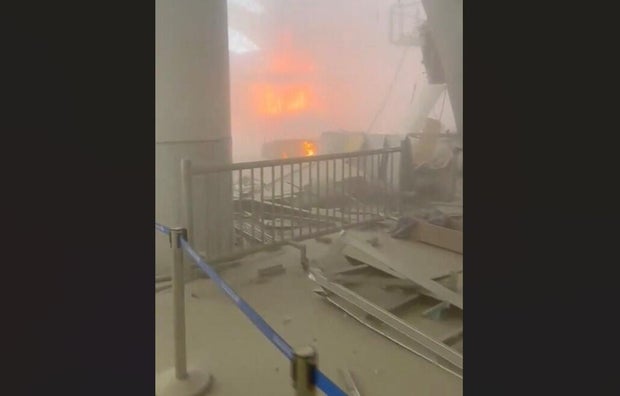
The statement from the ministry said Kuwait reserved its "full and inherent right to take appropriate measures in response to these sinful and repeated Iranian attacks, in a manner consistent with international law."
Iran's Revolutionary Guard claims it hit U.S. bases in Kuwait in retaliation for latest American strikes
Iran's Islamic Revolutionary Guard Corps claimed Tuesday to have struck U.S. military bases in Kuwait, causing the "destruction of targets and the ignition of fires," in retaliation for the latest American strikes on Iran overnight.
The IRGC "carried out precise and concentrated missile strikes against the military bases of the American occupiers in Kuwait, resulting in the successful destruction of targets and the ignition of fires in the fortresses of the aggressors," the paramilitary force declared in a statement, warning that any further U.S. attacks "will be met with a shocking, crushing, and decisive response that goes beyond conventional rules and limits"
The U.S. military's Central Command said earlier that it had "downed multiple drones" targeting American forces in Kuwait, and Kuwaiti authorities confirmed Iranian weapons had hit the country's main airport, causing damage and casualties.
Iranian drones hits Kuwait airport, causing injuries
Kuwait said Wednesday it had suspended commercial flights after an Iranian drone attack hit the country's airport, injuring a number of people hours after Iran and the United States traded missile strikes in the region.
The attacks came after Iran stopped communicating with mediators about extending a ceasefire in the war with the U.S. and Israel, according to reports Tuesday from two semiofficial Iranian news agencies. President Trump disputed that claim and said talks were continuing.
Defense Ministry spokesperson Brig. Gen. Saud Abdulaziz Al-Otaibi said that "a number of hostile drones" had targeted Kuwait International Airport's passenger building, severely damaging the building and injuring "a number of individuals."
The airport reopened on June 1 after closing due to the Iran war.
Late Tuesday, the U.S. military said it had launched strikes on an Iranian military facility in retaliation for Iranian missiles fired at Kuwait and Bahrain. It said Iran had fired two missiles at Kuwait that fell apart en route, while U.S. and Bahraini forces intercepted missiles aimed at Bahrain. U.S. Central Command also said it had "downed multiple drones" targeting American forces in Kuwait.
Iran's paramilitary Revolutionary Guard said it had targeted the headquarters of the U.S. Navy's 5th Fleet in Bahrain and another country in its attack, without naming Kuwait. It said it launched its attack in response to the U.S. firing a missile into the engine room of an oil tanker that was trying to reach Iran despite the U.S. blockade.
Central Command said it responded with strikes on an Iranian military ground control station on Qeshm Island in the Strait of Hormuz.
Iran's Fars and Tasnim news agencies, both believed to be close to the Guard, reported that Iran's negotiators have stopped communicating with ceasefire mediators as tensions flared in Israel's separate but related fight against the Iranian-backed Hezbollah militia in Lebanon.
Oil prices rise on doubts over Iran deal, stocks build on tech rally
Oil prices extended gains Wednesday as Middle East peace talks stuttered, though stocks mostly rose on the back of continued demand for all things linked to artificial intelligence.
Despite President Trump's assurances that the U.S. and Iran are edging closer to ending their three-month-long war and reopening the Strait of Hormuz, crude investors appear unmoved as they await solid progress.
Uncertainty about a peace deal pushed oil prices up more than 1%, with both main contracts up around 5% this week.
However, stocks extended their breathtaking rally, fueled by the tech sector and demand for artificial intelligence. Tokyo climbed more than 2%, helped by a more than 11% surge in chipmaker Tokyo Electron, while Advantest also jumped.
Taipei was up a similar amount thanks to Taiwan Semiconductor Manufacturing Company's strong advance.
Shanghai, Sydney, Singapore and Manila were also up, though Hong Kong, Wellington and Jakarta retreated. Seoul was closed for a holiday.
The gains followed another record for the S&P 500 and Nasdaq on Wall Street, where chipmaker Marvell Technology soared more than 32% after Nvidia CEO Jensen Huang hailed it as the next trillion-dollar firm.
Adding to the upbeat mood among equity traders was data showing U.S. job openings jumped in April to their highest level in 23 months.
The reading comes ahead of employment data on Friday that could determine if the Federal Reserve will keep its benchmark rate stable or potentially hike borrowing costs to fight inflation.
U.S. military says it conducted "self-defense strikes" against Iran in response to attacks across Middle East
The U.S. military said it conducted more "self-defense strikes" after shooting down Iranian missiles and drones in the latest test of the ceasefire.
U.S. Central Command said its forces struck an Iranian military ground control station on Qeshm Island and multiple other targets in response to attempted attacks by Iran across the Middle East on Tuesday.
"Iran launched several ballistic missiles toward regional neighbors; however, all failed to hit their intended targets," CENTCOM said in a statement.
No U.S. personnel were harmed, CENTCOM said.
U.N. chief proposes options to help end conflict between Israel, Hezbollah
The United Nations chief has proposed three options to help end the decades-old conflict between Lebanon's Iran-backed Hezbollah militant group and Israel when the 8,100-member U.N. peacekeeping mission in southern Lebanon ends on Dec. 31.
All of the options presented to the U.N. Security Council by Secretary-General Antonio Guterres would continue U.N. military monitoring of the boundary between Israel and Lebanon, support Lebanese forces in deploying throughout the country and strengthen political efforts to end the fighting, which has persisted despite a nominal ceasefire.
In his letter to the Security Council on Monday, Guterres said U.N. military monitoring of the U.N.-drawn boundary between Israel and Lebanon, known as the Blue Line, was "paramount."
Guterres proposed three options for the U.N. military force, ranging from 1,980 to 5,525 personnel, including some unarmed military observers. He said the largest force would be able "to most credibly observe developments along the length of the Blue Line."
U.N. spokesman Stephane Dujarric told reporters Tuesday that the secretary-general hopes the Security Council will make a decision soon.
Energy experts say gas prices are likely to remain high for months
American motorists would face pain at the pump for months even if the U.S. and Iran strike a peace deal and move quickly to reopen the Strait of Hormuz, according to energy experts.
"It is all contingent on when boats start moving through the Strait of Hormuz," GasBuddy petroleum expert Patrick De Haan told CBS News. "If and when that happens, it will be a very long, multi-month to multi-year process for things to fully normalize."
Across the U.S., a gallon of regular gas on Tuesday sold for an average of $4.29, down from more than $4.50 in May, according to AAA. Gas averaged $2.98 a gallon just before the U.S. and Israel attacked Iran at the end of February.
"We won't see those levels until potentially mid-to-late 2027," De Haan predicted, referring to pre-war fuel prices.
Negotiations with Iran are "going on continuously," Trump says
President Trump dismissed claims Tuesday by Iranian state media that Iran and the U.S. had stopped negotiating indirectly via mediators as "false and erroneous."
"The conversations between us have been going on continuously, including four days ago, three days ago, two days ago, one day ago, and today," Mr. Trump wrote on Truth Social. "Where they lead, one never knows, but as I told Iran, 'It's time, one way or another, for you to make a Deal. You've been doing this for 47 years, and it cannot be allowed to go on any longer!'"
Trump said Iranian media were incorrectly reporting that negotiations had ended a day after Iran's semi-official Tasnim news agency, which is closely linked to the country's Islamic Revolutionary Guard Corps, said Tehran had halted the dialogue with the U.S. due to Israel continuing its war against Hezbollah in Lebanon.
Iran's semi-official Fars News agency then said on Tuesday that the exchange of messages between Iran and the United States via mediators had stopped several days earlier.
Fars quoted an unnamed "informed source" as saying the last message sent by Tehran to Washington conveyed a clear stance regarding Iran's demand for an end to Israel's fight with Hezbollah as part of any agreement between Washington and Iran's leadership.
"The exchange of messages between Iran and the U.S. has been suspended for at least a few days for what is called the initial memorandum of understanding" between the countries, Fars said.