Iran says it's ready for new sanctions U.S. describes as "economic D-Day"
Follow updates on the war in the Middle East for Wednesday, Aug. 26, here. See earlier developments below.
What to know about the Iran war:
- Iranian Economy Minister Ali Madanizadeh said Monday that Tehran has been preparing for the new sanctions announced by the U.S. "for a long time" and that it is ready to face them.
- China warned the U.S. on Tuesday against trying to interfere in its business dealings with Iran, which it insists adhere to international law. U.S. Treasury Secretary Scott Bessent threatened Monday to sever Iran's remaining ties with its trade partners as part of a shift in U.S. strategy in the nearly six-month war aimed at breaking the stalemate by heaping economic pressure on Iran.
- Pakistan's interior minister heralded "significant progress" after a meeting with Iran's president on Tuesday that focused on the U.S.-Iran war. Pakistan was a key mediator in the memorandum of understanding signed by Washington and Tehran in June.
Israeli forces seize vocational school run by U.N. agency
Israel on Tuesday seized a United Nations-run facility housing a vocational school on the outskirts of Jerusalem, advancing its campaign against the U.N. agency that provides humanitarian services to millions of Palestinian refugees across the Mideast.
Israel's Foreign Ministry said the agency, known as UNRWA, does not own the land. Israel cited similar reasoning when its forces demolished the agency's former east Jerusalem headquarters in January.
The U.N. interim Mideast coordinator, Ramiz Alakbarov, called the seizure unlawful and said it deprived 340 Palestinian refugees of educational services.
Israel has accused UNRWA of anti-Israel bias and at times of employing Palestinian militants. The United Nations and UNRWA have denied the accusations and say they investigate credible allegations and act quickly to purge suspected militants among staff.
Last year Israel's Knesset passed legislation severing ties with the agency and banning it from functioning in what it defines as Israel — including east Jerusalem.
Iranian foreign minister and Qatari prime minister hold phone call to discuss ongoing negotiations
Qatari Prime Minister Sheikh Mohammed bin Abdulrahman bin Jassim Al-Thani, who also serves as Qatar's minister of foreign affairs, held a phone call on Tuesday with Iranian Foreign Minister Abbas Araghchi, Qatar's Ministry of Foreign Affairs said in a statement.
"They discussed the latest regional developments, particularly the ongoing talks between the Sultanate of Oman and the Islamic Republic of Iran on establishing a temporary joint shipping corridor through the Strait of Hormuz, and on a joint project to clear mines from the Strait," the ministry said.
Al-Thani "stressed during the call the State of Qatar's full support for diplomatic efforts and all efforts trying to find a solution that guarantees the freedom of maritime navigation and paves the way for reaching a comprehensive agreement that achieves sustainable peace in the region," it added.
Iranian foreign minister says talks on Strait of Hormuz included "proposed framework for new corridor" and "future management"
Iranian Foreign Minister Abbas Araghchi said Tuesday on social media that "Iran's commitment to peace and stability is matched by steadfast diplomacy with our neighbors. In talks with Pakistani and Omani guests, regional solutions were stressed."
He said those talks included "proposed framework for new corridor, joint mine-clearing, and future management of Hormuz."
Oil prices fall for second straight day after sanctions announced
Oil prices are falling again on Tuesday, after they did the same yesterday, despite the announcement of new sanctions on Iran.
The price for a barrel of Brent crude fell 3.8% to $87.14 midday and was heading for a second decline following 13 gains in 14 days. The drop came even though tensions between the United States and Iran seemed to ratchet higher after the Trump administration announced new sanctions to further hurt Iran's economy.
Brent's price zigzagged between $72 and $102 last month as hopes rose and fell that the United States and Iran could reach a deal that would allow oil tankers to freely exit the Persian Gulf again.
A delegation from Pakistan left Iran Tuesday after talks with Iran's president and other senior officials on reopening the Strait of Hormuz and reviving negotiations to end the Iran-U.S. conflict, the Pakistani military said. Pakistan Interior Minister Mohsin Naqvi said a meeting with Iranian President Masoud Pezeshkian had been "very positive and productive."
Iranian leaders "panicking" over economic sanctions, Secretary Bessent claims
Treasury Secretary Scott Bessent quoted political leaders in Iran on Tuesday as evidence that the country is "panicking" over the stepped-up sanctions announced by the U.S. on Monday.
"Iran's leadership is admitting what the world can now see: the pressure is working," Bessent wrote on X, alongside quotes from Iranian Parliament speaker Mohammad Bagher Ghalibaf and President Masoud Pezeshkian about wanting the war to come to an end soon.
The quotes are from a story published last week in The Wall Street Journal and both men have since attacked the U.S. sanctions and said they would not pose a concern.
"Americans know that no one buys their bombast; the United States is not in an economic position to further restrict its relations with other countries," Ghalibaf said Monday on X. "Iran's trading partners, both in the media and through messages sent to us, have made it clear that they don't take these statements into account anywhere."
Iran's economy minister on Tuesday said the country had been preparing for sanctions for two years and the U.S. plan would "suffer yet another defeat."
Oman says it's "hopeful" it will soon announce temporary corridor in Strait of Hormuz
Oman signaled an optimistic tone to negotiations with Iran on Tuesday, saying they are "hopeful" a temporary corridor for ships to pass through the Strait of Hormuz will be opened soon.
Omani Foreign Minister Badr bin Hamad bin Hamood Albusaidi said the dialogue held Tuesday with Abbas Araghchi, his Iranian counterpart, was "constructive." The comments appeared more positive than a joint statement issued by the two sides earlier, which said only the two sides had discussed a "proposed framework" to open a temporary corridor.
"I am hopeful we will soon announce a temporary corridor for the Strait of Hormuz and practical arrangements to restore safe navigation," Albusaidi said on X. "Future management of the Strait and a permanent solution will follow in due course, as per article 5 of the Islamabad Memorandum."
Article 5 of the memorandum of understanding proved to be the biggest point of contention in the document signed by the U.S. and Iran in mid-June. The article stated, "Upon the signing of this MOU, the Islamic Republic of Iran will make arrangements using its best efforts for the safe passage of commercial vessels with no charge, for 60 days only, from the Persian Gulf to the Sea of Oman and vice versa."
Iran has insisted, according to the language of the memorandum, that they alone should decide how passage through the strait is managed and, after an already-expired 60 days, should be allowed to charge tolls.
"Discussions with regional partners will be conducted in support of peace and cooperation, stability and freedom of navigation," the Omani foreign minister added Tuesday.
U.S. "annihilating" international law, showing no respect for countries' sovereignty, Iran foreign ministry says
Iran's foreign ministry struck back at the Trump administration's "economic D-Day" on Tuesday, saying the U.S. campaign is actually about global bullying and disrespect for other countries' sovereignty.
"When a bully declares that every bank, company, port, and government must choose between obeying Washington's whims or facing American vengeance, this is no longer just about Iran," Esmaeil Baqaei, the foreign ministry's spokesperson, wrote on X.
"It is about annihilating the most foundational rules of international law and the UN Charter — namely, respect for the sovereign equality and self-determination of all States," he continued.
Baqaei also invoked the United States' newly reignited trade war with Canada, saying it was a symptom of the same policy the U.S. has taken with Iran.
"No decent State that values its sovereignty and national interests will accept the normalization of such grand lawlessness and systemic bullying," he wrote. "Canada is among those already learning that lesson."
Iran, Oman say they discussed temporary corridor, mine-clearing in Hormuz
Iran and Oman said Tuesday they have discussed establishing a temporary corridor through the Strait of Hormuz.
In a joint statement published after a visit from Omani Foreign Minister Sayyid Badr bin Hamad bin Hamood Albusaidi to his Iranian counterpart Abbas Araghchi, the two countries said the ministers "discussed a phased framework that could provide a practical and implementable basis for moving forward."
This included "the establishment of a joint temporary navigational corridor through the Strait of Hormuz and an agreement to implement a joint project to clear the Strait of mines," according to the statement, despite President Trump reiterating his claim earlier Tuesday that the waterway had been completely de-mined already.
Technical negotiations between Iran and Oman "would continue with a view to agreeing on a permanent navigational corridor and future administration of the Strait," read the bulletin, "as well as a mechanism for information-sharing, traffic management, and the provision of relevant navigational and security services."
The two countries, which sit on either side of the strait, have been negotiating over the future of the chokepoint for weeks.
Oman's top diplomat in Iran for talks
Oman's top diplomat held talks in Iran on Monday, Tehran said, as the two countries seek a way to regulate transit through the Strait of Hormuz, which has emerged as a flashpoint in the Middle East war.
"Oman's Foreign Minister Badr al-Busaidi met and talked with Iran's Foreign Minister Abbas Araghchi in Tehran," an Iranian foreign ministry statement said.
No further details of the meeting were immediately announced.
Oman and Iran, whose shorelines sit across the vital waterway, have been engaged in talks for weeks to negotiate how to manage the chokepoint. Some details have emerged regarding the possible introduction of fees for ships transiting the strait, as well as specific routes for entering and exiting the area, but no official information has been announced.
CBS/AFP
Iranians queue for gas after U.S. announces new sanctions
Long lines formed at gas stations in Tehran Tuesday after the United States announced fresh sanctions aimed at pressuring Iran into submission.
Washington has turned to pulling economic levers six months into a war on Iran that has ground to a stalemate militarily, with peace talks stalled and most traffic through the crucial Strait of Hormuz blocked.
Treasury Secretary Scott Bessent on Monday laid out plans for the "economic asphyxiation" of Iran, saying the "objective is to sever every economic lifeline that sustains this tyrannical regime."
Though Iran's leaders have shrugged off the tough talk, having already endured sanctions for decades, some residents of the capital feared that they would feel the pinch.
"Naturally, sanctions affect people's lives," realtor Mehdi Yazdian, 55, who urged the authorities to control prices, told the AFP news agency. "People are being hurt, both those who are financially well-off and those who are financially weak."
"Yes, these sanctions are having an effect," he said. "But naturally, our people are resilient. These sanctions have been in place for 47 years."
"I personally am not afraid of war at all because this is our land," English teacher Kia Farahani, 45, said. "But I think that this war will be more economic and will cause people to feel a lot of pressure, and now maybe there will be protests again."
Iran's national police chief said Monday that the U.S. was "seeking to create unrest in a part of the country or throughout the country," by imposing the additional economic pain.
CBS/AFP
U.S. will destroy any Iranian ship deploying mines in the Strait of Hormuz, Trump says
President Trump said Tuesday that the U.S. was implementing a "Zero Tolerance" policy on any Iranian ships placing mines in the Strait of Hormuz, saying they would be "immediately and systematically destroyed."
In a post on his Truth Social platform, Mr. Trump reiterated his claim that all mines have been removed or destroyed from the vital waterway, adding, "Iran has been notified that any ship or boat placing new mines will be immediately and systematically destroyed."
He said the U.S. Space Force was "watching every square inch of the Strait" and that there is "a Zero Tolerance policy on mine placement in full force and effect."
Quoting anonymous Iranian sources, the Financial Times reported last week that Iran would fire missiles at U.S. targets in Europe if Mr. Trump stepped up military pressure over the Strait of Hormuz.
Iranian news agency says Pakistan set to relay Tehran's conditions for a return to ceasefire deal with U.S.
Pakistani Army Chief Field Marshal Asim Munir did not carry a threatening message from the United States during his visit to Tehran this week, but instead sought to help reopen negotiations, and it is expected that he will convey Iran's positions to Washington, Iran's semi-official Tasnim news agency quoted a source close to Iran's negotiating team as saying Tuesday.
The source told Tasnim Iran had clearly communicated its positions to the Pakistani side during meetings with Munir's delegation, including that the U.S. returns to and fully implements the principles of the memorandum of understanding signed in June.
Tasnim's report said, specifically, that the U.S. must adhere to Article 5 of the MoU, which deals with arrangements concerning ship traffic in the Strait of Hormuz.
Under the MoU, Iran was to immediately "make arrangements using its best efforts for the safe passage of commercial vessels with no charge for 60 days only from the Persian Gulf to the Sea of Oman and vice versa," and it was also to negotiate with Oman "to define the future administration and maritime services in the Strait of Hormuz in discussion with other Persian Gulf states in line with the applicable international law and the sovereign rights of coastal states of the Strait of Hormuz."
Iran accused the U.S. of violating the MoU, which also called for "the immediate and permanent termination of military operations on all fronts … and to refrain from the threat or use of force against each other," as President Trump left the U.S. naval blockade of Iran's ports and vessels in place.
According to Tasnim, the source said Tuesday that Iran's conditions were clearly conveyed to the Pakistani side, which was "seeking to pass them on to the United States."
China insists trade with Iran "within the framework of international law and should not be disrupted"
China's government on Tuesday dismissed any looming efforts by the U.S. to impose punishment for doing business with Iran as likely illegal, and warned Washington against taking such measures.
U.S. Treasury Secretary Bessent, in announcing new sanctions targeting Iran on Monday, said President Trump was making phone calls to world leaders warning them to cease interactions with the Iranian regime. He declined to name any of those leaders when asked by CBS News, and he didn't get into a timeline or other specifics.
Asked whether Chinese banks that finance Iranian oil imports would be among those hit with the punishing financial measures, Bessent said, "no one is above the reach of U.S. sanctions."
Speaking to reporters in Beijing, Foreign Ministry spokesperson Lin Jian said Tuesday that China has "repeatedly stated its firm opposition to illegal unilateral sanctions without the basis of international law and without authorization from the UN Security Council," according to China's state-run Xinhua news agency.
"Economic warfare and extreme pressure do not help solve problems; they only further intensify conflicts, cause risks to spill over, disrupt the global economic and financial order, and harm the legitimate rights and interests of other countries," Lin said, adding that China's cooperation with Iran has "always been conducted within the framework of international law and should not be disrupted or undermined."
China "will take all necessary measures to firmly safeguard its own rights and interests," he added.
Iran's currency continues falling vs. dollar as U.S. announces "unprecedented campaign" of sanctions
Iran's currency continued its plunge in value Tuesday, after the U.S. Treasury announced the beginning of an "unprecedented campaign against the Islamic Republic of Iran and its enablers" using sanctions and other economic measures aimed at pressuring the country into capitulation.
Iranian officials have shrugged off the new sanctions, insisting they will have little impact, but Iran's economy has been in tatters for years, even before the war began, with high inflation making it difficult for most families to afford basic goods.
On Tuesday, the value of one U.S. dollar was up by another 1,000 Iranian tomans, selling for about 203,000 tomans. The euro also gained about 1,000 tomans in value in Iran reaching 240,000 tomans. Tomans are an informal unit of measure, equal to about 10 Iranian rials, so the U.S. dollar is currently worth about 2 million rials.
According to Iran's state-linked Nour News agency, currency market activity was being influenced by concern over possible restrictions along the Iran-Iraq border, which could disrupt foreign currency inflows, as well as uncertainty over the new U.S. sanctions.
Iranian lawmaker claims Pakistani army chief came to Tehran with U.S. message calling for renewed talks
Abbas Golrou, chairman of the Iranian Parliament's Foreign Relations Committee, said Monday that the United States had asked a visiting Pakistani delegation to encourage Iranian officials to return to peace talks.
Golrou said Pakistani Army Chief Field Marshal Asim Munir, during his visit to Tehran on Monday, delivered a message from Washington urging Iran to return to the memorandum of understanding.
"The Americans asked the Pakistanis to speak with the Iranian side so that Iran enters the political space and they can move forward together," Golrou told Iran's state-run ISNA News Agency. "On behalf of the United States, Asim Munir sent a message to Iran that Iran should return to the memorandum of understanding."
Iranian officials have called over the past couple days for a return to the principles of the MoU signed by President Trump and his Iranian counterpart in mid-June. That agreement ushered in a ceasefire and a 60-day period intended for talks to negotiate a wider peace deal, but it collapsed and fighting resumed in early July.
Mr. Trump declared the ceasefire over, and the U.S. and Iran have remained locked in a stalemate over control of the Strait of Hormuz ever since.
According to Golrou, the message conveyed by the Pakistani delegation reflected what he called a contradictory U.S. approach, with Washington simultaneously threatening Iran and imposing new sanctions while also sending direct and indirect messages seeking negotiations.
"Americans, on the one hand, threaten and, on the other hand, directly and indirectly send messages for negotiations. This approach shows the ugly dual behavior of the American side," he said, adding that the message delivered by Munir would need to be assessed by Iran's leadership.
"The Islamic Republic of Iran unanimously supports the political process and wants the interests of the Iranian people to be resolved through political processes," he was quoted as saying, adding: "The people of Iran are now prepared to stand against the Americans' excessive demands and not give concessions to the American side."
Trump claims Iran not paying its military
President Trump claimed Tuesday that Iran was failing to pay some of its military units and executing protesters "even when they are not protesting."
In a post on Truth Social, the president said Iran "is not paying large segments of their military, while at the same time killing protesters, even when they are not protesting, at levels not seen before."
According to data from Amnesty International, Iran executed at least 39 people in the three months between Feb. 28 and May 28.
Mr. Trump described the situation as a "humanitarian crisis of epic proportions" that he said "must be stopped, NOW."
Iranian security chief calls on U.S. to return to memorandum of understanding
Iran's national security chief on Tuesday called on the U.S. to return to the memorandum of understanding signed in June.
Speaking during a visit by the Pakistani army chief, Iranian Supreme National Security Council Secretary Mohsen Rezaei said "America must change its behavior and take practical steps regarding the implementation of the conditions of the memorandum of understanding."
Rezaei's comments echoed a statement by Iranian President Pezeshkian on Sunday, when he defended the memorandum of understanding as the best path forward to end the war with the U.S.
The two countries signed the MoU in mid-June, initiating a ceasefire and a 60-day period intended to give time for a full peace deal to be negotiated. Iran accused the U.S. of violating the deal for keeping a naval blockade of Iranian ports in place, and it attacked several ships around the Strait of Hormuz in response.
President Trump then, in the first week of July, ordered new strikes against Iran and declared the ceasefire "over," and peace talks have been on hold since.
Pakistani army chief and Iranian interior minister meet in Tehran
The Pakistani military released pictures Tuesday showing Pakistani Army Chief Field Marshal Asim Munir meeting with Iran's Interior Minister Eskandar Momeni in Tehran.
In the caption, the Pakistani military says the two officials are seen looking over maps of the Strait of Hormuz, which has been a focal point of the U.S.-Iran war and subsequent negotiations.
Earlier, Pakistan's interior minister said "significant progress" was made during the meeting in Tehran, which he said had focused on the conflict.
Pakistan played a central role as a mediator in the U.S.-Iran negotiations which led to the signing of the memorandum of understanding between both sides in June. Since then, a 60-day negotiation period designated by the MoU for Iran and the U.S. to nail down a wider peace deal has expired, and both countries have declared that agreement dead.
State Department offers $10 million reward for information on Iranian IRGC leaders
The U.S. State Department said Monday that it was offering rewards of up to $10 million for information on key leaders of Iran's powerful Islamic Revolutionary Guard Corps (IRGC), according to the department's website.
The agency's Rewards for Justice program identifies five senior Iranian commanders who it accuses of targeting U.S. personnel with armed attacks and U.S. infrastructure with cyber operations.
The State Department says the individuals command or direct various elements of the IRGC and also accuses the force of planning, organizing and carrying out terrorism worldwide. The IRGC has been designated a Foreign Terrorist Organization by the U.S. government for almost a decade.
Price of oil falls after U.S. sanctions announcement
The price of Brent crude, the international standard for oil, fell 0.6% early Tuesday to $90.04 per barrel. U.S. benchmark crude oil shed 0.6% to trade at $84.51 per barrel.
Last month, the price of Brent zigzagged between $72 and $102 as hopes rose and fell that the United States and Iran could reach a deal that would allow oil tankers to freely exit the Persian Gulf again.
The new U.S. sanctions announced Monday helped drag the value of Iran's currency, the rial, to a record low against the U.S. dollar.
While the key oil prices have dipped again slightly this week, they remain up about 35% on the year, compared to pre-war levels, and about 2% higher than they were a month ago.
China vows to defend its "rights and interests" in face of U.S. sanctions on Iran
China has defended its cooperation with Iran on Tuesday when asked about the new U.S. sanctions on Tehran, which are aimed at pressuring the country's allies
A foreign ministry spokesperson said China will "firmly safeguard its own rights and interests," when asked about the new sanctions announced by Treasury Secretary Scott Bessent Monday.
The spokesperson added that China's cooperation with Iran should not be interfered with or disrupted.
"China has already stated many times that it firmly opposes illegal unilateral sanctions ... China will take all necessary measures to firmly safeguard its own rights and interests," foreign ministry spokesman Lin Jian told a regular news briefing.
CBS/AFP
Pakistan says talks with Iran yielded "significant progress"
Pakistan's interior minister heralded "significant progress" after a meeting with Iran's president on Tuesday that focused on the U.S.-Iran war, according to the Reuters news agency.
Talks between Pakistan and Iran were held on Tuesday and focused on measures to prevent further escalation and the Strait of Hormuz, according to a statement from the Pakistani military quoted by Reuters.
Pakistan was a key mediator in the memorandum of understanding signed by Washington and Tehran in June. It set an ambitious 60-day deadline for ending the war with Iran and reaching an accord on its nuclear program. That period ended last week, after weeks of stalled progress and flare-ups, with both sides declaring they had abandoned it.
Projectile hits oil tanker in Strait of Hormuz off Oman coast, U.K. maritime agency says
An oil tanker was struck and disabled by a projectile in the Strait of Hormuz off the coast of Oman, causing damage but no casualties, a British maritime agency said.
"The Master of an oil tanker reports the vessel has been struck by an unknown projectile causing damage to the engine room and disabling the vessel," with the crew reported as safe, the United Kingdom Maritime Trade Operations said.
The incident occurred 9 nautical miles northeast of Ash Shishah in Oman, according to the maritime agency.
The online statement did not specify the vessel's nationality or direction of travel.
Tehran has imposed an effective blockade of the strait since the United States and Israel struck Iran in late February, and wants to charge tolls for passage, attacking ships it accuses of attempting to circumvent its preferred route.
U.S. Treasury Secretary Scott Bessent laid out plans on Monday for the "economic asphyxiation" of Iran, as the Middle East war approached its sixth month.
Iran predicts "another defeat" for U.S. with new sanctions
Iranian Economy Minister Ali Madanizadeh predicted on Monday "another defeat" for the U.S., saying the Islamic Republic had a "two-year plan" to counter Washington's new sanctions.
"They have done everything they could to test the determination of the Iranian people and the country's officials, but they have failed every time. It seems they wished to suffer yet another defeat," Madanizadeh told state television.
"We've been waiting for these plans for a long time, and the government is and was ready and has a two-year plan to manage these events," he added.
Netanyahu says Iran tried to kill one of his sons
Israeli Prime Minister Benjamin Netanyahu said Monday that Iran had attempted to assassinate one of his two sons, without offering further details.
"Something incredible happened: Iran targeted one of my sons. Iran tried to kill one of my sons," Netanyahu said during a phone interview with Israel's Channel 14.
The claim came during a discussion about reports that the Shin Bet domestic security agency had declined to provide a security detail for Gadi Eisenkot, the former army chief who is running neck and neck with Netanyahu ahead of elections on Oct. 27.
Netanyahu voiced support for around-the-clock protection for Eisenkot, saying it was "not a luxury."
"Without that, (the Iranians) will succeed," he said.
Netanyahu has two sons and a daughter. It remains unclear which of his sons was targeted.
71 commercial ships redirected in U.S. naval blockade against Iran, Central Command says
The U.S. military has redirected 71 commercial ships in its blockade against Iran, U.S. Central Command said Monday.
The new number posted by Central Command means U.S. forces have redirected seven commercial ships since last Monday, when the total was 64. Over the course of the blockade, the U.S. has also disabled three ships and boarded two to enforce compliance.
Central Command said Monday that over 40 ships supporting humanitarian aid have been allowed to pass through the blockade.
Iran-linked hackers took U.K. power plant offline for first time, reports say
Iranian-affiliated hackers successfully but temporarily took a power plant offline in the United Kingdom, according to multiple British media outlets.
The Telegraph and Financial Times reported the attack, which they say happened in July but is only now being reported, is believed to be the first time Iranian-linked hackers managed to shut down such a facility in the country.
Of further concern, the breach also happened the same month Iranian-linked hackers are believed to have targeted the water systems of a dozen states including New Jersey, Minnesota, Georgia and South Dakota, locking out operators and causing pressure loss and flooding.
CBS News reached out to the U.K.'s cybersecurity agency, the National Cyber Security Centre, but it neither confirmed nor denied any hacking had occurred.
Iran war won't end with more U.S. economic pressure, China says
Before the U.S. announced new sanctions on countries that trade with Iran, China criticized the move.
"They will only exacerbate tensions and escalate the situation, which is in no one's interest," Foreign Ministry spokesperson Lin Jian said in Beijing.
China is calling on all parties to avoid measures "that could further intensify differences and conflicts and disrupt global economic development and financial stability," he added.
China is considered the biggest buyer of Iranian oil, and was importing more than 80% of Iranian oil before the U.S.-Israeli war with Iran.
-CBS/AP
Bessent says entities laundering money for Iran will be removed from U.S. dollar system
Treasury Secretary Scott Bessent said any entity that facilitates money laundering on behalf of Iran "will be removed from the U.S. dollar system. The clock just started ticking."
The new sanctions announced Monday expand the categories for secondary sanctions on entities and countries that transact with Tehran and also introduce new sanctions across a variety of vital sectors, including digital assets, gold, aviation, technology and shipping.
Bessent announcing new Iran sanctions
Treasury Secretary Scott Bessent is holding a press conference at the Treasury Department announcing Operation Economic Outcast, the Trump administration's ramped up push to use economic tools to reopen the Strait of Hormuz and end the war with Iran.
"Today, at President Trump's direction, the United States Treasury has begun Operation Economic Outcast, an unprecedented campaign against the Islamic Republic of Iran and its enablers," Bessent said.
Trump spoke with Pakistani Army chief before visit to Tehran, as Pakistan pushes for renewed talks
President Trump spoke with Pakistani Army chief Asim Munir ahead of Munir's trip to Tehran on Monday, a source familiar with the matter told CBS News on Monday.
Iran's foreign ministry spokesman Esmail Baghaei announced Sunday that Munir would visit Tehran as the head of an official Pakistani delegation. He said the visit was in line with strengthening Iran-Pakistan bilateral cooperation and continuing Pakistan's efforts to help strengthen peace and security in the region.
Pakistan has served as a key mediator between the U.S. and Iran, and Munir is thought to have developed a personal rapport with Mr. Trump.
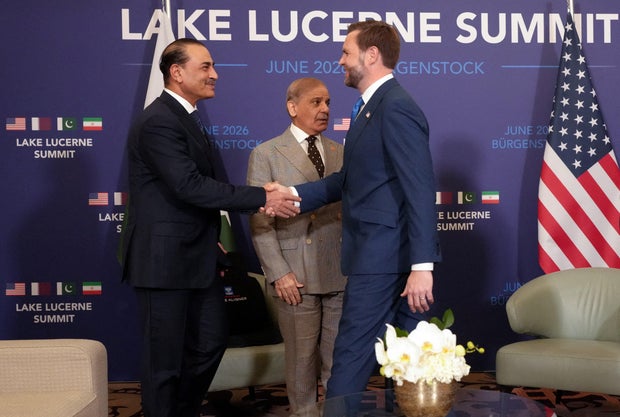
Pakistani officials said his visit to the Iranian capital was part of the country's efforts "to promote regional peace and stability."
The Reuters news agency quoted sources as saying Munir was expected to try and draw Iran back into a dialogue with the U.S., after President Trump said at least twice last week that all talks had ended.
Houthis claim missile attack on Saudi tanker in Red Sea
Houthi military spokesman Brig. Gen. Yahya Saree said in a video statement Monday that the Iranian-allied rebels had struck the Saudi oil tanker Amzan in the northern Red Sea, off the coast of Yanbu, with a ballistic missile.
The claim came hours after the British Navy's Maritime Operations Center said a vessel was struck by an unknown projectile about 63 miles off Yanbu, causing a fire on the main deck, but harming no members of the crew.
Saree said the Houthis "succeeded in targeting the Saudi enemy's oil tanker Amzan," calling the strike "accurate and direct" and claiming it had prompted "a number of other ships in the targeted area to flee."
He said it was part of the Iranian-allied group's ongoing effort to blockade Saudi ships and ports in the Red Sea, which the Houthis announced in July. They have since attacked multiple Saudi-owned tankers in the region.
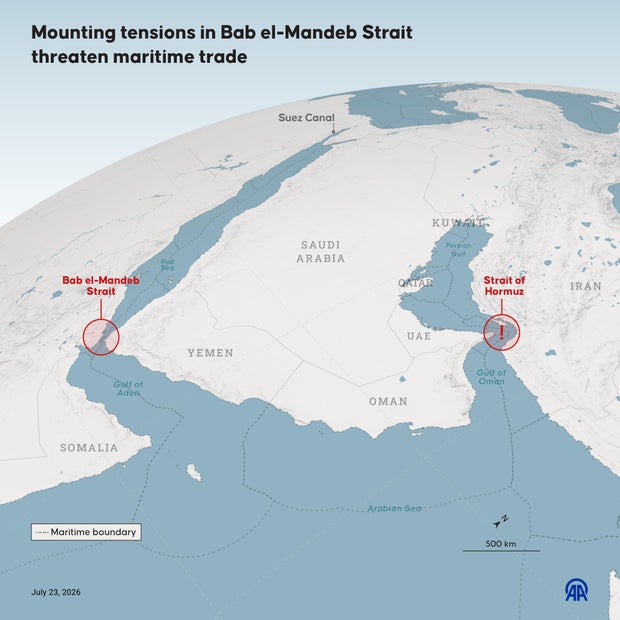
Iran had warned throughout the first phases of the war with the U.S. that it could ask its Houthi allies to disrupt shipping through the Bab el-Mandeb Strait, which is the southern gateway to the Red Sea, in response to U.S. naval operations in the Strait of Hormuz and Persian Gulf.
Iranian police chief says U.S. economic warfare intended to foment nationwide unrest
Iran's national police chief, Brig. Gen. Ahmad-Reza Radan, warned Monday that Iran's adversaries were seeking to exploit economic and social grievances to trigger unrest, potentially across the entire country.
"The enemy is seeking to create unrest in a part of the country or throughout the country, and there are many pretexts, including livelihoods, gasoline, the economy and unemployment," Radan said hours before the U.S. Treasury unveiled a new package of sanctions that President Trump has said will hit Iran with an "economic D-Day."
Radan, cited by the semi-official Tasnim News agency, urged police to adopt a preemptive approach to any potential unrest, including by identifying what he described as hidden networks in society and on social media and confronting those who seek to incite the public.
Trump says Iran is "completely collapsing"
Hours before the U.S. Treasury was set to unveil a raft of new sanctions aimed at squeezing Iran's economy to force the Islamic Republic to capitulate in the war launched by the U.S. and Israel almost six months ago, President Trump declared the theocracy to be "completely collapsing."
In a brief post on his Truth Social network Monday, Mr. Trump wrote simply that "IRAN IS COMPLETELY COLLAPSING!!!" without offering any further context.
He previously vowed that the new U.S. tactic in the war, which represents a shift from military strikes and threats to sanctions-based financial warfare, would impose an "economic D-Day" on Iran.
Iran has, thus far, dismissed the U.S. plans to ratchet up sanctions, noting that the Islamic Republic has already withstood decades of U.S. economic punishment.
Iran's central bank chief says U.S. has long wielded sanctions, and "they were unable to do anything"
Iran's Central Bank Governor Abdolnaser Hemmati said Monday that the country's leaders must speak honestly with the public about economic difficulties facing the country, but he argued that pressure from the U.S. will ultimately fail to force the nation to capitulate.
"I believe we must speak honestly with the people," Hemmati said at the Entrepreneurs' Assembly in Tehran. "We are meeting the people's basic needs. If our exports are cut off, we have made preparations for that as well."
Hemmati compared the current situation, as the Trump administration prepares to impose an "economic D-Day" on Iran, with the previous "maximum pressure" campaign adopted by Mr. Trump during his first term in office.
"I was also the head of the Central Bank from 2018 to 2020. Our circumstances were almost exactly like this. They imposed maximum pressure, imposed secondary sanctions, sanctioned all our banks, sanctioned all our agriculture, sanctioned all our oil purchases — they sanctioned everything," he said. "The country stood and got through that period. It is the same now. We stood through those conditions and, in practice, they were unable to do anything."
Hemmati questioned what additional measures Washington could even impose after having already subjected Iran to extensive sanctions for many years, and he argued that the U.S. has a greater interest than Iran in bringing the conflict to an end, and quickly.
"It won't take very long," Hemmati said. "The information I have tells me that it will not last long. They need this matter to be resolved sooner than we do."
Iran will respond to U.S. sanctions, foreign ministry says
Iran's foreign ministry spokesman warned Monday that Tehran would respond harshly to new U.S. sanctions, including with measures against countries it sees as cooperating with Washington.
"Any escalation of this situation will undoubtedly bring about consequences," Esmaeil Baghaei said. "Our hands are not tied."
Iran downplays potential impact of new sanctions
Iran's foreign ministry spokesman downplayed the potential impact of new economic sanctions the U.S. is set to unveil on Monday.
Asked by a reporter about their impact, spokesman Esmaeil Baghaei said previous similar attempts by the U.S. to pressure Iran had failed, and "the Iranian people will show that they are determined and steadfast in safeguarding their rights."
Baghaei said the new measures were being imposed because the Trump administration had "miscalculated" its attacks and believed "military aggression could bring the Iranians to their knees."
South Korea says U.S. canceled military exercise over Iran war
The South Korean military said Monday the U.S. canceled a large, joint military exercise that had been scheduled to take place next month due to force limitations amid the war with Iran.
The Ssang Yong (Twin Dragons) exercise is a joint amphibious landing drill conducted regularly since 2012 by the South Korean Navy and Marine Corps alongside the U.S. Navy and Marine Corps. British and other allied forces have taken part in previous years.
A spokesperson for the South Korean Marines said its U.S. counterparts had notified the force in June that "due to the situation in the Middle East," the U.S.'s ability to deploy forces for the exercise was constrained this year.
The news of this year's Ssang Yong drills being called off came a week after the U.S. cut short another major joint military exercise with South Korea, on President Trump's orders, fueling concern in Seoul, and in Japan, that Washington is becoming a less dependable ally in the face of rising threats from North Korea and China.
CBS/AFP
Iranian currency hits new record low
Iran's currency hit a record low against the dollar on Monday as the U.S. government prepared to unveil new sanctions in a bid to further squeeze the country's economy to force Iran's theocratic rulers to capitulate in the nearly six-month war.
The rial dropped to 2.02 million to the U.S. dollar as trading opened on informal currency markets. Iran's official Central Bank rate stood at around 1.5 million rials to the dollar, but the informal rate is what most Iranians pay.
The currency had already been under pressure before the U.S. and Israel attacked Iran on Feb. 28, with double-digit inflation and negative growth, but it has been hitting new lows as the war takes an even greater toll.
CBS/AP
Ship struck off the coast of Saudi Arabia
A ship was struck by an unknown projectile in the Red Sea off the coast of Saudi Arabia, the British military's Maritime Trade Operations agency said Monday.
The incident caused a fire on the main deck of the vessel, but the crew was safe, UKMTO said in a brief statement.
The incident took place 63 nautical miles west of the Saudi city of Yanbu, the agency reported.
Yemen's Iran-backed Houthi rebels said on July 20 that they would impose a blockade on Saudi ports and vessels in the Red Sea, and they have since attacked multiple Saudi-owned tankers in the region.
Greek military reportedly moves Patriot interceptor systems in response to Iranian threats
The Greek military on Monday moved one of its Patriot missile interceptor systems to the island of Crete in response to Iranian threats to hit U.S. military bases in Europe, local media reports said.
The battery was moved from the eastern island of Karpathos to Crete, where there is a major U.S. base at Souda, the reports said. Media images showed the Patriot system on a truck waiting to be loaded on a barge.
The Financial Times reported last week, quoting Iranian sources, that Iran would fire missiles at U.S. targets in Europe if President Donald Trump steps up military pressure over the Strait of Hormuz.
The Greek defense ministry did not comment on the reported transfer of the missile system.
Iran-Oman talks on Strait of Hormuz to continue Tuesday
Oman and Iran are set to continue their talks on the future management of the Strait of Hormuz on Tuesday, Tehran's foreign ministry spokesperson Esmail Baghaei said Monday.
The spokesperson said Oman's foreign minister will travel to Tehran to meet with Iranian officials.
The two countries, whose shorelines include the strategic waterway, have been engaged in talks for weeks to negotiate how to manage the chokepoint. Some details have emerged regarding the possible introduction of fees for ships transiting the strait, as well as specific routes for entering and exiting the area.
CBS/AFP
Treasury Secretary warns Iran, allies of "economic D-Day"
Treasury Secretary Scott Bessent has warned Iran and its allies the U.S. will unleash an "economic D-Day" on Iran as part of a shift in strategy to pile economic pressure in the hope of breaking the stalemate in the conflict – a term first used by President Trump last week.
Writing in the British Financial Times newspaper, Bessent said the measures would be "the single greatest financial offensive ever marshaled against an adversary."
The secretary also urged Iran's allies to sever ties with Tehran, saying that doing so would "deepen their access to global capital, reinforce confidence in their markets and attain the standing they seek in the world economy."
Bessent is set to hold a news conference on Monday at which he will unveil the new measures.
After months of military pressure and a failed agreement to negotiate an end to the war, Mr. Trump signaled in recent weeks a shift in the strategy to exert economic pressure on Iran.
Iran's president defends memorandum of understanding as best path forward
Iranian President Masoud Pezeshkian defended the memorandum of understanding signed with the U.S. in June as the best way for the country to move beyond what he described as a situation of "neither war nor peace."
In a speech published by state-run IRNA news agency Sunday, he said members of Iran's Supreme National Security Council believed the agreement was the best possible based on what he described as dignity, wisdom and the national interest.
"There is not a single provision in this agreement that amounts to capitulation," Pezeshkian said. "The supreme leader sets the policies, and we will follow that path."
The deal known as the Memorandum of Understanding was signed by President Trump in June. It set an ambitious 60-day deadline for ending the war with Iran and reaching an accord on its nuclear program. That period ended last week, after weeks of stalled progress and flare-ups, with both sides declaring they had abandoned it. There appear to be no signs of compromise on the crucial issue of reopening the Strait of Hormuz, vital to global shipping.
CBS/AP
Iran says any country joining U.S. sanctions is considered an "enemy"
Iran on Saturday warned countries against participating in the United States' "economic war" against the Islamic Republic, saying they would be considered enemies.
"We declare to all countries ... do not join the economic war waged by the United States. Any country participating in the imposition of economic restrictions against us is considered an enemy," Mohsen Rezai, the head of Iran's Supreme National Security Council, said on state television.
If the countries concerned refuse to "distance themselves" from the United States, Iran would "harm" their interests, he added.
Rezai also insisted Iran had more cards to play in the war, claiming, "We have not yet attacked any American economic interests."
President Trump said last week the U.S. will enforce "Economic Warfare and Isolation on an unprecedented scale." But he also called on the rest of the world to come to the aid of the U.S. in enforcing sanctions, the specifics of which have still not been announced.
CBS/AFP