Safety advocates call for transparency in investigation into deaths of three wildland firefighters in Colorado

Memorials are being held in the hometowns of three wildland firefighters who died while battling a fire on the Colorado-Utah border. Meanwhile, the circumstances surrounding their deaths are still under investigation.
Sydney Watson's funeral was held Tuesday in Alabama. Services for Nick Hutcherson are scheduled to take place Saturday in Arizona, and Emily Barker's funeral is set for July 14 in Michigan.
Two additional firefighters who have not been identified were also injured during the initial attack on the Knowles Fire when the crew became trapped in a burnover.
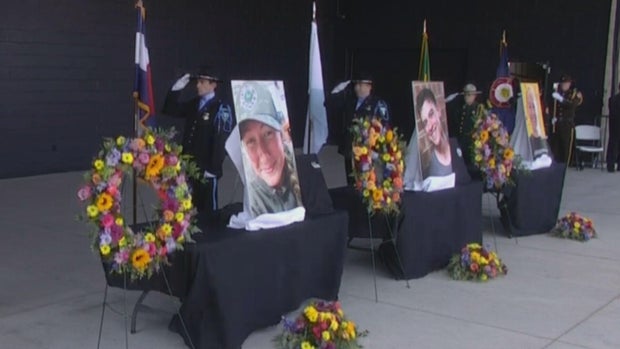
While more details continue to emerge about the lives of the three firefighters, far less is known about the events that unfolded in the moments before their deaths.
"Wildland firefighting, as it's currently constructed, has inherent safety risks and health hazards on every assignment," said Timothy Ingalsbee, director of Firefighters United for Safety, Ethics and Ecology, known as FUSEE.
Ingalsbee said every line-of-duty death investigation should examine not only what happened on the fireline but also the decisions that placed firefighters there.
"We need to ask more questions about policy," he said. "Why were crews sent to this place, and for what purpose? What were they really protecting or defending? What is the objective there?"
The investigation into the Knowles Fire fatalities will be led by the newly formed U.S. Wildland Fire Service. The agency, created this year, has revived the "10 a.m. strategy," which emphasizes aggressive initial attack efforts aimed at containing new fires by 10 a.m. the day after they are first reported.
Supporters argue that attacking fires while they are still small can prevent them from growing into major incidents. Critics, however, contend that the approach is not appropriate for every fire.
"We should rapidly respond to every ignition, but there's a difference between taking an initial action and framing it as an initial attack," Ingalsbee said. "In some cases, that initial action may be okay. This is doing good work for free, reducing some of this hazardous surface fuel air."
Fire Chief Brian Fennessy was named the Director of the U.S Wildland Fire Service and addressed the fatalities shortly after the incident.
"While this is now called the Snyder Fire, the three fatalities occurred on the Knowles Fire on Saturday, June 27, when the fire burned over the crew members," Fennessy said. "Fire shelters were deployed."
Fennessy said it was too early to speculate about whether firefighters should have been in that location.
"I will say the fact that they were there was, I'm 100% sure, based on good decision-making," Fennessy said during an official press conference. "They weren't being foolish. They weren't being careless. They were there because they thought they could do what needed to be done to suppress that fire. Many times, the weather changes."
Ingalsbee said a thorough and transparent investigation is essential.
"For the sake of all the wildland firefighters still out there, and those who will follow, we really need an open, transparent and inclusive process," he said. "Then learn those lessons and apply them in our policies going forward."
For advocates like Ingalsbee, understanding exactly what happened on the Knowles Fire is about more than explaining one tragedy. They say the goal is to prevent the next one.


