Can El Niño turn Colorado's dry pattern around? Here's what forecasters expect.

According to the latest U.S. Drought Monitor, roughly 95% of Colorado is experiencing some level of drought, with about one-third of the state classified in Extreme or Exceptional Drought -- the two most severe categories.
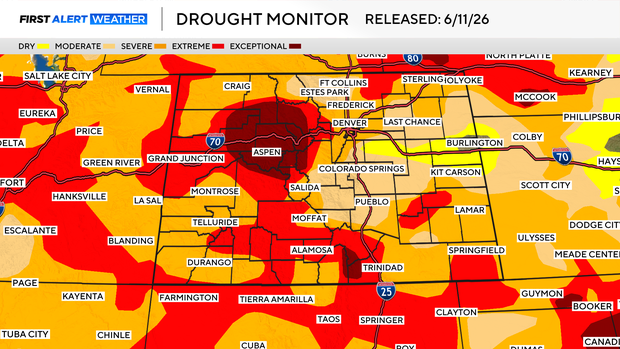
"Right now most of Colorado is experiencing some amount of drought conditions," said Allie Mazurek, engagement climatologist with the Colorado Climate Center at Colorado State University.
Although April and May brought some much-needed precipitation, Mazurek says it wasn't enough to erase months of snowpack deficits that developed during the winter.
"We've had some rain and snow, but unfortunately not really enough," Mazurek said. "We had our deficits in mountain snow stack up over the course of many months, and while we did see some beneficial precipitation in April and May, it really wasn't enough to make up for those major deficits that we saw throughout the winter."
Colorado's mountain snowpack serves as the state's primary water source, supplying reservoirs, rivers, agriculture and communities throughout the region.
"Mountain snowpack is super important not only to Colorado, but to the West as a whole," Mazurek said. "When we have less of it and we're seeing it melt off earlier, we don't necessarily have as much water to work with throughout the summer months."
Drought-related impacts are already being felt across Colorado. Mazurek points to water restrictions implemented by several communities and burn bans enacted in some areas due to dry conditions. She also notes that drought can affect one of Colorado's largest economic drivers: tourism.
"We have less mountain snow coming down into our reservoirs and waterways, and those are huge sources of tourism," she said. "From rafting to fishing and boating, we might see some impacts to those areas as well this summer."
The dry conditions could also contribute to elevated wildfire concerns later this season.
"Our mountain snowpack melted off fairly early this year and we didn't have a lot of it," Mazurek said. "As we head into the summer months and it gets warmer, sunnier and drier, those soils can become really dry and be primed if a wildfire were to start." Colorado has experienced several significant droughts over the past two decades, including major drought years in 2003, 2012, 2018 and the from late 2020 into early 2021.
Mazurek says it's still too early to determine whether the current drought will become as severe or long-lasting as those events.
Despite the concerning drought conditions, climate outlooks are showing some encouraging signs for the months ahead.
The latest outlook from the National Oceanic and Atmospheric Administration favors above-average temperatures and above-average precipitation across Colorado during June, July and August.
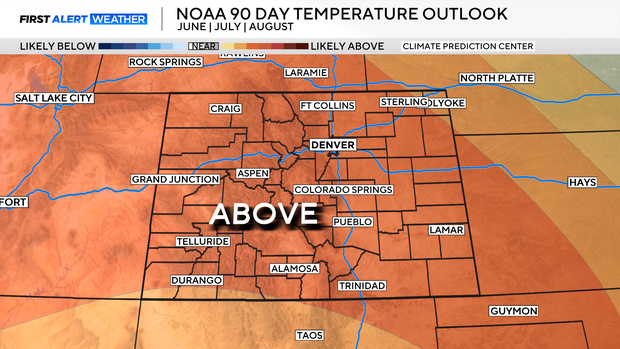
"That's definitely something positive after this past winter," Mazurek said.
However, she cautions that wetter-than-normal conditions don't necessarily mean drought conditions will disappear.
"When we're talking about above-average precipitation, we're looking at it at a single point in time," Mazurek explained. "It's not taking into account that we're already in an extreme and exceptional drought situation in a lot of the state. While that precipitation might put a dent in the drought, it might not totally alleviate it."
One reason forecasters are optimistic about increased precipitation is the development of El Niño conditions. El Niño is part of a large-scale climate pattern that influences weather around the globe. Historically, Colorado often experiences wetter conditions during El Niño years, though the relationship isn't guaranteed.
"When we see El Niño conditions in place in Colorado, we do tend to see above-normal precipitation," Mazurek said. "It's not a slam dunk relationship, but there is a positive relationship there."
Some climate models are also hinting at the possibility of a stronger-than-normal summer monsoon, which could provide an additional source of moisture for the state.
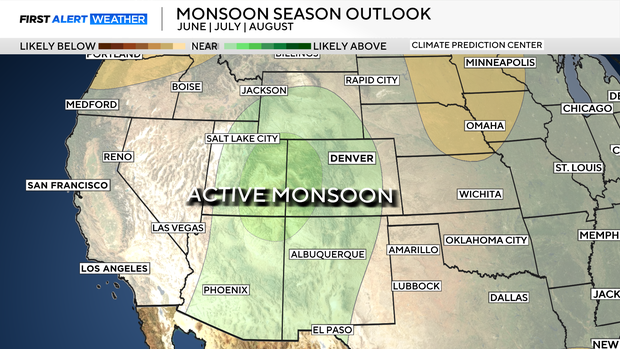
"The monsoon is a big source of moisture for Colorado, especially in the summer months," Mazurek said. "Some of our climate models have been hinting that we might see a stronger-than-normal monsoon. If we get that, it could pump more moisture into the state, which is another positive sign given our drought conditions."
Even if Colorado experiences a wetter summer, experts say it will take multiple rounds of significant precipitation to meaningfully improve drought conditions.
"We need multiple rounds of kind of steady, inch-plus storms to make those deficits chip away further," Mazurek said.
She encourages Coloradans not to focus too heavily on individual storm systems.
"We've been stacking up these deficits over the course of months," she said. "Don't lose sight of that fact when we have one or two precipitation events that come through. We need this to happen multiple times. Let's keep our fingers crossed for precipitation this summer and a better winter next year."


