Dangerous conditions for trout cause Colorado officials to close 2 rivers to fishing
Officials from Colorado Parks and Wildlife decided this week to restrict fishing on two waterways while simultaneously giving anglers permission to remove all the fish they can from a reservoir. Low water levels are responsible in both cases.
Cold-water species like trout are now stressed in sections of the White and Crystal Rivers in northwestern Colorado, the agency explained. Snowmelt coming from the mountains is decreasing and the volume of water in the rivers is falling below 50% of average. This, combined with mid-summer heat, has water temperatures reaching 71 degrees, a dangerous conditions for cold-water fish.
Trout, in particular, struggle to recover following capture this time of year.
"CPW takes implementing fishing closures very seriously," Northwest Region Senior Aquatic Biologist Ben Felt stated in a press release. "Closures, voluntary or mandatory, are implemented once river conditions meet a threshold where fish health is impacted."
The voluntary fishing closures -- meaning CPW is asking anglers to obey the request -- went into effect Friday.
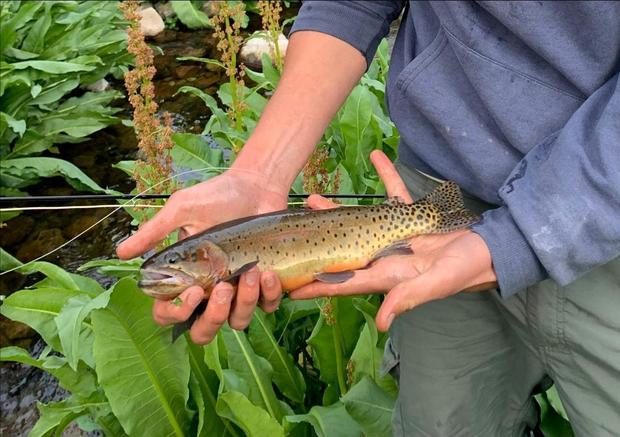
The White River restriction is from 2 p.m. to midnight every day for the following sections in Rio Blanco County:
- The North Fork White River from the White River National Forest boundary downstream to the confluence with the South Fork White River.
- The South Fork White River from the White River National Forest boundary downstream to the confluence with the North Fork White River.
- The White River from the confluence of the North Fork White River and the South Fork White River downstream to Rio Blanco County Road 5.
"The White River is known as an amazing fishery," added Meeker Area Aquatic Biologist Gage Dean. "From Rainbow and Brown trout to Mountain Whitefish, anglers seem to be very successful when fishing these stretches. Closures are a necessary measure to help conserve these valuable resources for today and future generations."
Some portions of the White River outside the fishing restrictions are already closed due to firefighter efforts on the Lee and Elk wildfires. The potential debris washing from the hillsides in the burn areas is another concern for the health of fish populations there. CPW personnel led an effort last week to rescue 266 rare cutthroat trout downstream from the Stoner Mesa Fire.
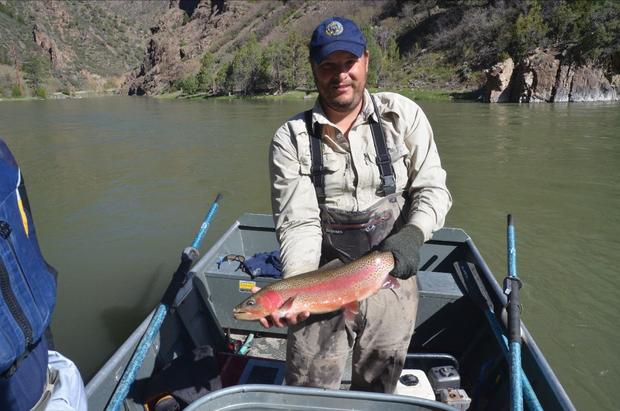
The Crystal River closure is an all-day restriction. Anglers are asked to avoid a five-mile stretch of the river south of Carbondale in Garfield County until further notice.
"Between drought conditions and wildfires," CPW's John Livingston told CBS Colorado, "it's a bad time to be a fish on the Western Slope."
In fact, CPW suggested anglers in all cold-water areas of the state this time of year should fish early in the morning when water temps are the coolest and release fish caught species as quickly as possible.
A previous voluntary fishing closure established due to similar conditions remains in place on the Yampa River from the Chuck Lewis State Wildlife Area to the western edge of Steamboat Springs town limits.
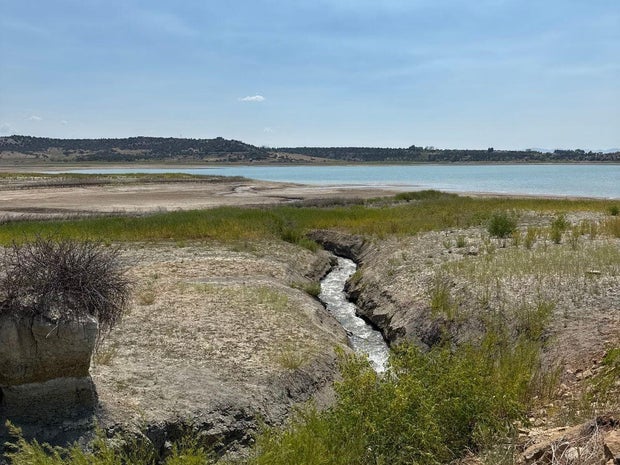
Meanwhile, CPW also announced an emergency fish salvage at Narraguinnep Reservoir north of Cortez this week. The order eliminates bag and possession limits, meaning anglers can use all legal means of fishing at the lake to remove as many fish as they want to catch.
Narraguinnep Reservoir is operated by Montezuma Valley Irrigation Company. The company is draining the lake to allow for planned construction at the reservoir's dam. A contractor is scheduled to begin work on the dam Monday.
CPW says water conditions won't permit long-term fish survival.
Narraguinnep contains bass, crappie, northern pike, perch and walleye. Livingston said CPW cannot move the fish due to tighter restrictions on non-native, warm-water species. Anglers, too, are not allowed to move the fish to other bodies of water. Plus, CPW determined the water is too low already to allow launching of its raft to recover these fish.
The boat ramp at the reservoir is closed. CPW warned anglers to be cautious reaching the water's edge; deep mud may present a hazard.
Narraguinnep is the second such fish salvage in the Cortex area. Summit Reservoir, about 15 miles away, received the same lifting of fishing restrictions in July due to failure of the dam's headgate there.
Also last week, a partnership between CPW, Rocky Mountain National Park, the U.S. Forest Service and U.S. Fish and Wildlife Service announced plans to remove all non-native from the Grand Ditch in RMNP. Called the Poudre Headwaters Project, biologists will use a poison to clear the 14.3 mile system of al species, then restock it with native Greenback cutthroat trout. Brook trout and other non-native species currently occupy those waters.
All areas and trails within the project zone will be closed to all uses beginning on Monday, August 25 through Sunday, August 31. Treated areas will be marked with signs.
The poison, Rotenone, decays over a short period of time and leaves no harmful residue, according to research. Its final product is reduced to water and carbon dioxide. CPW used the product to restock Rito Hondo Reservoir in Hinsdale County with Rio Grande cutthroat trout in 2023.