Colorado's drought fuels a mountain pine beetle outbreak. Here's how to protect your trees.

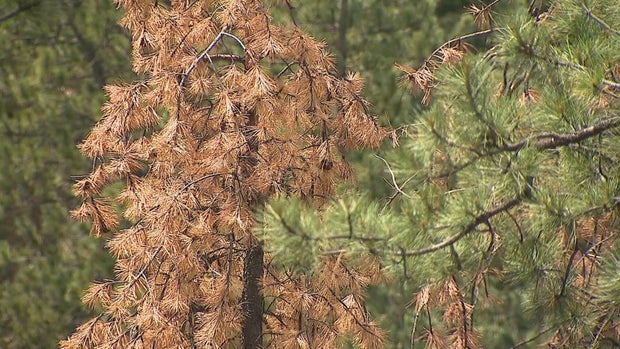
Colorado's persistent drought and stretches of hot, dry weather are creating ideal conditions for one of the state's most destructive forest pests: the mountain pine beetle.
The tiny insect, smaller than a grain of rice, is once again spreading across parts of the Front Range, with thousands of pine trees already showing signs of infestation along the U.S. 285 and Interstate 70 corridors.
According to Karim Gharbi, Extension Agent for Horticulture with CSU Extension in Denver County, the beetles' strength comes from overwhelming trees in massive numbers.
"When a mountain pine beetle attacks a tree, it signals to all of its friends through an aggregation pheromone in their feces to tell them, 'Hey, I found a really good host. Let's all come,'" Gharbi said. "Just one of us can't overwhelm the tree, but if we all attack it at the same time, we can overwhelm its natural defenses."
Healthy pine trees normally defend themselves by producing sticky resin, or pitch, that pushes invading beetles back out of the bark. But drought changes that.
"When trees have drought stress, they have fewer resources available to allocate toward defense, mainly the production of pitch tubes that physically expel the beetles from the tree," Gharbi explained. "When we have milder, drier winters, fewer of these beetles are dying over the winter."
Those two factors — weakened trees and higher beetle survival — have created the perfect conditions for another significant outbreak.
Gharbi says the future depends heavily on Colorado's weather pattern, but the current trend isn't encouraging.
"Pretty bad," he said when asked how severe the outbreak could become. "I'm banking on us getting a strong El Niño cycle so we'll get some more precipitation, but if things keep going the way they are currently going, with these really dry, hot days, we'll have more drought-stressed pine trees that become prime targets for mountain pine beetles."
The concern extends beyond losing trees. Dead forests can increase wildfire hazards by adding more combustible material.
"When trees are initially killed by these beetles, they create a fuel source higher up," Gharbi said. "Then once the trees die, all of that flammable material is deposited on the forest floor. As the trees fall, it also allows more airflow, which can fuel later fires moving through."
While preventing an outbreak across an entire forest isn't possible, homeowners can help protect valuable landscape trees.
Gharbi recommends:
- Applying verbenone pheromone packets to healthy, high-value pine trees. The packets signal to beetles that the tree is already occupied, encouraging them to move elsewhere. Gharbi says they typically cost less than $10 to $15 each through forestry suppliers.
- Providing supplemental irrigation during dry periods to reduce drought stress.
- Removing severely weakened or infested trees to reduce nearby beetle populations.
- Maintaining proper spacing between healthy trees to reduce competition for water.
Gharbi also encourages homeowners to act quickly if they notice signs of infestation.
"These infestations can spread very fast," he said. "The beetles may be attracted to one weakened tree, but once they're on your property, they'll start looking for other weakened trees nearby."
With drought continuing across much of Colorado and warm temperatures expected to persist through the rest of the summer, forestry experts say reducing tree stress now could make the difference between saving a tree and losing it to one of the state's smallest — but most destructive — insects.


