Colorado teacher's one-of-a-kind find revealed at Denver Museum of Nature & Science

The Denver Museum of Nature & Science is preparing to display one of the rarest dinosaur fossils ever discovered: a footprint from what researchers have identified as the world's only known adult Tyrannosaurus rex trackway.
The find traces back to the badlands of North Dakota, where Northglenn High School science teacher Kent Hups made the discovery while exploring the area last summer.
"When you're out walking and looking for things, you're just looking for things," Hups said. "You don't wake up that morning and go I think I'm going to find a T-rex trackway."
But that's exactly what happened.
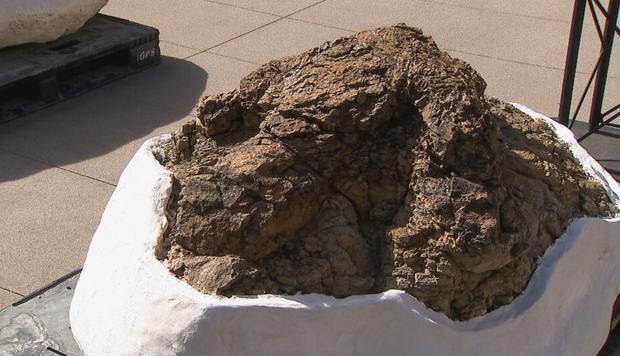
Hups first identified one track, then noticed another nearby, and eventually realized he had discovered an entire trackway left behind by a walking Tyrannosaurus rex. Researchers now recognize the tracks as the first reported adult T-rex trackway ever discovered anywhere in the world. Previously, scientists had identified only two isolated footprints attributed to T-rex, one in Montana and another in New Mexico.
"What can I say? It was mind blowing," Hups said. "When you look for things your whole life and you actually find it, it's really hard to wrap your head around that."
The realization, he added, prompted a celebration in the middle of the site.
"I did my little dance and hooting and hollering," Hups said with a laugh. "I did go up, and I walked where the tracks were, and I got my hands in the little T-Rex thing, and I said, you know, I want to be the first one to do that."
Scientists say the fossilized footprints offer a rare glimpse of a living dinosaur in motion.
"This is a moment frozen in time," said museum fossil preparator Evan Tamez-Galvan. "The king of dinosaurs walking along a stream 66.5 million years ago in what is now southwestern North Dakota."
Unlike fossilized bones, trackways can reveal behavior. By documenting the series of footprints, researchers were able to estimate the animal's stride length, walking speed and movement across the prehistoric landscape. Tamez-Galvan said the trackway showed an approximate stride length of 13-feet and a walking speed between 3.5 and 4.5 miles per hour.
"For an 18,000-pound animal, that's not very fast," she said. "So, it looks like T-rex was having a nice leisurely walk along the stream."
The discovery was considered so significant that museum researchers moved quickly to document it before excavation began. That responsibility largely fell to her
"It became my job to scan each individual print as well as the entire trackway. No pressure, right?" she said. "It was just like a once-in-a-lifetime discovery. I had one day to get it done, and I hadn't seen it before I walked on the site that day."
The excavation that followed became a massive undertaking involving scientists and hundreds volunteers.
"Kent is the one who made this amazing discovery," Tyler Lyson, senior curator at DMNS and lead scientist for the project, said. "But over 200 volunteers and interns from around the world helped with the collection and excavation of these incredible fossils that are sitting here before me."
Each footprint was encased in a protective plaster jacket before being removed from the site. Just weeks ago, researchers used a helicopter to lift the fossils, each weighing more than 2,000 pounds, from the rugged badlands and then transport them to Denver.
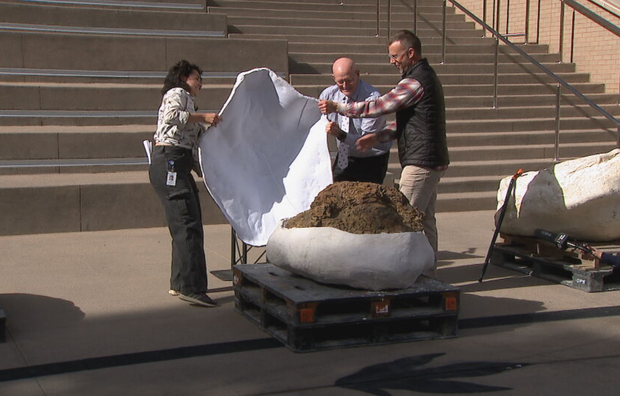
While one track was unveiled Wednesday, scientists intentionally left additional footprints at the North Dakota site for future research.
"We did leave two of the footprints in the ground going back into the hill for future generations of scientists to go and excavate," Lyson said. "We know there'll be technology in the future that we just don't have right now that they might be able to learn additional things, so it's always important to leave some things left for future generations of scientists."
Museum scientists have also created a complete digital model of the trackway, allowing museums around the world to reproduce the footprints.
"[People will] have to come here to the Denver Museum of Nature and Science to see the real thing," Lyson said. "But what we are excited about is that we made a digital model of the entire trackway that can be 3D printed at life-size scale."
Lyson also explained why the fossilized tracks are not impressions pressed into stone. Instead, he said, the dinosaur's footprints were filled with sediment and hardened into a dense rock formation over millions of years. As softer surrounding rock eroded away, the infilled tracks remained behind as three-dimensional fossils.
"Sort of like the top of Castle Rock, right?," Lyson said. "That top of Castle Rock is really, really hard. All the other rocks have eroded around it, so that's a nice analogy."
PREVIOUS STORY: Coloradan who discovered Tyrannosaurus rex trackway in North Dakota says first reaction was "Oh my god"
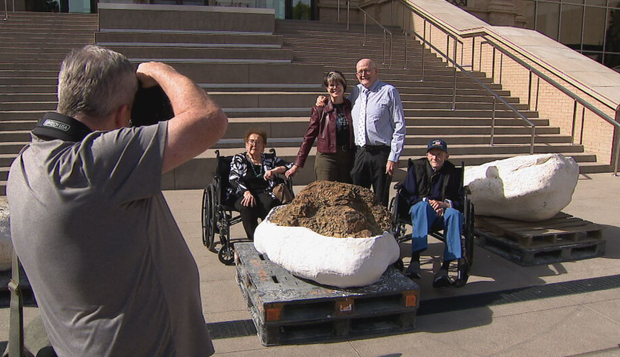
For Hups, the moment was especially meaningful because he was able to share it with family members who helped nurture his lifelong fascination with dinosaurs, including his 94-year-old father and 89-year-old mother.
"I'm so excited they could be here today," Hups said during the unveiling. "I just want to thank you for all the neat little dinosaur books and all the dinosaur toys that you gave me."
As researchers continue studying the trackway, Hups hopes the discovery inspires others to be curious and pursue their own passions.
"You never find anything sitting at home. You never find anything looking on your phone," he said. "You find things when you go out."
Part of the trackway will go on public display at the Denver Museum of Nature & Science on Friday, Oct. 30 and will remain on exhibition through the end of the year.


