Coloradan who discovered Tyrannosaurus rex trackway in North Dakota says first reaction was "Oh my god"
A remarkable discovery was recently made by a rather unlikely person.
"I'm still like in this dream that I'm going to wake up at any time," said Colorado resident Kent Hups.
Hups is a science teacher at Northglenn High School, and a research associate with the Denver Museum of Nature & Science. In July 2025, he became the first person to ever identify a Tyrannosaurus rex trackway.
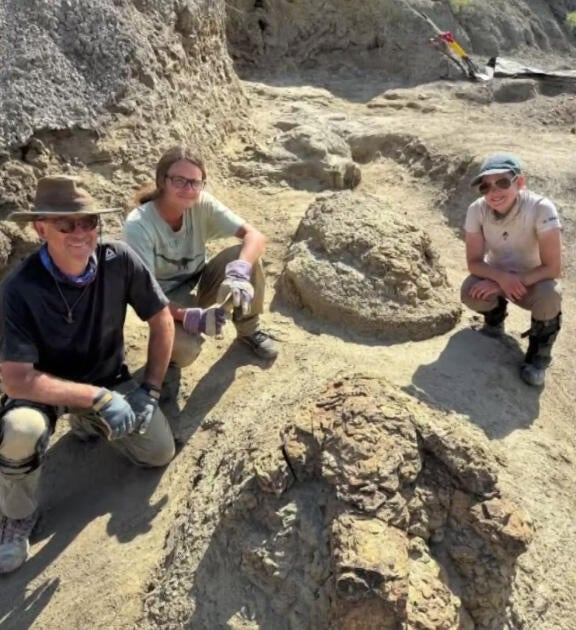
"I just kept looking and looking and looking, and then I eventually came around a corner, and I climbed up a little bit on this hill," he said. "I looked and I saw what I thought was a track, and that to me was that's when I got excited."
Hups was among several volunteers who went with researchers from the Denver Museum of Nature & Science on a summer trip to the badlands of southwestern North Dakota, in search of any discoveries they could find on the land.
"We've been very lucky over the last several years, where we found some pretty remarkable things that we brought back here to the Denver Museum of Nature and Science; things like Teen Rex, this juvenile Tyrannosaurus rex that was found by these three kids. We found a large, beautiful Triceratops skull and partial skeleton that's here at the museum," Hups said.
"But usually, we find the bodies of these dinosaurs," said Dr. Tyler Lyson, senior curator of vertebrate paleontology at the Denver Museum of Nature & Science.
It was on this mission, however, that Hups stumbled upon a formation of a T. rex track.
"In that process of getting excited and doing measurements, I looked behind and I said, 'Oh my god, there's another track back there, I think,'" said Hups.
"There's never been a trackway of a Tyrannosaurus rex ever found. There have only ever been two isolated tracks of T. rex found, one in Montana and one in New Mexico," said Lyson. "To find an entire trackway is certainly hitting the lottery."
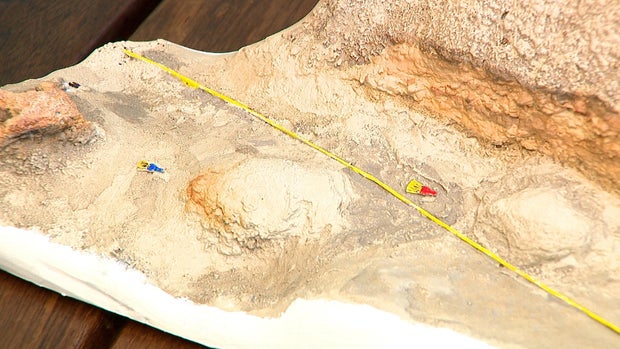
Four tracks were ultimately uncovered with Hups' help. Each of them has now been visually preserved through a 3D digital model, helping researchers determine the T. rex's size and speed.
"Seeing it was impressive, the scale of it. It's a big area, and so it was awesome to see like the pattern," said Evan Tamez-Galvan, Fossil Preparer at DMNS.
"They're my babies. It's my babies, you know. It's like, you know, people go, 'What are they? They're my babies. I found them,'" said Hups.
Hups keeps one of those tracks close by with a 3D replica in his classroom, while the tracks he discovered will eventually be shipped over to DMNS in October, so visitors can watch as scientists cut through the tracks and uncover even more details about this epic predator.
"I'm really hopeful that there's some skin impressions preserved. That's my dream," said Lyson. "It would provide us with an idea of what the foot actually looked like."
For Hups and his students, this discovery fuels a ferocious passion for learning.
"I was so excited when I went home," said Angela Aguirre, one of Hups' students. "I was literally jumping up and down with joy."
"It's crazy to think that that was once a real animal that caused this, and now we're like the first people to be messing with it," said student Alayna McClurg.
It's a one-of-a-kind discovery that Hups also hopes will inspire more people to get out and explore.
"There's always amazing stuff to be discovered, and people find it all the time, but you have to be out looking for it," said Hups.


