Construction officially underway for new Chicago Fire soccer stadium in The 78 development



Construction is officially underway for the Chicago Fire FC soccer team's new stadium in The 78 in the South Loop.
A groundbreaking ceremony was held on Tuesday, marking the start of the city's first major stadium development since the United Center in 1994, replacing the Chicago Stadium.
Among those in attendance were Chicago Fire FC leaders, including Joe Mansueto, and Mayor Brandon Johnson.
Johnson said he hopes that the city working with the team on the development will be beneficial to the area.
"We're grateful, of course, of the private investments that are coming from Joe [Mansueto]. The full force of government will be on display to make sure that our transportation, the opportunities for affordable housing, that the entire development of this neighborhood will be able to reach its full potential in this capacity," he said.
Tuesday's groundbreaking was filled with positivity and pride, with the American and Chicago flags hanging off a crane. Organizers called the groundbreaking for the Chicago Stadium a "historic moment for Chicago sports." Chicago Fire FC team owner Joe Mansueto said the city deserves the development.
"We'll have an environment for our fans that is second to none in North America that we think will take fan engagement to new levels of heights," Mansueto said.
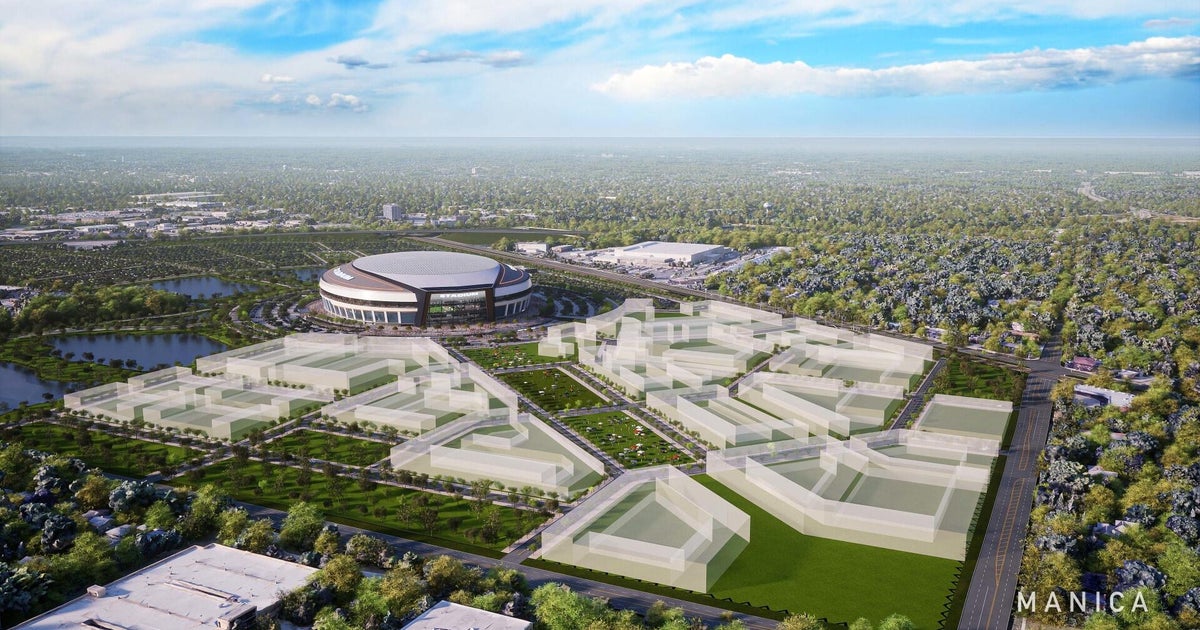
The 78 is a long-undeveloped 62-acre parcel of land near Roosevelt Road and Clark Street along the South Branch of the Chicago River. The land has been dubbed "The 78" for its potential to become the city's 78th official community area.
In about two years, the new Chicago Fire stadium will mark a change to the landscape there — open-air, with seats for 22,000. The goal is to host fans by the 2028 Major League Soccer season.
While fans will mainly flock to the stadium for soccer games, the stadium will reportedly also host rugby matches, concerts, trade shows, and other events.
But not everybody is so excited about the stadium and The 78 development. On Monday, people who live and work nearby shared fears that the stadium development could lead to community displacement.
"When there's not transparency, when there's no inclusion, our communities start going backwards," Ald. Byron Sigcho-Lopez (25th) said at a news conference Monday. "And I'll tell you, here on the South Side, on the Southwest Side, and Chinatown and surrounding areas, South Shore, for way too long, we see what business as usual does in our communities."
Sigcho-Lopez was joined by a group who want the city to commit to protecting affordable housing in the area. There is concern that The 78 development could negatively impact nearby Ping Tom Memorial Park, small businesses, particularly in the Chinatown area, and longtime residents who could be pushed or priced out of the area.
Plans also include on-site parking, and some people who live and work nearby remain concerned about congestion and traffic.
The newly formed CBA for 78 Coalition hopes to get a community benefits agreement signed by developers and the city that would include transportation investments, affordable housing protections, and job guarantees.
"The message is very clear — The 78 is not for everyday Chicagoans. It's for rich people. It's a playground for developers, for the soccer team to bring up yachts and come see a soccer game," said Sarah Tang, director for programs for the Coalition for a Better Chinese American Community.
Johnson responded to the concerns surrounding the new stadium.
"We'll continue to have ongoing conversations as this project develops," Johnson said. "This is an investment in the people of Chicago. This is not just about a sports team."
The community groups are also calling for more transportation investments in the area, including a new Chicago Transit Authority Orange Line stop between the Halsted stop at Halsted Street and Archer Avenue, and the Roosevelt stop a couple of miles away above Roosevelt Road between State Street and Wabash Avenue.
The location for The 78 falls between the two stops.
"L service is essential to move people in and out of the stadium," said Kate Eakin of the McKinley Park Development Council. "It is simply impossible for 22,000 to enter and exit an event by car or move on foot with the infrastructure proposed."
The $750 million Chicago Fire stadium will be privately funded by Mansueto.
In 2024, the Chicago White Sox also floated a plan for a stadium on The 78 grounds. While this plan has been the subject of little attention in recent months, the White Sox said Tuesday that the plan is not off the table and "conversations continue with various stakeholders."