Right whale mothers and calves spotted off Massachusetts in "encouraging" sign for endangered species
The season's first North Atlantic right whale mothers and calves were spotted off the coast of Massachusetts Monday as scientists see some positive signs for the critically endangered species.
Researchers on an aerial survey with the Center for Coastal Studies saw two mother whales and their calves in the middle of Cape Cod Bay. They appeared to be on their way to join at least 40 other right whales "deep diving" for food in the southwest corner of the bay, the center said.
According to the federal government, 22 right whale offspring have been spotted during the calving season that runs from mid-November through mid-April. The center says that's the highest number of calves in 15 years - an "encouraging statistic."
"We have been eagerly awaiting the arrival of this year's mothers and calves in Cape Cod Bay, and it is always encouraging to see them after their long and hazardous journey north through some of the busiest shipping waters on the East Coast," Daniel Palacios, director of the center's right whale ecology program, said in a statement.
There's already been more than 100 individual right whales spotted in Cape Cod Bay this season, include a record 33 sightings in January.
"Conditions in the bay appear favorable this season, with a strong food supply that we hope will support these mothers as they nurse and care for their calves," Palacios said.
Right whale mothers
The two right whale mothers seen Monday are familiar to researchers.
Millipede, 21, was recognized by her "distinct boat propeller scar on her right flank," the center said. This is her third calf, and it was first seen by Florida researchers back in December.
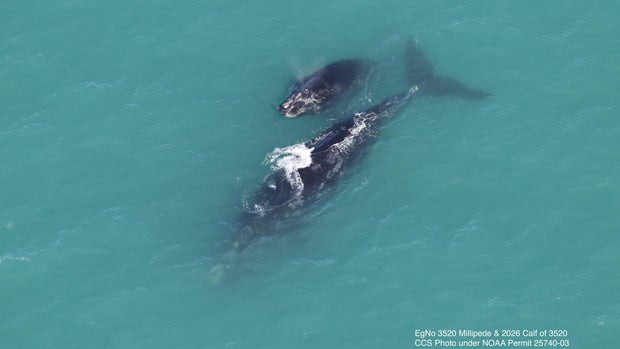
The other mother is Mantis, who was first seen in 1986. She has eight calves, and the newest was seen off South Carolina in late December. A calf of hers from 2015 was also spotted in Cape Cod Bay earlier this month.
Endangered whales
There are estimated to be just 384 right whales left on the planet. The New England Aquarium says there has been a trend of "slow growth" over the past four years.
"Each calf represents an important addition to this critically endangered population, and we are hopeful that many of this year's mothers will spend time in Cape Cod Bay and that this year's cohort will grow and thrive in the years ahead," Palacios said.
The biggest threats to the whale population are ship strikes and entanglement in fishing gear.
Last week, aquarium scientists documented a rare sighting of blue whales, the largest animals on Earth, just 15 miles south of Martha's Vineyard.