When does allergy season start? Here's the pollen forecast for Massachusetts.

Now that the snow has melted and temperatures are warming up, it feels good to get outside after a long winter. But you may be noticing your allergies starting to flare up as pollen begins to emerge. Allergy season is generally early spring through October, ending with the first frost in Boston.
How might Boston's cold and snowy winter affect this year's allergy season?
The frost and cold temperatures of winter may briefly delay the onset of intense tree pollen. That's only because tree pollen is usually the first to really show up. The cold can also yield milder tree pollen conditions for us this spring.
However, this can also lead to a surge or spike in tree pollen once we string together a few warm and dry days this spring. So there is a bit of a give-and-take relationship here. If we experience a delay, we may be dealing with an intense spike to follow.
Tree pollen forecast: Some good news?
Forecasting the severity of pollen that causes allergies depends heavily on weather conditions and the current pollen count. Historical climate and pollen data also come into play.
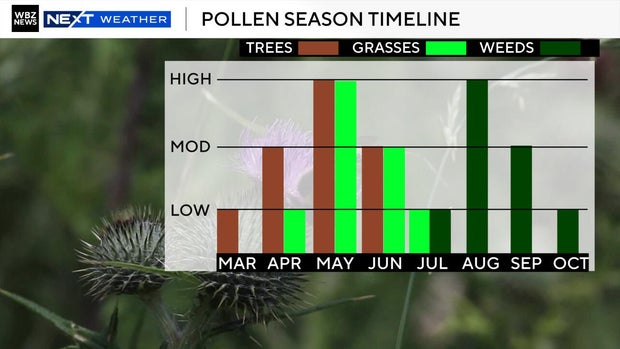
Based on all of the available information, the current prediction is for a lower-than-average tree pollen season for New England during April and May, with the peak being in the middle of May.
Grass pollen forecast: On pace for average
Summer is the season that sees the highest grass pollen counts late May through July. With the peak expected in July, this could be a fairly average year for grass pollen in the northeast.
Warm, dry and breezy days carry grass pollen into the air, making it worse. Any extra rain we receive will certainly help wash it away and lower the pollen count. But similar to the delayed effect with cold and frost, a soaking rain can in turn help grass grow faster and produce an additional burst of pollen right after.
Weed pollen forecast: Potential for a milder season
This typically peaks late summer into early fall for New England during August and September. Potentially good news here again, as a September peak may yield less-than-average weed pollen counts.
This would be more likely if we see a lack of rainfall early on in the season, along with colder temperatures towards the beginning of fall.
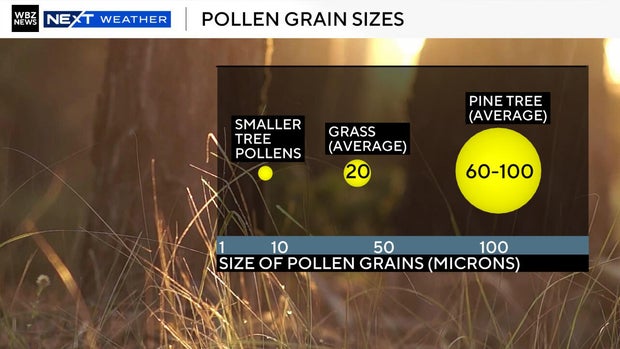
Forecasting seasonal allergies
Realistically, seasonal allergy forecasting is not very reliable. Here are some of the challenges.
At the end of the day, forecasting seasonal allergies is not a perfect science.
Lack of available data
There are tools that capture the current pollen count at a point location, then use that data to make assumptions about the pollen count for a much broader area. But the availability of those tools is very limited.
Reliance on weather patterns
Additionally, the pollen forecast depends heavily on the current weather patterns at each location. Meteorologists are pretty good at weather forecasting (it is predicting future events after all), but there's a reason why we publish a seven-day weather forecast, not a two-month forecast.
Emphasis on historical data
We can look at past pollen counts and climate data to help. But if too much of the forecast relies on that, it doesn't give us much use (or explain the variability) in the seasonal outlooks you may find online each year.
It really comes down to knowing when different trees, grasses, and weeds are in bloom. When they bloom, allergies spike.
If it's windy, warm and dry, then whatever is in bloom will spike. If it rains, then rain may briefly give us some relief and wash the pollen away. A simple explanation, but that's where we land at the beginning of every season.