MIT researchers use AI to improve weather forecasts up to 6 weeks in advance

What if meteorologists could give you a better idea of the weather six weeks from now?
It's a question scientists have been trying to answer for decades. While weather forecasts have become increasingly accurate over the years, predicting what will happen beyond two weeks has remained a major challenge.
Now, researchers at MIT believe artificial intelligence could help change that.
Breaking through the "predictability desert"
Judah Cohen, a climate scientist at MIT, has spent much of his career studying long-range weather patterns and trying to improve forecasts.
He says the progress in short-range forecasting has been remarkable.
"When I was in grad school, we would say two days, that was it. Three days it was gone, there was no more accuracy or skill," Cohen said.
Today, meteorologists can often make useful forecasts seven to 10 days in advance, sometimes even longer. But beyond roughly two weeks, forecast accuracy drops significantly.
Scientists have a name for that difficult forecasting window: the "predictability desert."
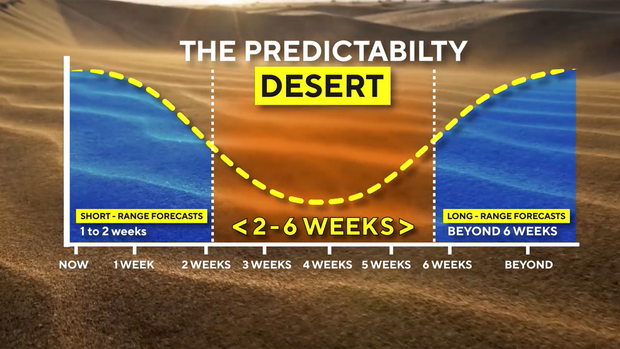
It covers what meteorologists call the sub-seasonal period, generally two to six weeks into the future.
For years, improvements in this range have been difficult to achieve. But Cohen and his research team have developed an approach that uses artificial intelligence to help existing weather models make better predictions.
How artificial intelligence improves weather forecasts
Rather than replacing traditional weather models, the new approach uses AI to identify and correct patterns of errors in their predictions.
By learning from past forecasts and what actually happened, the system can improve predictions of broader weather conditions weeks into the future.
Cohen says the research marks an important step forward in an area where progress has been limited.
"So, here really for the first time, I feel like in this paper we showed by using AI, we can make an improvement in this sub-seasonal two to six week forecast," Cohen said.
In an international forecasting competition, the team's approach demonstrated twice the improvement over historical weather averages compared with a leading forecasting model, according to Cohen.
That doesn't mean forecasts are suddenly twice as accurate. The improvement is measured relative to a baseline based on historical weather conditions, and Cohen acknowledges that overall forecast skill remains modest.
"It sounds amazing, but again, the accuracy is modest," he said.
Can AI predict snow six weeks in advance?
Not exactly.
The new system isn't designed to tell you whether it will snow on a particular Tuesday six weeks from now.
Instead, it focuses on broader weather patterns, including whether a given week is likely to be warmer, colder, wetter or drier than normal.
Those distinctions are important.
A forecast suggesting an increased likelihood of colder-than-normal temperatures several weeks from now could provide valuable information, even if meteorologists can't predict the timing or location of an individual winter storm.
Why a better six-week forecast matters
For most people, a more reliable long-range forecast might help with planning vacations or outdoor activities.
But for utilities, farmers, and emergency managers, the potential benefits are much greater.
Consider an approaching ice storm. Power companies may need to bring in additional crews and equipment from other parts of the country, a process that can take days.
More reliable advance warning could help them prepare earlier, without committing resources unnecessarily.
The same information could help agricultural operations prepare for unusual temperatures or precipitation, and give energy companies a better sense of future demand.
Cohen says the goal isn't to eliminate uncertainty. It's to provide useful information that wasn't previously available.
"So here, for the first time, we can say, hey, you know what? This forecast does better," Cohen said. "You can do better over the long run, and I'm not saying every time will be right."
What's next for long-range forecasting?
There is still plenty of work ahead.
Weather is inherently chaotic, and even the most advanced computer models cannot eliminate that uncertainty.
But Cohen believes the combination of traditional forecasting and artificial intelligence could help scientists make progress in one of meteorology's most challenging areas.
The predictability desert hasn't disappeared. But researchers may finally be finding a way through it.
And while meteorologists still won't be able to promise snow on a specific day six weeks from now, they may be getting closer to identifying the weather patterns that make it more likely.