Margaret Hamilton, pioneering computer scientist for Apollo program, dies at 90
Margaret Hamilton, a pioneering computer scientist who helped save the Apollo 11 moon mission, has died. She was 90 years old.
MIT, where Hamilton worked for two decades, said she died on Sept. 30.
In the 1960s, Hamilton was a young working mother in a male-dominated field when she led the MIT team that created the software for NASA's Apollo Guidance Computer.
Neil Armstrong and Buzz Aldrin were 3 minutes away from the historic moon landing when alarm bells started ringing.
"All of a sudden the priority alarms came on, 1201 and 1202," Hamilton told CBS Boston in 2019. "And I knew that those alarms came on when there was an emergency, and they had no business going on right then."
But it was thanks to Hamilton's code that the computer was able to solve the problem and avoid an emergency abort.

"I like to say not only was it the first human on the moon, but the first software to run on the moon," Hamilton said.
Hamilton was born in Indiana in 1936 and studied mathematics in college. She moved to Boston in 1959 and started at MIT as a junior programmer given low-end tasks, but became known for her commitment to error detection.
"The first assignment they gave me for the unmanned missions was to write a program for the computer that it would go to if there was an abort," Hamilton recalled.
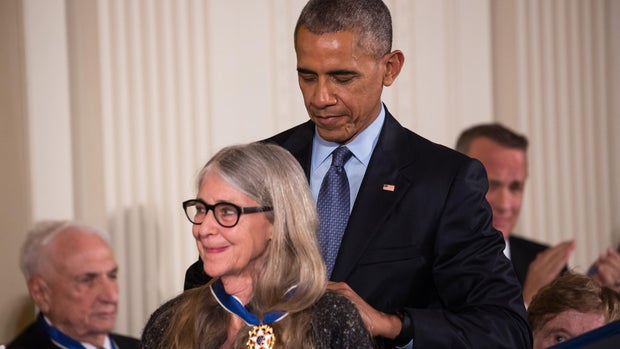
Former President Barack Obama awarded Hamilton the Medal of Freedom, the nation's highest civilian honor, in 2016. Obama said Hamilton "symbolizes the generation of unsung women who helped send humankind into space."
"Her software architecture echoes in countless technologies today," Obama said. "And her example speaks of the American spirit of discovery that exists in every little girl and little boy who know that somehow, to look beyond the heavens is to look deep within ourselves -- and to figure out just what is possible."
A memorial service for Hamilton is planned in the spring in Cambridge, Massachusetts.


