Andover man creates sensory-friendly, welcoming restaurant experience for autism families

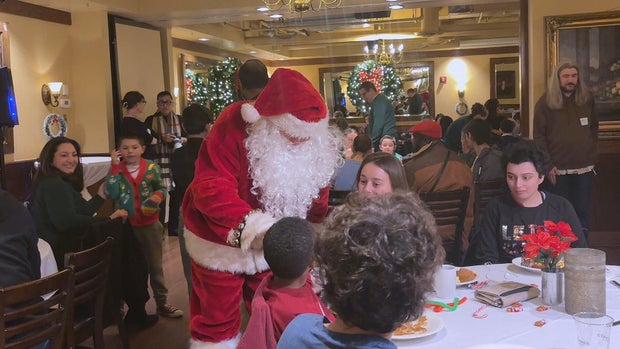
The biggest private room at Maggiano's Little Italy in Boston is set for a holiday brunch. Christmas trees dot the hallway, decorations hang from the ceiling, and holiday candies are scattered on big round tables. As families arrive, they take off their coats and choose a seat. They admire the decorations and, at their own pace, make their way toward a buffet of pancakes, eggs, pasta, and more. There is no waiting for servers, menus, or food.
The "children" are as young as two and as old as 40. Some fidget in their seats or rock back and forth. Some shout with happiness or jump up and down. Others sit quietly. No one, in this room of 150-plus diners, bats an eye. For all of the excitement, parents and guardians are unusually relaxed. This brunch offers an experience that makes everyone feel welcome. "This kind of event is really special for us as a family," Linda Bram explains as she and her daughter Sophia finish their meal.
Autism Eats
This brunch is what Lenard Zohn dreamed of when he came up with the idea for Autism Eats. Many of his formative memories, growing up in Lexington, were made during meals. "We were a family that loved being in the community. We loved food. So, when we weren't eating at our own kitchen table we were out with friends at a restaurant," Lenard said.
He and his wife Delphine assumed that they would create similar memories with their own children. "I never anticipated it would be anything other than that. Just a simple tradition that would continue for Delphine and I when we had our kids," Lenard said.
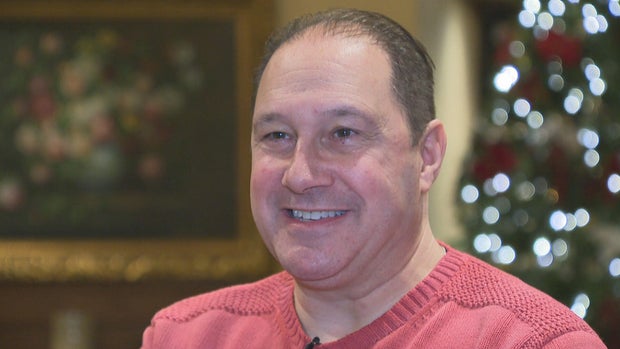
Lenard and Delphine have two children—Ava and Adin. Adin is on the autism spectrum and, from a young age, was overwhelmed in restaurants. "The sights, the sounds, the ambient noise. He absolutely did not like waiting for food. And that would come out in ways that showed he was overwhelmed," Lenard said. "He would flop on the floor. he would run for the door. He would jump on the seats." Lenard says that even the most well-intentioned servers couldn't help but struggle with Adin's behavior. The Zohns felt self-conscious, judged, and often unwelcome. They often left with their food in "to go" containers or, when Adin simply couldn't deal with the environment, no food at all.
The family's defining restaurant experience came at the Lexington Bertucci's when Adin was about 10 years old. As much as he disliked restaurants, he loved pizza. That night the Zohns were with a big group of family members and friends. The pizza was taking an especially long time to get to the table, Lenard recalls. Adin was restless. "He decided to take matters into his own hands. He jumped up from the table and he started running through the restaurant grabbing slices of pizza off other diners' plates," Lenard said.
Lenard jumped up from the table to stop him. "I finally caught up with him. But by the time I did, he'd taken food off three different tables," he said. Delphine's face drained of color. "After that event we stopped going out. It was just too stressful," Lenard said.
Challenges in restaurants
The pain of judgement was replaced by the sting of isolation. When friends and relatives were at restaurants on weekends, the Zohns were at home. They did not dine out for roughly two years. Then, they began to brainstorm. It dawned on Lenard and Delphine that they couldn't be the only autism family experiencing challenges in restaurants. "We took out a sheet of paper," Lenard said, "and on one side of the sheet we wrote down everything that does not work for a typical autism family when we try to go out in the community and have a bite to eat. And on the other side of that sheet of paper we wrote the opposite."
If guests could enjoy a buffet, there would be no waiting for menus or service and no arguing or agonizing over choices. If they paid in advance, there would be no waiting for a bill at the end of a meal. If the restaurant had a private room, autism families could enjoy their experience without disrupting other patrons. Lighting and music could be adjusted to accommodate sensory sensitivities. All ages and behaviors would be welcome.
The next step was to find a restaurant that would let him try it. He approached a number of establishments in Andover. Many were unsure of the concept. But eventually, Lenard found an owner who was receptive to the idea. Six weeks before the event, he asked Lenard how many people he expected. Lenard knew that he could guarantee at least 20 people. He promoted it on the internet and through word-of-mouth. "By the night of the event, we had 150 people. We sold the restaurant out entirely," Lenard said. "The small room they reserved for us became 'you guys have the run of the restaurant for the whole night.' And it was amazing!"
"Life-changing" events
Families came from all over Massachusetts—as far away as Springfield—and from communities in Rhode Island and New Hampshire. Lenard saw people smiling, laughing, making small talk, and watching their kids enjoy themselves without criticism or reprimands. Parents who never thought they would experience family time in a restaurant thanked him with tears in their eyes. "Without being overly dramatic," he says, "It was life-changing."
Almost 10 years later, the all-volunteer, nonprofit Autism Eats has hosted more than 250 events around the country. Restaurant events take place year-round. All family members benefit from the experience. "Autism is a family sport," Lenard explains. "If you have a loved one on the spectrum, the whole family is involved." He says that it was especially helpful for Ava, who is now 22, to see that other teens and tweens "deal with the same things" when they have a sibling on the spectrum.
The isolation that parents often feel disappears at the Autism Eats event which, he says, creates a positive cycle. "The parents become a bit more relaxed and can let their guards down. There's less telling their loved one or child 'don't do that' or 'stop doing that' or 'sit down.'" As a result, he says, the kids are also more relaxed.
Mariann and Howard Brown agree. The Maggiano's brunch is their second Autism Eats event with their daughter Halley. Their happiness is palpable. Mariann says they feel "bonded" with the other families and more hopeful. "We're a little bit stronger. And then we have the confidence to walk into a 99 or another typical restaurant," Mariann said. Howard points out that enabling kids on the spectrum to enjoy a restaurant experience (and a visit with Santa) also gives them valuable social practice. "They need to see it in front of them out there in the world—the fact that the holidays are here for everybody," Howard said. "Look at them. This is them at their best!"
Lenard's goal is to offer more events more often in more communities. He works full-time as a sales executive for a robotics company, but Autism Eats is his passion, his way of giving back to the community that has given so much to his family and to Adin. "Every community across the country where there are people with autism who have families and loved ones and friends—they want to feel welcomed and accepted," Lenard said. "And I want to enable them to do that."