Fight for charter amendment latest front in Baltimore inspector general's battle for records

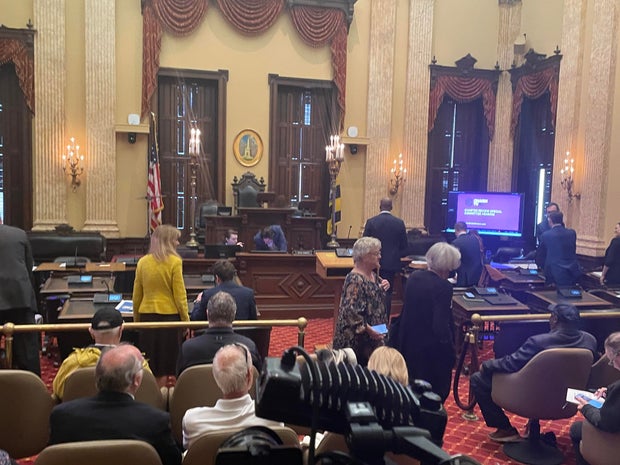
Supporters of Baltimore's inspector general packed city council chambers to push a charter amendment that would give the city's fraud watchdog independent access to records.
Inspector General Isabel Cumming and the mayor have been at odds after she said she received redacted financial records while looking into fraud in one of the mayor's signature anti-violence programs.
What's happening now?
The charter review committee of the city council heard testimony from Cumming, the city's law department, and the public during a lengthy hearing on Wednesday.
City council members must decide whether to approve placing a charter amendment before voters that would make the inspector general a co-custodian of records.
"I think our Law Department has a conflict of interest here. The Law Department is not only arguing in court against giving access to our inspector general in order to further investigate the fraud that we know of, but also our Law Department is effectively—and we all know this—acting on behalf of the mayor's office," said sponsor Mark Conway, a councilmember and the chair of the public safety committee. "They don't necessarily want to see this information come out. This is why we need the inspector general's independent office."
Conway said later to cheers from the gallery, "The people will decide whether or not they want the inspector general to have access to this information."
But attorney Jeff Hochstetler, representing the Law Department, told the committee, "In short there's nothing about the current charter that is a barrier to such unrestricted access. It's state law itself. The Supreme Court of Maryland along with the Attorney General are very clear that no charter amendment or no other local law can circumvent the PIA [public information act]."
Hochstetler said, "Crucially, providing the inspector general with blanket, unrestricted access to the records of other city agencies— as envisioned in this resolution and in the proposed amendments—would amount to an illegal end run around the PIA, which requires that records shared between city agencies are reviewed for mandatory confidentiality protections."
How it started
The dust-up began when Inspector General Cumming said key financial documents were blacked out when she started digging into fraud in the now-shuttered SideStep youth violence prevention program within MONSE, the Mayor's Office of Neighborhood Safety and Engagement.
Baltimore's Law Department later reduced Cumming's access to no more than what the general public could get through the Maryland Public Information Act.
The inspector general filed a lawsuit over the issue and won an early victory.
Mayor's position
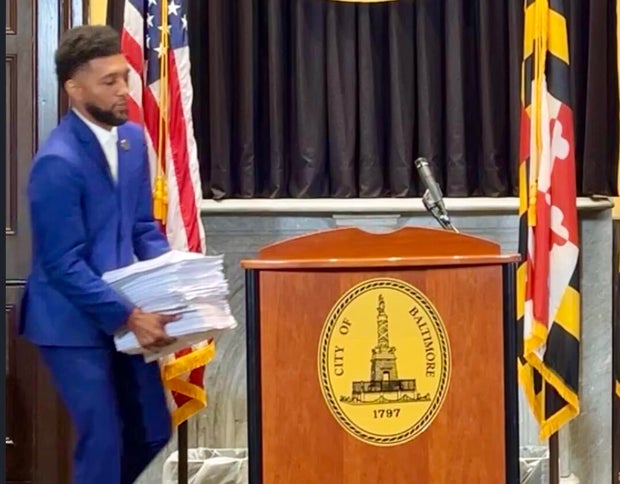
Mayor Brandon Scott strongly refuted allegations that his administration is not transparent and hauled out stacks of documents provided to the inspector general for the MONSE investigation.
He said most of the documents were not redacted at all.
"This stack is the unreacted papers from that same incident. We're talking about a significantly larger amount of information that was shared completely and openly and under accordance with state law," Mayor Scott said Wednesday morning.
He told reporters, "We can prove that we're always transparent with city records. We've always been that way."
The inspector general noted at Wednesday's hearing, "What we did not get was what mattered."
She said that while she received documents detailing policies and procedures, financial records were heavily redacted and that meant her investigators could not follow the money.
"What I did not get were financial documents that showed where money went, and that's the concern," Cumming said.
"The few documents that we did get that actually had information, we were able to use investigative techniques to find tens of thousands of dollars in fraud," the inspector general said. "Now, I would imagine if I could have the other 200 pages, perhaps there would be fraud in there as well."
Council concerns
Some expressed concerns the inspector general would be given access that is overly broad and in possible conflict with state law.
But Cumming maintained if the council does not take action, the city's current policy will gut the power and independence of her office.
"The people gave this office the ability to bring a report against any elected official. Think about that: I can bring a report that is against any elected official. Now, how am I going to do that?" Cumming asked. "That's a law, and I don't have the ability to get the records I need to bring to you to tell you what was the truth."
Her deputy told council members the public information act was being "weaponized" against the inspector general's office.
The council committee did not vote on the matter Wednesday.


