Sexual harassment investigation at North Texas police department highlights common experience for women with a badge
Most women in law enforcement experience repeated sexual harassment on the job and not just from the public they encounter. More commonly, they say, it's coming from their own colleagues.
At the Rowlett Police Department, where women make up one out of every six officers, some of their experiences on the force became the focus on an internal investigation last year.
CBS News Texas obtained records and video of interviews with professional standards investigators through a Freedom of Information Act request.
They show the investigation started with a complaint from a male officer. In January 2025, the officer claimed he was being retaliated against by his supervisor, Sgt. Ryan Doherty, because of the officer's relationship with a colleague.
But when internal affairs detectives began speaking with officers on the shift, it was Doherty's alleged behavior towards several women that caught their attention. Through nearly two dozen interviews, Rowlett detectives pieced together stories of a man who had apparently pursued female co-workers for years: allegedly initiating relationships with direct reports, soliciting officers for threesomes, and treating women differently as a whole.
Officer Victoria Bailey: "He wants to f*** me and I'm not interested."
In several of the interviews, the same name kept coming up: Officer Victoria Bailey.
"Bailey was always complaining about how he always harassed her," said one officer.
Another said, "In her terms, it was, 'he wants to f*** me, and I'm not interested.'"
Several officers said Bailey told them that Doherty had repeatedly asked her out, and that turning him down had led to problems on the job.
"He would talk to her in certain ways, with a tone," one told detectives, while another described it as Bailey feeling "picked on" for not going out with Doherty.
The revelations came months too late to ask Bailey herself: she committed suicide in October 2024. It was a shocking act that family members say was spurred not by work issues, but by other personal troubles.
When detectives confronted Doherty about the harassment allegations, he denied everything.
IA: It's reported by some female officers in the department that you either pursued them by asking them out, asking them to sleep with you, or asking them for a threesome with your wife. Uh.. who in the department have you approached for such activity?
DOHERTY: Uh.. I'm sorry, I don't know who would say that.
IA: Nobody at all? It's also reported that earlier in the year, in 2024, you asked Bailey to have sex with you and she said no. Did this happen?
DOHERTY: unintelligible
IA: It's also reported that you harassed her after the fact, stopped having her help you with traffic training and started treating her differently on the shift.
DOHERTY: Bailey?
IA: Yes
DOHERTY: No.
IA: You never asked her out, never asked to sleep with her, or have a threesome with your wife?
DOHERTY: No.
That may have been the end ot if, except for a text shared by one of the officers in which Bailey claimed she had "proof" of Doherty's behavior. Rowlett detectives turned to the Plano Police Department, which had investigated Bailey's death and obtained her phone records.
The text history confirmed Doherty had repeatedly asked her out, with the pair meeting up once. For months after that night, he sent messages ranging from professional to personal to pornographic.
After the discovery, detectives questioned Doherty again.
During the interview, Doherty acknowledged that he did ask Bailey to come over, though he said he couldn't specifically remember whether he formally "asked her out." He confirmed the two engaged in sexual intercourse.
When asked why he didn't disclose that in his first interview, Doherty said he interpreted the earlier questions narrowly, focusing on the exact wording rather than the broader nature of the relationship. He said he took the questions literally – whether he had explicitly asked her to sleep with him – rather than whether a sexual relationship occurred.
Investigators pushed back, emphasizing they were asking about the relationship itself, not the precise phrasing. As one investigator put it: "What we're asking about is the relationship, not the specific words that were used."
Rowlett PD cleared Doherty of the original retaliation claim made by the male officer, but found he violated policies requiring truthfulness and banning relationships between supervisors and subordinates.
While the investigation recommended he be fired, the department allowed Doherty to resign in June 2025. Internal records showed both sides signed a contract that included a confidentiality agreement and a non-disparagement clause.
Police Chief Michael Denning declined our request for an interview. Doherty did not respond to our attempts to reach him for comment.
Females on the force
Sexual harassment remains one of the most common problems in the workplace for women. A 2024 "Women in the Workplace" study found 40% of women in corporate America said it happened to them. The numbers are even higher in law enforcement: a recent survey by Police One magazine showed 77% of respondents had experienced sexual harassment.
Tanya Meisenholder, the director of police research at the NYU School of Law, says there is still a stigma attached to reporting in law enforcement agencies.
"In too many places, the burden is still on an individual woman to tough it out, instead of on the institution to fix the problem," Meisenholder said.
In a male-dominated workplace, Meisenholder says female officers often feel they have to live with the harassment out of self-preservation.
"There are ways to 'informally' punish people for things that might happen in the workplace," she told the I-Team. "Maybe that's changing their shift. Maybe that's not letting them have a day off. Whatever the case may be, but you can make the workplace very uncomfortable for people."
According to a recent survey by the Dallas Police Women's Association, nearly every member that replied had experienced sexual harassment or discrimination, including the organization's president. Jennifer Atherton recalled one instance early in her career, when a male supervisor repeatedly made advances towards her.
"It got to the point I had to tell my male partner, 'You gotta come with me. Don't let him close the door,'" she said. "Here's the thing, though. Everybody loved this guy. I even liked him — except for that part."
Atherton said she would have been "run out of town" if she had filed a complaint on the supervisor.
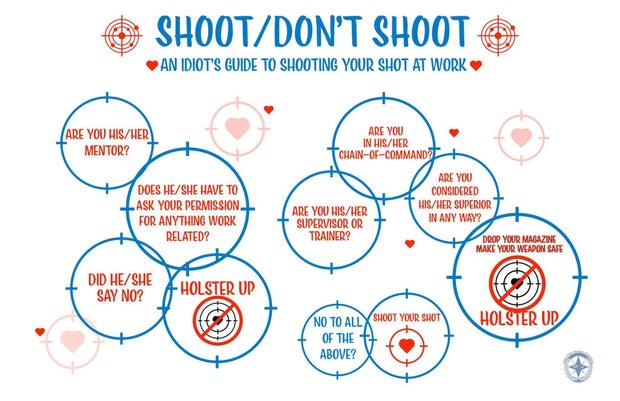
In one small effort to clarify what's appropriate, the DPWA posted tongue-in-cheek fliers in substations titled "Shoot/Don't Shoot: An Idiot's Guide to Shooting Your Shot At Work" educating officers when it is okay to ask a colleague on a date.
"Are you his/her mentor? Are you in his/her chain-of-command? Does he/she have to ask your permission for anything work related? Did he/she say no?" it asks. Any answer in the affirmative directs an officer to "holster up."
Atherton says police departments do not generally take sexual harassment seriously enough.
"Every chief in every department is going to tell you, 'Well, if there's a problem, then I'm not aware of it. They need to file a complaint,' like it's the easiest thing in the world," said Atherton.
According to Atherton, timing is everything. She recalled one case in which a major had asked a female officer why she didn't come forward sooner.
"And I said, 'Why did you ask that? Because I want you to tell me the answer, like, where's the sweet spot?'" she said.
Atherton said she was told that if the woman had reported the harassment sooner, the department could have saved the man's job.
"If it's sooner, nothing will be done," Atherton lamented. "Nothing is taken seriously; they'll just move people around."