Is Texas ready for the fast-approaching data center boom?
Texas is on track to become the largest data center market on earth, with more than 400 facilities already operating and hundreds more on the way.
But the boom comes with a cost. These centers are already among the state's biggest users of electricity and water.
In rural communities, where both resources are often limited, the issue has already sparked tension between landowners and tech companies, leaving lawmakers to navigate the delicate balance between moving cautiously and pursuing a potential economic windfall.
The data center boom
Every question you ask Siri, every chatbot reply, every picture saved to the cloud — it all has to live somewhere. That somewhere is data centers.
Data centers are large buildings that house the computers that provide the processing power needed to support our online activity. With the growth of AI, the demand for this computing power is exploding.
"We need to keep pace with other countries that are building out rapidly, and we also need to do it to ensure our own national security," said Dan Diorio, vice president of state policy at the Data Center Coalition, an industry trade group.
Texas, with its wealth of land and pro-business climate, is poised to play a big role. Texas' data center load is expected to more than double to 30% of total U.S. demand by 2028, according to a recent report by Bloom Energy.
"Texas is a great market for us," said Colin McLean, chief revenue officer at Digital Realty. "We obviously have great resources in terms of people, great access to energy."
Digital Realty runs 30 data centers across Texas, including a 450,000 square-foot facility in Richardson and another million square-foot center under construction in Garland.
With similar projects popping up across the state, some are concerned it's all happening too fast.
Tech companies zero in on Hood County
There are few places where the concern over the data center boom is more evident than in rural Hood County, southwest of Fort Worth, where as many as six new data center projects are now in the pipeline.
The largest of these is the Comanche Circle project, which has received conditional approval from the county. Each of the more than 30 buildings on the project would be roughly the size of two-and-a-half Super Walmarts. Construction is scheduled to begin by the end of 2026.
This massive data center would be built on land that's been rural for generations.
"It would just destroy everything that we hold dear here," said Brad Davis, whose family has owned property adjacent to the proposed site for more than six decades. "Light pollution, sound pollution, the water shed. Just the quality of life."
Brian and Lauren Crawford moved to the area to retire. They say the project's buildings would be as close as 300 feet from their fence line.
Both the Crawford and Davis families are urging county leaders to slow down these projects.
"It's not just the project that's next to us," Brian Crawford said. "There are other projects going on in Hood County and Somervell County, all right together. And it's a concern of the cumulative effect of all these."
So far, the county is allowing the project to move forward.
Sailfish Investors founder Ryan Hughes, the Florida-based developer behind the project, declined a request for an interview. But he did send CBS News Texas a statement that read in part: "Sailfish remains excited about the potential of Comanche Circle, a transformational project designed to bring substantial private investment, significant tax base growth, and long-term economic benefits to the region."
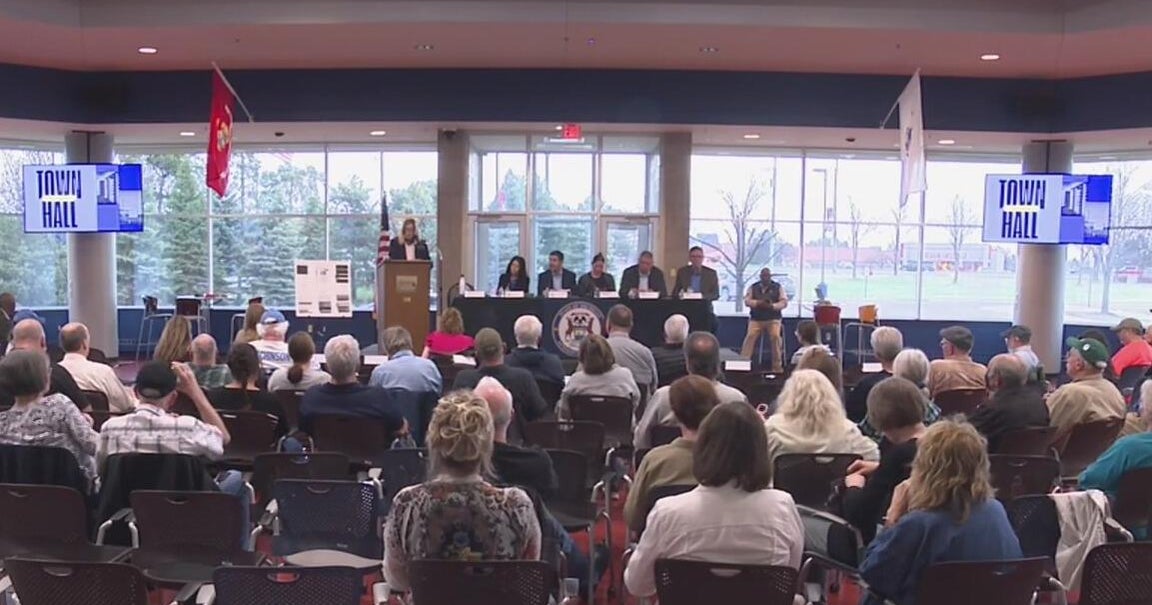
At a recent Hood County Commissioners Court meeting, he further defended his plans.
"If I follow the regulations in place, and I am a private landowner, and there is no zoning authority in Hood County, I deserve the right to build my project," Hughes said during that meeting.
Is Texas ready?
Fights like the one in Hood County are breaking out across Texas — especially in rural counties, where leaders often aren't sure what they should do, or what they can do. The biggest challenge: no one really knows what this boom will bring.
When it comes to water usage, a recent study estimated that data centers in Texas could use up to 161 billion gallons a year by 2030, or as little as 29 billion gallons. That's like the difference between adding 32 golf courses or more than 1,000.
And when it comes to power, the Electric Reliability Council of Texas (ERCOT) says more than 220 gigawatts worth of projects have applied to connect to the grid — more than double the energy Texas uses on the hottest summer day (More than half of those proposals have not cleared required studies and may never get built).
"That's one of the challenges for us, frankly, is trying to predict how many of these projects going forward are really going to make it across the goal line," said state Sen. Tan Parker, a Republican from Flower Mound.
Even with so many unknowns, Parker said he believes that Texas can handle the growth. He pointed to the changes made since the 2021 blackout: more power is on the grid and there are stricter reviews and guardrails to make sure both electricity and water are in place before a new data center comes online.
"We can walk and chew gum," Parker said. "We can support a strong grid, protect our water resources, our electricity resources, at the same time, supporting advanced technology. We can do all of it."