Fort Hood survivor wants to face Nidal Hasan at execution, opposes public livestream

Former Army Maj. Nidal Hasan will die by firing squad in December, barring any legal action. The Pentagon plans to livestream his execution, something that's never been done in the United States.
Hasan's execution is scheduled for 1 p.m. Dec. 3 at Fort Hood, the same Army post where he killed 13 people on Nov. 5, 2009. The execution is set for the same time of day as the shooting, nearly 17 years later.
For survivors and family members of victims, it's deeply personal.
"I want to be in the room where I can see him, and he can see me," said former Army Sgt. Alonzo Lunsford, who survived Hasan's attack.
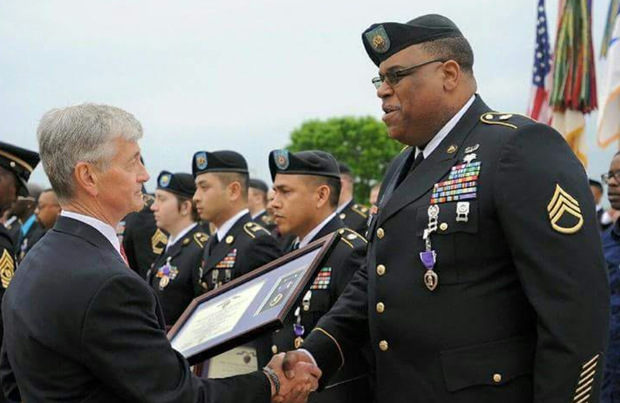
Lunsford was shot seven times that day, including in the eye. He was among 32 injured in November 2009.
For Lunsford and those affected by the shooting, the idea of a livestreamed execution is too much.
"People have to be held accountable for their sins, but I don't want this to be some pay-per-view event, like some John Wick movie," Lunsford said.
Lunsford said he worries about children's ability to watch. "As a country, we're better than that."
Hasan was paralyzed from the chest down before being arrested. During his court-martial, he needed a wheelchair.
The military hasn't executed anyone since 1961. That execution was by hanging. The last execution by firing squad happened in 1945. Private Eddie Slovik was tied to a post and shot for desertion. Military officials have not provided details on how Hasan's execution will be handled, beyond the method of firing squad.
"I don't know that that's actually going to happen," Vice President JD Vance said on Friday, adding that if it were, he wouldn't watch it.
Organizers with the Texas Defender Service called the livestream execution announcement "unconscionable," noting the U.S. hasn't carried out a public execution since the 1930s.
"This is behavior that is reminiscent of terrorists, and not what you want to see in a functioning justice system," said Burke Butler, co-executive director of the Texas Defender Service.
Butler said Hasan could still delay the execution by filing a habeas corpus petition.
"His lawyers are likely looking at all possible avenues to raise in the habeas corpus petition to argue why his upcoming execution would be unconstitutional," Burke said. "And I imagine one of the issues they will look at is whether it's cruel and unusual to conduct a public execution of a human being in this modern era."
The Death Penalty Information Center said, "Public executions are typically held in authoritarian countries to instill fear in the population, and to show the power and control of the government."
Meanwhile, for many survivors and victims, an execution isn't necessarily closure. Many of the wounds from that day never heal. In an interview on Friday, Lunsford said, "This will not be closure for me," adding that his closure comes from helping others.
Lunsford carries the bullet that was pulled from his body with him every day. A reminder of what he survived.
"I still have the slug of one of the bullets. Everywhere I go it goes," Lunsford said. "Whenever I'm having a bad day, I rub on the bullet. This is what keeps me balanced."
He went on to say that he "loves living".
Since the shooting, he's become a basketball coach and mentor.
Closure, he says, comes on the court when he forgets all his pain and can focus on building up those he coaches.


